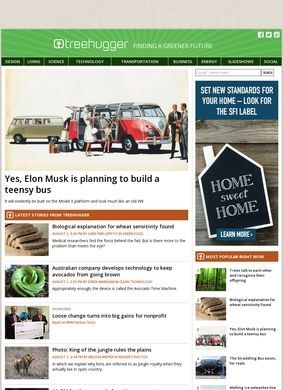
TreeHugger is an environmental and sustainability news and lifestyle site, published under Dotdash Meredith, the same media group behind a long shelf of consumer titles. The homepage fans out into a wide spread of categories, well beyond what a single-topic site usually attempts: News, Environment, Home & Garden, Science, Business & Policy, Eco-Design, Animals, Culture, and Clean Beauty, each one splitting again into a dozen or more sub-sections. The target is a general audience curious about eco-friendly living, gardening, green design and environmental news, and the writing rarely assumes a science background.
The breadth is the first thing you notice. Under Environment alone you get Planet Earth, Climate Crisis, Pollution, Recycling & Waste, Natural Disasters, Transportation, and an Eco Terms A to Z glossary that quietly doubles as a reference for anyone who trips over the jargon. Science adds Space, Technology, Agriculture and Energy. It is a lot of ground for one green banner to cover, and the site clearly wants to be the place a reader stays, not a single page they pass through.
Whether that breadth serves TreeHugger's readers depends on what you came for.
From climate crisis to clean beauty
The News hub is the closest thing to a front page for TreeHugger, sorting Environment, Business & Policy, Science, Animals, Home & Design and a Current Events strand, with a Treehugger Voices column for opinion and a News Archive for older material. Anyone tracking environmental policy or corporate responsibility has a clear lane here, and the Business & Policy section widens it with Economics and Food Issues. This is the part of the site that behaves most like a working newsroom, refreshed and sorted rather than left to sit.
The Eco-Design coverage is more distinctive. Tiny Homes, Architecture, Interior Design, Green Design and Urban Design sit together, a genuinely useful clustering for anyone who follows sustainable building or just likes looking at small, clever houses. TreeHugger has always leaned into design, and it shows in how much room the topic gets.
Two lighter wings round the offering out. Culture gathers History, Travel, Sustainable Fashion, Art & Media, Holidays and a Community strand, while Clean Beauty keeps to Products plus Tips & Techniques. Neither is why a serious reader shows up, though they push the site from a policy-and-science outlet toward a fuller lifestyle destination, which looks like the deliberate plan behind so many sections.
Home, garden, and green living
The Home & Garden wing is where the site turns practical. Natural Cleaning, Green Living, Sustainable Eating, Planting Guides, Indoor Gardening and Urban Farms are the sort of how-to material people actually search for, and gathering it under one roof makes TreeHugger a plausible bookmark for a would-be gardener or someone trying to cut the chemicals under the kitchen sink.
The Animals section, splitting Wildlife, Pets, Animal Rights and Endangered Species, serves a slightly different reader but fits the same worldview. There is enough on these pages that a curious person could lose an afternoon, which is presumably the point.
Product picks and the commerce line
TreeHugger also publishes editorial product reviews and recommendations, and to its credit it points to a commerce guidelines and mission page setting out how those picks are made. That page is worth finding, because product recommendations on a big-media site usually carry affiliate links, and a reader deserves to know where the line between editorial judgment and revenue sits.
For a site that mixes journalism with shopping guidance, an open disclosure is the difference between advice you can weigh and advice you cannot. I went looking for the policy half expecting boilerplate, and at least it exists and says something concrete.
How closely the guidelines are followed, a reader outside the newsroom has no way to check, and that gap is worth holding in mind whenever a green product gets a glowing writeup.
How the reputation lines up
The outside record on TreeHugger is genuinely split, and it is worth laying out plainly. Media Bias/Fact Check rates its factual reporting as high and its fact-check record as clean, while placing it firmly on the left of the political spectrum. That pairing, strong on accuracy and openly progressive in slant, is about what you would expect from a sustainability publication. Bias labels are a blunt instrument, and a left lean on climate coverage is hardly a scandal, but it is fair for a reader to know the editorial center of gravity before treating any single piece as neutral ground.
User satisfaction tells a rougher story. On Sitejabber the site sits at 1.5 stars across 56 reviews, which points to a real pool of visitors who came away unhappy. A separate listing on Smart.Reviews shows 4.9 out of 5, but that rests on one review and counts for almost nothing.
Aggregate scores like Sitejabber's also skew toward people motivated to complain, so the number is a caution, not a verdict, though 56 reviews is enough to stop calling it noise. Put it beside the high factual rating and TreeHugger comes out as a site trusted for what it reports yet capable of frustrating the people who actually land on it, most likely over ads, pop-ups, or the friction of a heavily monetized page.
The pedigree predates the current ownership. TreeHugger was named a top sustainability blog by Nielsen Netratings and appeared on a Time Magazine list before being absorbed into the Dotdash Meredith stable, which also folded in Mother Nature Network. The brand had genuine standing long before its current owner picked it up, and some of that goodwill still clings to the name even as the ownership has shifted toward scale and commerce.
Contact is the weak spot. There is an About Us section and a Follow Us set of social links, but no phone number, no address, and no obvious Contact tab in the main navigation. For a publisher like TreeHugger that is common enough, since the relationship is meant to be read and move on, yet anyone hoping to reach an editor, pitch a story, or flag a correction will have to go digging for a route the front end does not offer.
The doubt that lingers over TreeHugger has little to do with its facts, which check out. It has to do with the machine it now runs on: a publication with real green credibility and a clean reporting record, owned by a commerce-driven conglomerate, sitting under a stack of one-star user reviews that the polished homepage never explains.