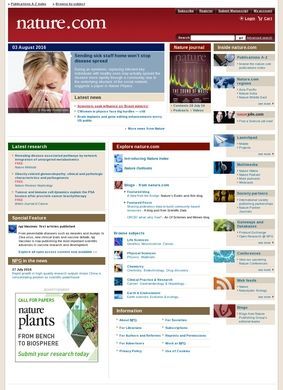
Nature.com is the online home of Nature, the weekly scientific journal published by Springer Nature, and it functions as a portal to a whole family of research titles rather than a single publication. The front page of Nature.com mixes freshly published research with news writing, so a first visit gives you two very different registers side by side: a dense original paper on protein folding, and a plain-language dispatch about a policy fight over research funding. That split is deliberate, and it explains a lot about who ends up here.
The backbone is peer-reviewed research. Original papers, letters, and the shorter News and Views commentaries that put a new finding in context all sit under the Research banner, spanning physics, chemistry, biology, earth science, and medicine. If a discovery is multidisciplinary and does not fit neatly into one field, Nature.com is often where it lands first.
Around that core, the site keeps a surprisingly wide editorial operation running.
What the portal gathers under one roof
The News section on Nature.com reads like science journalism in its own right, written by staff reporters rather than the researchers themselves, and it covers the sociology of science as much as the results: who is getting grants, which labs are under scrutiny, how a country is reshaping its universities.
Comment and opinion pieces run alongside and give working scientists a place to argue about the direction of their field. Then there is the daily Briefing email, a newsletter that condenses the day's science into something you can read over coffee, and a steady stream of podcasts and video for people who would rather listen than scroll. It is easy to forget how much of Nature.com is free at this layer, since the newsletter and much of the news reporting cost nothing to follow.
The site's research index is its own animal, a database that tracks research output by institution and country, useful if you care about where the productive work is concentrated. Careers is the practical corner: job listings for scientists, plus advice columns on the parts of academic life nobody trains you for, like negotiating a first faculty post or surviving a lab move. I found the Careers material more candid than I expected from a publisher of this size, which is worth noting on a site that could easily have played it safe.
The wider family of specialty titles
What makes Nature.com more than a single journal is the constellation of specialty titles reachable from the main portal. Nature Genetics, Medicine, Communications, and dozens of others each carry their own peer-reviewed research, and the shared platform means a reader chasing a citation can move between them without learning a new interface every time. For a graduate student trying to follow a narrow subfield, that consistency saves real hours.
The trade-off is scale. The sheer number of associated journals can blur the line between the flagship title and its siblings, and a casual reader may not always register which title they are actually reading. The branding is consistent enough that this rarely causes confusion, but it does mean the same name covers a very large body of work of varying specificity. Landing on a specialty paper through Nature.com, a reader still sees the flagship's reputation attached to a journal that may be far narrower in scope.
Access, submission, and the paywall question
Access is where most people meet friction on Nature.com. Some articles are open access and free to anyone, a growing share under the publisher's open-access agreements, but a great deal of the archive sits behind subscription or a per-article purchase. Institutional access through a university library is how most academic readers get in, and if you have it, the paywall barely registers. If you do not, you will hit it fast, and the cost of a single paper can surprise a general reader who wandered in from a news link.
For anyone on the other side of the process, the site is transparent about how publishing works. Author submission guidelines, editorial policies, and detailed explanations of the peer review process are all laid out, and early-career researchers deciding where to send a manuscript can read them directly instead of guessing. Nature.com does not hide the standards it applies, and that openness is part of why the journal's decisions carry the authority they do.
So who is this for? Researchers and academics are the obvious core, but the audience is broader than that. Students use it to learn how a field is structured, science journalists mine it for stories and source material, policymakers reach for it when they need evidence with a recognizable stamp on it, and curious members of the public land on the news coverage even when the underlying papers stay locked. Each of those groups gets a different slice, and Nature.com is unusual in serving all of them from the same address without feeling like it was bolted together.
Few science sites try to be a research archive, a newsroom, and a jobs board at once, and fewer still make it work.
The honest limitation is the same as its strength. This is a publisher's platform, and it is built to move readers toward its content and, often, toward paying for it. That is a description more than a criticism: the free news and the open-access papers on Nature.com are genuinely valuable, but the deepest part of the archive rewards a subscription or a library card. A reader who understands that going in will get far more out of it than one who expects everything to be free.
A search across the usual review platforms and business directory listings turns up nothing resembling a star rating for Nature.com. That is not a red flag; it is simply a publishing operation, not the kind of business people leave star ratings for, so there is no consumer feedback trail to set against the editorial reputation built up over more than a century of publication.
Weighed as a whole, Nature.com is one of the most consequential science publications on the web, and the range of what it offers, from raw research to career advice to daily news, is hard to match. The free layer alone justifies a bookmark, and the paywalled core rewards anyone who reads primary research often enough to want direct access instead of secondhand summaries.