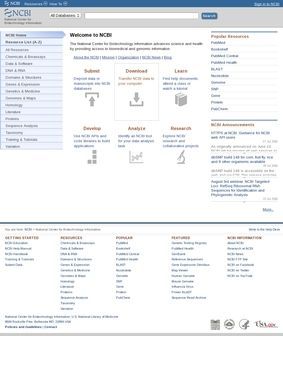
PubMed alone indexes more than 36 million citations, and it is only one of the databases the National Center for Biotechnology Information keeps running. That single number gives a sense of the scale here. The National Center for Biotechnology Information is the U.S. government's central clearinghouse for biomedical and genomic data, a division of the National Library of Medicine, which in turn sits inside the National Institutes of Health. Everything it holds is free to read, search, and download, with no paywall and no commercial layer sitting on top.
Literature databases for biomedical research
The literature side is what most people meet first. PubMed covers indexed biomedical and life-sciences citations, and PubMed Central (PMC) holds the full-text open-access archive, so a citation found in one often resolves into a complete paper in the other. For anyone doing a literature search, that pairing removes the usual wall between an abstract and the article behind it, at least for the open material. A student writing a first review and a clinician checking the current evidence on a treatment are both working from the same index, which is part of why it became the default reference point in medicine. The National Center for Biotechnology Information built PubMed and PMC as a pair for exactly this reason.
Sequence and genomics resources
Past the papers, the sequence and genomics resources are where the National Center for Biotechnology Information does work that no ordinary library does. GenBank stores annotated genetic sequences. BLAST, the Basic Local Alignment Search Tool, lets a researcher take a stretch of nucleotide or protein sequence and find matches across the collection, which is one of the most-used operations in molecular biology. Gene gathers gene-specific records across organisms, Genome holds reference assemblies, Protein collects sequence records from several sources, and Structure carries 3D macromolecular models.
The chemical side runs through PubChem, with its compounds, bioassays, and substance records. On the clinical-genetics end, ClinVar maps genomic variants to their clinical significance, dbSNP tracks short variation, Taxonomy classifies organisms, and MedGen pulls together medical-genetics information. Each of these is a serious database in its own right, and they cross-link, so a gene record can lead to its sequence, its variants, and the papers that describe it.
Workflow areas and access methods
What I find genuinely useful is how the site is laid out around what a person is trying to do, with the underlying data organized to serve that intent. The functions group into six workflow areas. Submit handles depositing sequences, manuscripts, and datasets. Download covers bulk transfer through FTP and APIs. Learn collects documentation, webinars, tutorials, and the NCBI Help Desk material. Develop is aimed squarely at programmers: the E-utilities REST API, the NCBI C++ Toolkit, and code libraries for hitting the databases programmatically. Analyze brings the online tools and pipelines together, including BLAST, Primer-BLAST, and the sequence viewers.
Original computational biology research
Research describes the intramural computational-biology projects the National Center for Biotechnology Information runs internally. That last category is worth noting, because the National Center for Biotechnology Information produces original work in computational biology and publishes it, rather than only hosting contributions from outside.
The audience is wider than it might look from the technical surface. Bioinformaticians and full-time researchers live inside these tools, but clinicians use them to check variants and literature, educators build courses around PubMed and BLAST, students learn the basics of sequence analysis here, and members of the public can read the same open papers a specialist reads. There is no tiering by who you are. The data a pharmaceutical lab pulls through the API is the data a curious reader can browse through the web interface. That openness is a deliberate policy decision by the National Center for Biotechnology Information, and it shapes how the whole resource functions.
If there is a fair caution, it is that the breadth is also a learning curve. The interface assumes you already know whether you want Gene or Genome, whether your question is a sequence-similarity problem for BLAST or a variant lookup for ClinVar. Someone arriving without a clear question can feel scattered across thirteen-odd databases that each have their own conventions. The Learn area exists for exactly this reason, and the tutorials and Help Desk go a long way, but the National Center for Biotechnology Information rewards users who come in knowing roughly what they are after. This is a working instrument built for people with a task, more than a gentle on-ramp.
The programmatic access deserves a second mention because it changes what the resource is. Through E-utilities and the toolkit, the databases stop being a website and become infrastructure that other software is built on. A large amount of biology tooling, including projects with no connection to the NIH, queries the National Center for Biotechnology Information behind the scenes. That dependency reflects a consistent decision to keep the data open and machine-readable rather than locked behind a portal.
For comparison, a researcher weighing where to start might think of Ensembl, the genome browser run jointly by EMBL-EBI and the Wellcome Sanger Institute. Ensembl is excellent, with a polished browser and strong comparative-genomics tools, and for genome-centric exploration some people prefer it.
Where the National Center for Biotechnology Information pulls ahead is reach: the literature, the sequences, the chemistry, the clinical-variant records, and the analysis tools all sit under one roof and link to each other, which Ensembl does not attempt to do on its own. If the job is reading the medical literature and chasing a gene or variant through to the underlying data, this is where to begin, and it is the one resource most others end up pointing back to anyway. Biomedicine does not have many genuine public utilities; the National Center for Biotechnology Information is one of them.