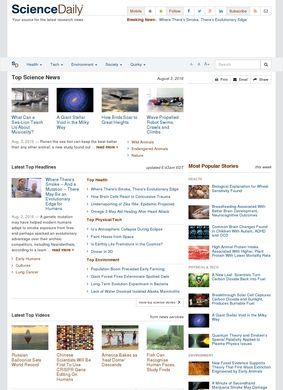
You read a headline somewhere claiming a new battery material doubles capacity, or that a study has linked some habit to sharper memory, and you want to know what was really found before you repeat it to anyone. That gap, between the breathless secondhand version and the actual research, is where ScienceDaily slots in. It pulls together daily summaries of fresh findings drawn from universities, research institutions, and journals across the world, and each writeup points back to the press release or the journal paper it came from. So a reader who wants to dig deeper has a thread to follow.
How ScienceDaily organizes research across disciplines
ScienceDaily's organizing logic is straightforward. Everything sits in four broad buckets: Health Sciences, which runs from medical research and disease to mental health and nutrition; Physical Sciences and Technology, covering physics, quantum computing, space, materials, and engineering; Environmental Sciences, with ecology, climate, geology, paleontology, and conservation; and Social Sciences and Education, which gathers economics, public health, behavioral work, and STEM teaching. Chemistry lives inside the physical sciences group, so anyone tracking materials science, nanotechnology, or specific chemical findings can narrow down to that strand without wading through medical or climate stories first.
Four subject areas and their coverage
What the site does, in plain terms, is condense. A new paper lands, often heavy with methodology and statistical caveats, and the daily summary trims it to the finding and a little context. That is genuinely useful for a student building background on a topic, or a professional in one field who wants to stay loosely current on three others. The tradeoff is that a summary is a summary. The originating source is cited precisely so that the curious can go check the framing, the sample size, the conflicts of interest, none of which a short news item can carry. ScienceDaily seems to treat the link out as part of the product, not an afterthought, and that instinct is what keeps the aggregation honest.
What condensing research means for readers
It is worth naming what the format does and does not promise. The stories lean heavily on the press releases issued by the research bodies themselves, which means the framing arrives already shaped by an institution that has a stake in the work sounding important. A careful reader keeps that in mind. The site states outright that its content is informational and not professional or medical advice, a disclaimer that applies most sharply in the health stories, where a single promising result can read like settled guidance if you squint. None of this is a knock on ScienceDaily so much as a description of what a daily research feed can honestly be.
Press releases shape the framing of stories
For people who want the stream rather than the occasional visit, ScienceDaily offers RSS newsfeeds, a Substack email newsletter, and accounts on Facebook and X. The RSS option in particular is handy for someone wiring science headlines into a reader alongside other sources, and it fits the way the site is built, which is less a destination you browse for an hour and more a tap you check when you want to know what dropped today. The breadth is the draw. Few single places try to span quantum computing, paleontology, behavioral economics, and nanochemistry under one roof and keep each one current.
Distribution formats for regular users
ScienceDaily's chemistry coverage specifically tends to surface the more news-friendly corners of the field. Materials science gets steady attention, partly because new materials translate into tangible applications that make for clean headlines, batteries, catalysts, coatings, that sort of thing. Nanotechnology shows up regularly for the same reason. Heavier theoretical or purely synthetic chemistry appears far less often, which is less an editorial choice than a reflection of what generates press releases. So a chemistry reader gets a reliable pulse on the applied and the headline-grabbing, and would still go elsewhere for deep coverage of slower-moving fundamental work.
Chemistry coverage leans toward applied work
The audience it serves is broad by design: general readers who want to stay informed without subscribing to journals, science enthusiasts, students assembling context, and working professionals scanning beyond their own specialty. ScienceDaily fits each of those uses differently. The casual reader gets a readable digest, the student gets a jumping-off point with citations attached, and the specialist gets a wide, shallow net that occasionally turns up something from a neighboring field. The site has been running for many years and is cited often enough across academic and general media that its role as a clearinghouse is established rather than aspirational.
Who uses ScienceDaily and how
Where ScienceDaily earns trust is in that consistent habit of pointing back to the source. A great deal of science coverage online strips away attribution until you cannot tell whether a claim came from a peer-reviewed study or a single conference abstract. ScienceDaily keeps the chain visible, and that single editorial discipline does more for its usefulness than any amount of polish. A reader who follows the links is better positioned to judge a finding for themselves, which is the whole point of an aggregator that takes its job seriously.
Attribution keeps the chain of sources visible
Used the way it is meant to be used, as a daily scan with the citation always one click away, ScienceDaily does what it promises. Treated as a final authority on any single result, it does not, and it is honest enough to say as much in its own disclaimer. The summaries are short, the sourcing is shown, the topical sorting is clean, and the chemistry material clusters around the applied end of the field. Checked the way one checks the weather, often, briefly, and without expecting the full picture from a single glance, it delivers consistently.