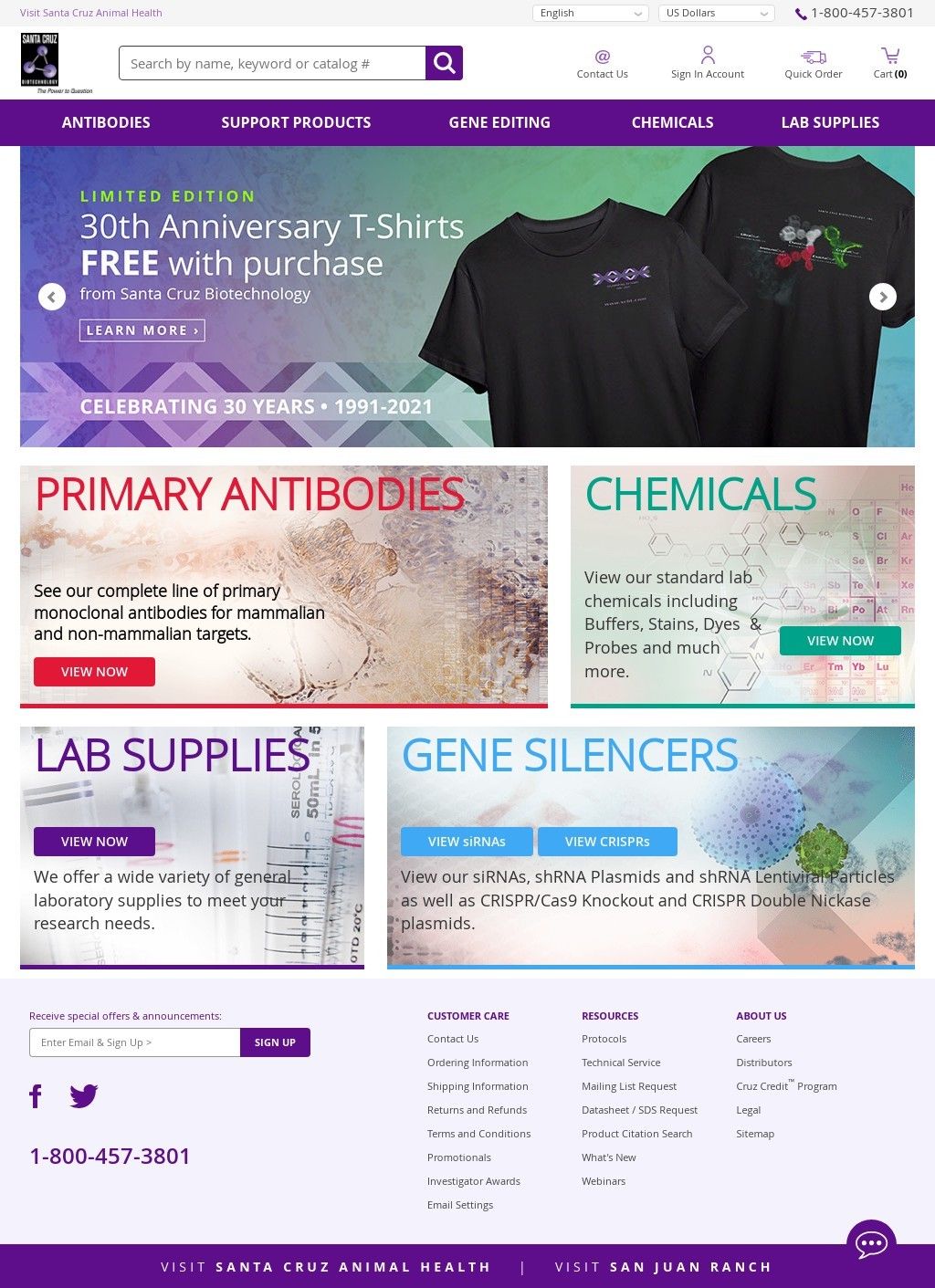
A researcher standing over a half-planned experiment usually arrives at a supplier like this with one stubborn, narrow need: an antibody that binds a single target cleanly, at the dilution the protocol calls for, without a week lost to a reagent that does not work. Santa Cruz Biotechnology is built around exactly that moment. Its catalog is organized so that you search by what you are trying to detect, not by an internal product code, and for a scientist under deadline that ordering logic is the whole point.
The company sells reagents to research laboratories. That is the audience, and the site reads like it knows the audience is technical and impatient.
The catalog is large, and that scale is the first practical thing Santa Cruz Biotechnology has going for it. A lab rarely has to ask whether a target is covered at all; the doubt shrinks to whether the specific clone on offer performs in the assay it is needed for. That narrowing saves time before a single order is placed, whether the lab found Santa Cruz Biotechnology through a colleague's recommendation or a general business directory search.
What sits in the catalog
Antibodies sorted by target class
The core of Santa Cruz Biotechnology is a large primary-antibody catalog broken down by target class. The categories track the way a molecular biologist actually thinks about a problem: Tumor Suppressors and Apoptosis, Cell Cycle Proteins, Transcription Regulators, Kinases and Phosphatases, Growth Factors and Hormones, Membrane Receptors, Neurobiology, Channel Proteins, and more specialized buckets like Phospho-Specific and Veterinary Research Antibodies. Someone chasing a signalling pathway can walk straight to the family they need instead of guessing at product names.
Alongside the primaries sit the pieces you need to make an antibody experiment work end to end. Control IgGs and conjugates for setting up your negatives and readouts. Secondary antibodies to carry the detection. It is a catalog assembled by people who understand that a primary antibody on its own is half an experiment.
The breadth is the real argument for Santa Cruz Biotechnology. A group working across several pathways can source its detection antibodies, its controls, and its conjugated secondaries from one place, which keeps reordering and lot handling simple. For a niche target parked in an unusual class, that same coverage can be the difference between finding a candidate off the shelf and commissioning a custom project from nothing.
Reagents, gene editing and labware
The range extends well past antibodies. On the support side there are Protein A, G and L agarose reagents for immunoprecipitation, chemiluminescence detection reagents, staining systems, molecular-weight standards, blocking and purification reagents, biologically active proteins, and reagents aimed at flow cytometry and ChIP. These are the consumables that fill the gaps between the headline products, and having them under one roof spares a lab from splitting an order across three vendors.
There is a dedicated Gene Editing line too: CRISPR knockout and activation kits, plus siRNA and shRNA gene silencers for knocking a target down instead of out. A lab studying a protein often needs both the antibody to see it and the tools to remove it, and Santa Cruz Biotechnology carries both sides of that workflow. General lab chemicals round it out: buffers, crosslinkers, nucleotides, peptides, amino acids, stains and dyes. And then the unglamorous but necessary supplies, pipettes and tips, gloves, membranes, plasticware, cell culture and PCR products, even benchtop equipment.
Put together, a molecular or cell-biology lab can source nearly everything it needs from Santa Cruz Biotechnology alone. A related brand, Santa Cruz Animal Health, tied to San Juan Ranch, extends the same parent into animal health products, which is worth knowing if a search turns up the name in an unexpected context.
How it holds up beyond the product pages
Protocols, technical service and Cruz Credit
A reagent vendor lives or dies on support, because a scientist whose blot came out blank needs an answer, not a sales pitch. Santa Cruz Biotechnology publishes protocols, runs a technical service line, and handles datasheet and SDS requests, which are the documents a lab needs before a reagent can even be logged for use. There is a product citation search, genuinely useful for checking whether a given antibody has actually appeared in published papers before you stake an experiment on it, and that single feature does more to reassure a buyer than anything printed on the product page.
Webinars, investigator awards, and a "Cruz Credit" loyalty program fill out the extras, the last of which rewards repeat ordering with credit back.
Contact is easy to find, which is not a given for a technical supplier. A toll-free number sits in the footer, a Contact Us link appears in both header and footer, and separate routes exist for Customer Care, Ordering Information, Shipping Information, Returns and Refunds, and Technical Service. A buyer who hits a problem has an obvious door to knock on, and the different doors are labelled for the different problems. For a lab weighing whether to route a standing order through Santa Cruz Biotechnology, that clarity of support is a fair point in its favour.
What customers and staff report
The outside record splits in a way that is worth reading carefully, because two very different things are being measured. On the customer side, Bizrate Surveys shows a strong 9.5 out of 10 across 271 reviews, a sizeable sample pointing at satisfied buyers. Birdeye tells a cooler story, 3.7 stars from only 13 reviews, a much smaller sample that a handful of frustrated customers could swing either way. A Better Business Bureau profile exists for a Dallas, Texas location but is marked Not Rated for accreditation, which is a neutral status, not a strike against the company.
The employee-facing numbers run lower, and they need to be kept in their own box. Glassdoor sub-ratings sit at 3.4 out of 5 for work-life balance, 2.6 for culture and values, and 2.3 for career opportunities, with 45 percent of reviewers saying they would recommend the place to work. Indeed shows 2.5 out of 5 across 55 reviews, and some comments single out management. These are workplace opinions from people who work there, not verdicts on the reagents that arrive at your bench.
A prospective buyer should not read those staff scores as a warning about product quality, and should not read the strong Bizrate figure as proof the workplace is a happy one. The two measures barely touch. What a purchasing scientist can take from the record on Santa Cruz Biotechnology is that the buying experience, judged by the largest available sample, lands well, while the internal culture is a separate and less flattering story that does not follow the reagent into the freezer.
That distinction is the honest crux of judging Santa Cruz Biotechnology. The product-buying signal is largely positive and comes from a big enough pool to trust; the workplace signal is mixed and, for a customer, mostly beside the point. A catalog this broad, this precisely organized, with citation search and real technical support behind it, covers a great deal of what a working lab needs from a single supplier.
Santa Cruz Biotechnology can supply the experiment; the catalog and the citation search settle that much. What is left to weigh is which review sample counts for more, the 271 buyers who rated the service highly or the smaller, sharper set of complaints sitting beside them, and whether the target on the shopping list has actually turned up in the published literature before it goes into a protocol.
Business address
Santa Cruz Biotechnology, Inc
10410 Finnell Street,
Dallas,
Texas
75220
United States
Contact details
Phone: 800-457-3801
Fax: 214-358-6070