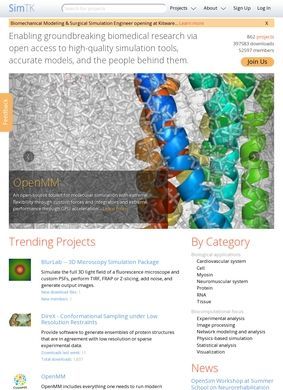
A researcher modeling how blood moves through a reconstructed artery, or how a knee joint loads during a sprint, hits the same wall early: the simulation code exists somewhere, written by another lab, but finding it, trusting it, and getting it running is its own project. Simulation Toolkit, the platform that runs at simtk.org, was built to remove most of that friction. It is a shared home for biomedical simulation work, where the software, the computational models, the underlying research data, and the source code all sit together in one place and stay open for anyone to pull down.
Scale and structure of the platform
The scale of Simulation Toolkit is the first thing worth registering. The platform hosts 2,026 projects, has pushed past 12 million cumulative downloads, and counts 186,393 registered members. Those figures describe an active research commons where labs publish their tools and then keep using each other's. Funding comes from the National Institutes of Health under grant R01GM124443, which explains both the open-access model and the absence of any paid tiers. You register a free account, and the catalog opens up.
Biological and computational organization
What the Simulation Toolkit catalog covers ranges across the body and across the math. On the biological side there are projects in molecular dynamics, biomechanics, cardiovascular modeling, protein structure, tissue simulation, and even whole-cell organisms. On the computational side, projects are sorted by method: physics simulation, image processing, statistical analysis, and visualization. The dual organization is genuinely useful. Someone who knows they need a physics solver can browse that way, while someone working on, say, RNA or cardiovascular questions can come at it from the application angle and still land on the right tools.
Flagship projects
The flagship projects give a clear sense of the caliber. OpenMM handles GPU-accelerated molecular dynamics, the kind of high-throughput work that used to demand a dedicated cluster. OpenSim is the musculoskeletal and biomechanical modeling package that has become close to standard in movement science labs. SimVascular reconstructs and simulates cardiovascular blood flow, and the Mycoplasma genitalium Whole-Cell Model is exactly what its name promises: an attempt to simulate an entire organism computationally. These are the tools that real papers are built on, and hosting them on Simulation Toolkit means the code, the documentation, and the user community travel together. A model that would otherwise be a zip file attached to a supplementary materials link instead gets a living page, with version history and a place for the next person to report what broke.
Community features and engagement
That community layer is where Simulation Toolkit does more than act as a download mirror. Projects carry forums organized around specific research initiatives, shoulder modeling and biomechanics among them, so a question about how a particular model behaves can go to the people who wrote it and the people already using it. A Jobs board lists research positions, which quietly tells you the audience here is the academic and lab world looking to hire as well as compute. A News section tracks project updates and new software releases, so a returning user can see what has changed since the last visit without digging through individual project pages.
Scope across molecular to organism scales
The reach of Simulation Toolkit is deliberately wide. Biomedical researchers, computational biologists, and academic institutions worldwide are the intended users, and the structure reflects that. Projects span the molecular up through the organ and the whole-organism, with categories for cardiovascular, cell, protein, and tissue work sitting alongside the method-based filters. A graduate student building a first biomechanics model and a senior lab maintaining a cardiovascular pipeline are both served by the same shelf, which is harder to pull off than it sounds when the material runs from raw source code to finished applications.
Requirements for users
There is a sober point to make about what Simulation Toolkit asks of you. The tools are powerful, and several of them, OpenMM and SimVascular especially, expect a user who is comfortable with the underlying science and with getting computational software configured. This is a working repository built for practitioners rather than newcomers to simulation. The forums and documentation soften that learning curve, and the consolidation of code, data, and models in one project page helps a great deal, but a casual visitor with no background in simulation will find the depth here aimed past them. That is the right tradeoff for the audience it serves, and it keeps the material rigorous.
Durability and reproducibility
What makes Simulation Toolkit hold up over time is the durability of an open, funded archive. When a lab publishes its model and source code on the platform, that work stays reachable for the next researcher who wants to reproduce a result or extend it, instead of vanishing when a personal web page goes dark. Reproducibility is a chronic problem in computational biology, and a stable public home for the actual artifacts, the running code and data themselves, is one of the more practical answers to it. The download counts suggest the field has voted with its bandwidth.
Quality variation in the catalog
The breadth can cut both ways. With more than two thousand projects of varying maturity, quality is not uniform, and some entries will be far more polished and maintained than others. The featured projects are clearly the load-bearing ones, and a newcomer is well advised to start there before wandering into the long tail. But having the long tail at all is a strength, because niche models that would never justify their own infrastructure get a place to live and be found.
For a computational biologist or biomechanics researcher weighing where to publish or source simulation work, Simulation Toolkit is worth setting up an account on and exploring directly. Start with the flagship project that matches your domain, OpenSim for movement, SimVascular for cardiovascular flow, OpenMM for molecular dynamics, then check the relevant forum to gauge how active the surrounding community is before you commit a project to it. The price of entry is a free registration, and for anyone doing serious modeling in the life sciences, the catalog of code and models behind that login is the strongest reason to look. Simulation Toolkit has built the kind of resource that gets more valuable the more the field uses it, and the numbers say the field already does.