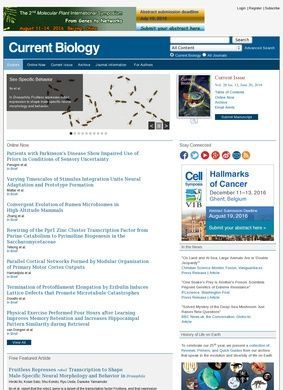
A researcher finishes a striking experiment in, say, circadian rhythms or chromosome segregation, and now faces the question every working scientist eventually hits: where does this go to reach the people who will actually build on it? For broad biology that crosses the usual departmental fences, Cell.com: Current Biology is one of the obvious answers, and the home page makes clear within a few clicks what kind of venue it is. This is the official site of Current Biology, the journal published by Cell Press under the Elsevier umbrella, and the whole operation is built around moving research from a submission portal into a citable, indexed record of work.
Scope across life sciences
The scope is the first thing worth understanding, because it shapes who should submit here and who should bother reading. Cell.com: Current Biology does not corral itself into one corner of the life sciences. It runs original research across cell biology, genetics, genomics, neuroscience, evolutionary biology, ecology, developmental biology, and plant biology, which means a paper on insect behaviour and a paper on chromatin structure can sit in the same issue. That breadth is a deliberate editorial stance, and it is the reason a working biologist might keep an eye on Cell.com: Current Biology even outside their own specialty. The site reflects that range in how it presents its latest issues and articles, with new work surfaced as it clears review.
Quick guides and primers
Beyond the headline research papers, the content types are more varied than a casual visitor might expect. Alongside full-length articles, Cell.com: Current Biology publishes reviews, dispatches, correspondence, and news and views pieces that put fresh results in context. Two formats stand out as genuinely useful to a non-specialist reader: the Quick Guide and the Primer. These are short, accessible explainers that lay out a topic for someone who is competent in biology but new to a particular subfield.
That kind of writing is far more valuable for orientation than a dense methods section when you are trying to enter unfamiliar territory. A graduate student picking up a new technique or a journalist trying to get the science right can both get something useful out of those pieces. The publishing cadence is biweekly, which keeps a steady flow of new material rather than the long gaps some quarterly titles leave between issues.
On the practical side, Cell.com: Current Biology carries the machinery you would expect from a major publisher. Manuscript submission runs through Editorial Manager, and the site links out the author guidelines that spell out formatting, scope, and what the editors want before a paper goes into the queue. Reviewer resources are gathered for the people doing the unpaid but essential work of peer review. Access is the part that tends to generate the most discussion, and the site is reasonably upfront about how it works. Content can be reached through an institutional subscription, an individual subscription, or pay-per-article purchase, and the home environment includes the licensing and access-management pages that university libraries deal with on the back end.
Some articles are published open access under a CC-BY license, and Cell.com: Current Biology participates in the publisher's open-access pathway, so a portion of the catalogue is freely readable while the rest sits behind the usual paywall. For anyone weighing where to publish, the open-access options and their terms are laid out as part of the submission and licensing information, which spares authors a fair amount of guesswork about costs and reuse rights.
Supplementary data repositories
One feature that gets less attention than it deserves is the supplementary data. Cell.com: Current Biology hosts supplementary repositories tied to published papers, meaning the additional figures, datasets, and methods detail that no longer fit inside a print-length article but that a careful reader needs to evaluate or reproduce a result. For a field where reproducibility is a live concern, having that material attached and findable is a real point in the journal's favour.
Indexing in major databases
Indexing is the quiet thing that determines whether anyone finds your paper at all, and here Cell.com: Current Biology is well placed. The journal is covered by PubMed and MEDLINE, Scopus, and Web of Science, which are the databases most biologists actually search through. That coverage means an article published in Cell.com: Current Biology turns up in the literature searches that matter, gets pulled into citation analyses, and feeds into the indexing pipelines that institutions rely on. Its impact factor has sat consistently in roughly the nine to ten range, which puts it among the stronger general-biology titles without straying into the rarefied territory of the flagship journal that gives the publisher its name. That standing is part of what authors are buying into when they submit.
Publishing platform for researchers
It helps to be clear-eyed about what Cell.com: Current Biology is and is not. It is a publishing platform, not a teaching resource or a popular-science magazine, and the bulk of its content assumes a reader who already speaks the language of molecular and organismal biology. Someone hunting for an introductory tour of genetics will find the Primers helpful but the research articles heavy going, and the paywall will frustrate anyone without institutional access trying to read a specific non-open paper. None of that is a fault so much as a description of the audience: this is built for researchers, academics, and scientists, and it serves them well on those terms.
Inside the Cell Press ecosystem
What ties the experience together is the connection to Cell Press, which sets a recognisable house standard across its titles. The editorial filtering, the consistency of format, and the integration with the wider publisher platform mean a reader moving between Cell.com: Current Biology and its sibling journals encounters a familiar structure for navigation, access, and supplementary material. An active researcher who learns how one journal's site behaves can apply that knowledge across the rest, which saves real time.
Cell.com: Current Biology does not have a meaningful footprint on consumer review platforms, which is exactly what you would expect for an academic journal. Researchers do not leave star ratings on Trustpilot for the journals they publish in. The relevant reputation lives in citation databases and editorial reputation among biologists, and on those measures Cell.com: Current Biology has a well-established position built over decades of publication. Academic forums and preprint communities discuss the journal's editorial decisions and turnaround times, and the general picture that emerges is of a publication taken seriously in its field, even if the peer review process, as with most journals, draws occasional complaints about pace.
An active biologist with a broad-interest result that spans subfields should read the author guidelines and the open-access terms before taking the submission through Editorial Manager. A librarian or research administrator should look at the institutional licensing pages to sort out access for their users before subscription renewals come due. A student or early-career scientist trying to get oriented in a new area should start with the Quick Guides and Primers, which cost the least time and return the most. The published evidence covers scope, indexing, impact factor, and the open-access pathway, which gives enough to make that call without waiting for something further.