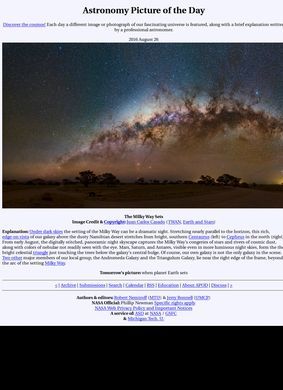
June 1995 is when Astronomy Picture of the Day published its first entry. That was before most of the web existed in any recognisable form, and the site has put up one image of the universe every single day since. That kind of longevity is not an accident. It reflects a narrow, consistent editorial decision: one picture, a short caption written by a working astronomer, and enough explanation to tell you what you are looking at and why it is worth your attention. No slideshow, no carousel, no membership tier.
Two scientists leading the project
The two scientists behind Astronomy Picture of the Day are Robert Nemiroff at Michigan Technological University and Jerry Bonnell at the University of Maryland, working under the Astrophysics Science Division at NASA's Goddard Space Flight Center. Because the captions come from people who study these objects professionally, a photograph of a distant galaxy arrives with a paragraph that names the distance, the physics involved, or the mission that captured it. The writing is brief on purpose. A casual visitor and a graduate student are likely reading the same caption, and the site handles that well by keeping the language precise without becoming technical in a way that shuts people out.
Images from amateurs and observatories
The subject range is as wide as the sky. One day is a Hubble deep-field, the next a close pass of a solar system body, then an aurora, an eclipse, or a James Webb infrared composite. A meaningful share of entries in Astronomy Picture of the Day come from amateur astrophotographers credited by name alongside the big observatories, which is unusual for a site of this standing. A backyard photographer's shot of the Milky Way can sit next to a Webb image from a billion-dollar telescope, and both get the same careful treatment in the caption.
Searchable archive and browsing tools
Thirty years of daily entries has produced something that functions as a reference in its own right. The full archive is searchable, so a teacher hunting for a vetted image of a specific nebula or a meteor shower can find one quickly and read a verified caption alongside it. A calendar interface lets you browse by date, which turns Astronomy Picture of the Day into a kind of visual almanac. You can pull up exactly what the site featured on any given day across three decades, which has practical uses for anyone teaching astronomy history or tracking how imaging technology has changed over time.
Random generator and feed options
For visitors without a target in mind, the Random APOD Generator is the better starting point. Click it and you land somewhere unpredictable in the back catalogue, a genuinely good way to find corners of astronomy you would never have searched for. The site index collects the whole archive in one place, and an RSS feed delivers each new picture to people who would rather have it arrive than remember to visit. These are small features, but together they make Astronomy Picture of the Day easier to use as a long-term habit than as a one-time visit.
Education materials and reader discussion
The education section draws on three decades of imagery that has already been explained in plain language, with materials aimed at classroom use. A discussion forum attached to each day's entry lets readers and the occasional expert push back on a caption's interpretation or add context the caption left out. That community layer has built up over years and gives each entry a second life as a conversation rather than a static page.
Free access without login or paywall
Access has stayed free the entire run, with no login, no subscription, and no paywall. That has held through redesigns of nearly every other corner of the web, and it is part of why Astronomy Picture of the Day is trusted by the general public, students, educators, and professional astronomers in roughly equal measure. The interface looks plain to the point of dated. That plainness is arguably the reason it has survived this long: nothing about it requires constant rebuilding, and nothing about it gets in the way of the picture.
Thirty years of consistent editorial vision
Astronomy Picture of the Day does one thing and has done it for thirty years. The captions reward a slow read. The archive rewards a long afternoon. Visual quality is rarely in question because the images come from NASA missions, partner observatories, and credited photographers who know what they are submitting. The explanatory voice stays consistent because the same two scientists have steered the project from the beginning, an unusual degree of editorial continuity for any publication at any scale.
One picture daily, no expansion planned
There is a narrowness to what Astronomy Picture of the Day offers, and that narrowness is a feature. It has no interest in expanding into news, opinion, or adjacent science topics. One picture, one explanation, every day. The depth of the archive alone makes it worth returning to, and the free access policy means it is available to anyone with an internet connection and a passing interest in the sky. For a resource that has been online continuously for thirty years, Astronomy Picture of the Day has changed remarkably little, and that is the point.