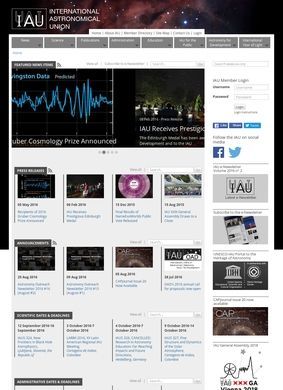
Governing astronomy at a global level is an odd job, but the International Astronomical Union has been doing it since 1919. The site makes the structure immediately legible: nine scientific Divisions at the top, Commissions and Working Groups beneath them, together covering every branch of the field from planetary science to cosmology. Anyone trying to understand who actually decides naming conventions, coordinates observing campaigns, or sets the agenda for the discipline will find the org chart here, written plainly rather than buried in committee-speak.
Structure and governance divisions
Most of the practical value for working researchers sits in the meetings calendar. The International Astronomical Union coordinates and funds the major scientific gatherings, and the headline event is the General Assembly, next set for Rome in August 2027. Around that are Symposia, Regional Meetings, and Focus Meetings, with 21 scientific meetings already announced for that year alone. That schedule is the reason a researcher might keep the page bookmarked, since it is where abstract deadlines, venues, and themes get published. I spent longer than I intended clicking through the 2027 listings, partly because the spread of topics across them shows how wide the field has become.
Meetings calendar for researchers
Prizes are the other prominent thread. The International Astronomical Union administers or is formally associated with a serious roster of awards: the Kavli Prize in Astrophysics, the Shaw Prize in Astronomy, the Gruber Cosmology Prize, the Gruber Fellowship, the IAU PhD Prize, and the IAU ODE Prizes. These are not vanity ribbons. They rank among the most recognised honours in the field, and the number of them tied to a single coordinating body is a fair measure of the organisation's position within the discipline. The PhD Prize is worth flagging separately for anyone who has just finished doctoral work, since it is aimed squarely at that stage.
Major awards and fellowships
The part of the International Astronomical Union that surprised me most was the development work. The Office of Astronomy for Development, the OAD, runs annual calls for proposals that fund astronomy projects in developing regions. This is money pushed toward places far from the well-resourced observatories of Europe and North America, and it reframes the organisation as something broader than a club for established scientists. The funding is modest by big-science standards, but the calls are recurring, which is more useful over time than a single large grant would be.
Development funding in astronomy
Education is handled separately through the Office for Astronomy Education, the OAE, which runs teacher training and professional development workshops globally, including the I-HOW programme and the ISYA schools. Pairing a development office with an education office is a sensible division of labour: one funds projects on the ground, the other builds the people who will teach the next cohort. Together they give the International Astronomical Union a reach extending well past its own membership, into classrooms and regional programmes that most visitors would never connect to a professional union. Few international scientific bodies at this level maintain both an OAD and an OAE simultaneously, and the International Astronomical Union does so with recurring funding calls and structured curricula rather than occasional one-off initiatives.
Teacher training and education programmes
Membership itself is tiered and easy to parse. There are National Members (the adhering countries), Individual Members (professional astronomers), Junior Members, Honorary Members, and Associates. The Junior Member category is worth noting as a quiet sign the organisation is thinking about succession as much as its current roster. A reader can work out fairly quickly which category they might qualify for, and that clarity is uncommon in a field where governance can feel opaque.
How do you join the organisation?
The publishing side is leaner. The International Astronomical Union puts out meeting Proceedings and an e-Newsletter, which is about what you would expect from a coordinating body whose members do their real publishing in journals elsewhere. The Proceedings serve as a record of what was discussed at Symposia and Assemblies, and the newsletter keeps members current between the large meetings. Nobody is coming here for frontier research papers, and the site does not pretend otherwise. There is no business directory of affiliated researchers or observatories, and the organisation is right not to try to be one.
Publishing and member communications
Holding all of this together is the Strategic Plan 2020 to 2030, a decade-long framework that the various offices and programmes are meant to serve. It is the kind of document that can read as administrative filler, but in this case it gives the meetings, prizes, funding calls, and education work a stated direction. The International Astronomical Union also maintains partner offices and centres worldwide and coordinates more specialised efforts, among them the Kavli Foundation Global Coordination Workshop and the Young Astronomers Lunch programmes, the latter a small human touch in an otherwise institutional setting.
Strategic direction through 2030
The International Astronomical Union covers more professional ground than its name implies. Working astronomers find the authoritative source for meetings, membership, and career-shaping awards. Junior researchers find prizes and fellowships aimed at their stage. Astronomers in developing regions have a concrete route to project funding through the OAD. Teachers reach professional development through the OAE. The structure is legible across all of these entry points, and the organisation does not oversell what it is. The published evidence is consistent and substantial: International Astronomical Union occupies a position in the field that the record bears out.