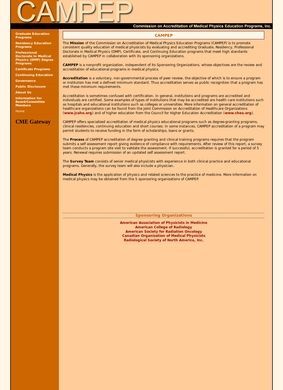
Five distinct kinds of training fall under the eye of the Commission on Accreditation of Medical Physics Educational Programs, Inc.: graduate degree programs at the master's and doctoral level, clinical residencies, the Professional Doctorate in Medical Physics (DMP), certificate programs, and shorter continuing education and short-course offerings. That spread tells you most of what the body does. It is a peer-review accreditor for the pipeline that produces medical physicists, and the scope is drawn tightly around medical physics education specifically, not the wider sciences the field touches.
Five training categories accredited
The organization is a nonprofit that operates independently of the professional societies that sponsor it, which is the structural detail that gives an accreditor its credibility. An accreditor too closely tied to the programs it judges would be worth very little, so the separation is the point. The Commission on Accreditation of Medical Physics Educational Programs, Inc. counts the major professional bodies in medical physics and radiology among its sponsors, and that backing is what connects a program's accredited status to the credentialing and certification routes graduates eventually need. A hospital physics department hiring from an accredited residency program can reasonably assume the training met a defined floor; one hiring from an unaccredited program cannot make the same inference. That asymmetry is the whole reason the body exists.
What the review process checks is whether a program meets defined minimum educational standards, verified through peer review. It sets a floor, not a ranking. A program either clears the bar or it does not, and the work is done by people who understand the discipline assessing whether the curriculum and clinical training meet the standard. For a graduate program, that means the academic side; for a residency, it means the clinical training that turns a degree-holder into someone fit to work in a clinical setting.
Professional Doctorate in Medical Physics
The inclusion of the Professional Doctorate in Medical Physics as its own accreditation category, separate from the traditional master's and doctoral tracks, is one indicator that the Commission on Accreditation of Medical Physics Educational Programs, Inc. has kept pace with how the profession structures its degrees. The DMP blends doctoral-level academics with clinical residency, and treating it as a named category rather than folding it into existing buckets reflects a real understanding of the field's training paths.
Certificate programs and continuing education round out the list. These serve people already working or transitioning into the field, and accrediting them extends the same minimum-standard logic to shorter, more targeted instruction. The continuing education piece keeps the Commission on Accreditation of Medical Physics Educational Programs, Inc. relevant to practitioners well past their formal schooling, which a purely degree-focused accreditor could not do. That is a meaningful distinction for a field where technology and technique continue to shift throughout a career.
Public disclosure of accredited programs
The site carries a Public Disclosure section listing accredited programs and their current status. This is the part most outside visitors will reach for. A prospective student weighing where to apply can check whether a given program holds accreditation before spending years and tuition on it. The same list lets employers and credentialing bodies confirm that an applicant trained somewhere recognized. One maintained, public register doing all three jobs is sensible infrastructure, and making it public rather than burying it behind a login is the right call for something this consequential.
Funding eligibility through accreditation
There is a concrete stake for students beyond prestige. Enrollment in a program accredited by the Commission on Accreditation of Medical Physics Educational Programs, Inc. can open eligibility for certain funding sources, so accreditation is a gate to practical resources, not a quality stamp alone. That ties the accreditor's decisions directly to the financial reality of training, which raises the consequences of getting those decisions right and helps explain why the independence from sponsoring societies is structural, not incidental.
A search for third-party discussion of the Commission on Accreditation of Medical Physics Educational Programs, Inc. in a general business directory or review platform turns up very little. The body operates in a narrow professional niche, and its audience knows where to look; it does not cultivate a public profile in the way a consumer-facing organization might. That absence is unremarkable given the context.
It is worth being clear about what the site does not try to be. There is no attempt to rank programs against each other, no marketing of one institution over another, and no broad commentary on the profession. The Commission on Accreditation of Medical Physics Educational Programs, Inc. confines itself to the accreditation function and the records that flow from it, and that narrowness is appropriate. A reader looking for the standing of a specific program gets a direct answer; a reader looking for career advice or program comparisons will need to go elsewhere, and the site does not pretend otherwise.
For a field as specialized as medical physics, where the gap between a competent program and an inadequate one is genuinely hard for an outsider to judge, having a single recognized body that draws the line is useful. The Commission on Accreditation of Medical Physics Educational Programs, Inc. handles graduate, residency, doctorate, certificate, and continuing education accreditation under one roof, publishes the results, and keeps its judgments separate from the programs it judges. The public record is accessible, the criteria are documented, and the scope is honest about what falls inside and outside its remit. That is what a functional accreditor looks like.