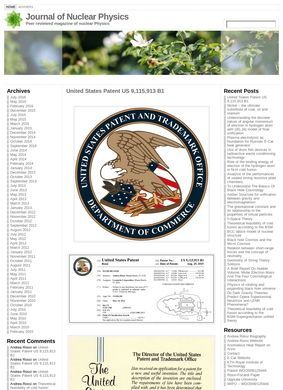
Andrea Rossi built the Journal of Nuclear Physics as the online home for his work on the E-Cat, or Energy Catalyzer, a device he claims produces usable heat through low-energy nuclear reactions, sometimes described as cold fusion. Running since 2010, the Journal of Nuclear Physics is a blog with monthly archives, a stack of downloadable papers in PDF and ZIP form, and a public comment thread now past 46,000 entries spread across more than fifteen years of posts. Rossi edits and runs it himself, which is the first thing a visitor needs to understand before reading a single paper.
How the Journal operates without peer review
Calling it a journal sets an expectation the format does not meet. There is no editorial board, no external peer review, no anonymous referees weighing in before something goes live. What you get is a personal publishing channel where the inventor posts theoretical papers, fields questions in the comments, and points readers to his other properties. The Journal of Nuclear Physics links out to andrea-rossi.com and to the commercial E-Cat site at ecat.com, so the line between research write-up and product promotion is openly blurred from the start.
Technical topics covered in the papers
The technical range on display is wider than you might expect. Papers touch on nuclear geometry, quantum mechanics, reactor cooling, tritium separation, and even desalination, and Rossi cites US Patent No. 9,115,913 B1 repeatedly as the anchor for his claims. For someone following the LENR scene, that breadth is part of the appeal: the material is laid out in one place and the back catalog is easy to walk through chronologically. The comment section, for all its volume, doubles as a record of how the ideas have been received and debated by the people who keep returning to the Journal of Nuclear Physics over the years.
Outside assessments and academic indexing
The harder question is what any of it is worth, and outside opinion is not kind. The Journal of Nuclear Physics appears in no recognized academic indexing system: it is absent from SCImago, from ResearchGate, and from journal ranking lists generally. Wikipedia's article on the Energy Catalyzer states flatly that there is no evidence in the corpus of nuclear science to support Rossi's central claims. OilPrice.com dismissed the platform as a self-published blog standing in for a real scientific journal, and Wired called Rossi's claims far-fetched in its coverage. Those are not stray potshots. They line up into a consistent picture, and the absence of any independent validation is the loudest fact about the Journal of Nuclear Physics.
Comparing ratings across review platforms
No consumer review platforms carry ratings for it, which fits the nature of the thing. Google, Trustpilot, and Yelp track restaurants and contractors, not one-man physics blogs, so the silence there says little either way. The meaningful judgment comes from the scientific and journalistic coverage cited above, and that coverage trends skeptical to outright dismissive across multiple independent outlets.
Contact methods and site accessibility
Reaching the person behind the Journal of Nuclear Physics is straightforward only up to a point. An email address sits on the page for correspondence, and given the active comment threads, Rossi is clearly reachable through the site itself. There is no phone number and no physical address, so anyone wanting a formal point of contact will not find one. For a platform that presents itself as a journal, that gap is consistent with a self-run blog where the email and comment box do the work.
Who benefits from this resource
It helps to be honest about who this serves. People already invested in LENR research, those tracking the long saga of the E-Cat, and readers curious about cold fusion claims will find a dense, regularly updated archive maintained by the central figure himself. That is a real resource of a kind. Someone arriving at the Journal of Nuclear Physics expecting vetted, citable science is in the wrong place, and nothing on the site pretends otherwise once you grasp how it is structured.
Primary source material for LENR researchers
The value of the Journal of Nuclear Physics depends entirely on what a reader brings to it. As primary-source material straight from the inventor, with patent references and a decade of documented argument, it has a clear use for researchers and critics who want to study the claims at the source. As a credible scientific journal, it falls short: the format is self-published, the review process is absent, and the independent assessments range from doubtful to scathing. Treat it as Rossi's own record of his case, read it with the criticism in plain sight, and it can be informative. Treat it as established physics and you will be misled. That split verdict is about as fair as the published evidence allows.