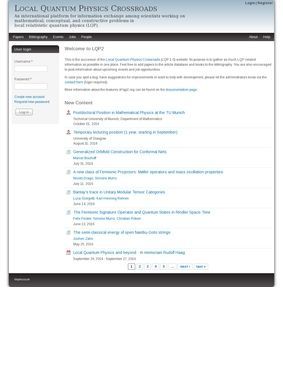
Nobody wanders into a site about local relativistic quantum physics by accident, and Local Quantum Physics Crossroads makes no pretense otherwise. This is a working hub for people who study algebraic quantum field theory, the strand of mathematical physics often shortened to AQFT or LQP, and it assumes you already know roughly what those letters stand for. The site is the second incarnation of an older platform, picking up where LQP 1.0 left off, and it carries the slightly utilitarian feel of a place built by researchers for researchers, where the function matters and the polish comes second.
Paper database and research bibliography
At the center of Local Quantum Physics Crossroads sits a searchable database of papers. Registered scientists can submit their own work and browse what colleagues have posted, which turns the site into something closer to a curated noticeboard for the field than a static archive. Alongside the papers there is a bibliography of LQP-related books, useful if you are trying to assemble a reading list or check whether a particular monograph belongs in the canon. The research the platform tracks runs through the construction and classification of local quantum field theories, modular theory, phase-space properties, algebraic concepts, and the analytical methods that connect elementary particle constituents up to relativistic bulk matter.
That is a narrow band of physics, and Local Quantum Physics Crossroads does not pretend to serve anyone outside it. The bibliography sits next to the database for a reason: between the two, a researcher can move from a foundational text to the latest preprint without leaving the site, and that adjacency is part of what makes the platform worth keeping in reach.
Events calendar and colloquium series
What I find genuinely useful here is how much of the platform is organized around the calendar of academic life. There is an events archive paired with an upcoming-events listing, so you can see which workshops, conferences, and colloquia have happened and which are still ahead. Anyone planning travel to a meeting, or just trying to keep a finger on where the community is gathering next, gets a single place to check. Local Quantum Physics Crossroads also runs its own LQP Colloquium series, set up to draw attention to strong research in the area, which gives the site a voice of its own instead of only aggregating other people's announcements. That editorial choice, deciding which work deserves a spotlight, is the kind of judgement a passive archive never makes.
Job board and community directory
Then there is the job board. For a field this specialized, postings for postdoctoral spots, fellowships, and faculty lines tend to scatter across departmental pages and mailing lists, and pulling them into one feed is a real service to early-career researchers. A PhD student finishing up in mathematical physics could reasonably keep Local Quantum Physics Crossroads open in a browser tab through the hiring season. Paired with the People directory, which lists members of the community, the platform starts to function as a small social map of who works on what, and where they fit within the network of groups studying these problems.
Documentation pages round out the structure, explaining how the various sections fit together and how to use them. None of this is flashy. The value is in coverage and concentration: papers, books, events, the colloquium, jobs, and people, all aimed at the same audience and kept under one roof. Because the content is user-contributed by registered scientists and registration is open to that community, the database grows in the way the field itself moves, which is both its strength and the reason it lives or dies by participation. A platform like this is only as current as the researchers who feed it, and Local Quantum Physics Crossroads is clearly built on the assumption that they will.
Login requirements for registered scientists
The substantive tools sit behind a login, which is worth knowing before you arrive expecting to browse freely. The paper database and the working sections open up once you have an account, and registration is open to the research community the site exists for. For a resource of this kind that gate reads as a deliberate boundary: it is meant for working scientists, and keeping the casual traffic out keeps the contents focused. If you are evaluating whether to commit, plan on creating an account before you can poke around in earnest.
Who should use this platform?
It helps to be honest about who this will not serve. A general reader curious about quantum mechanics, a student looking for an introduction to physics, or anyone outside the AQFT community will find the language and the contents impenetrable and probably unrewarding. The site does not explain itself to outsiders, and it should not have to.
Its job is to be precise and complete for a specialist readership, and on that count Local Quantum Physics Crossroads holds together well. The breadth of its sections, from the paper database through to the events calendar and the job board, covers the practical needs of someone embedded in the field. The lineage matters too. As the successor to the earlier LQP 1.0, Local Quantum Physics Crossroads inherits an established place in the community, which is no small thing for a resource that depends on researchers choosing to contribute to it year after year.
A few things would help the merely curious. A short public-facing summary of what the colloquium covers, or a sample of recent paper titles visible before login, would let a prospective member judge the activity level without committing. The current design asks for trust up front. For its intended users that is a fair trade, since they already know the field and the people in it. For everyone else, Local Quantum Physics Crossroads is a closed door, and the site seems content with that.
Participation sustains the resource
The platform makes most sense as a standing resource rather than a one-time visit. The events page and the job board reward regular checking, and the paper database is only useful if researchers keep putting their work in. Local Quantum Physics Crossroads is built on that reciprocity: it gives the community a shared space, and the community keeps it current by using it. That arrangement has held across two platform generations, which is a reasonable sign it will hold into a third. Whether Local Quantum Physics Crossroads remains genuinely active depends on participation, and the infrastructure to support that participation is clearly there.