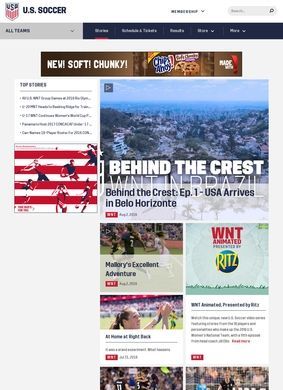
U.S. Soccer is the United States Soccer Federation, the FIFA- and CONCACAF-sanctioned governing body that runs the sport at national level across the country. The website functions as the federation's front door, and the first thing that registers is how many distinct audiences it tries to serve at once. Players, parents, coaches, referees, and the administrators who organize matches all have a path here, and the menu is built around those roles rather than around a single marketing message.
National team coverage
The national-team coverage sits at the center of everything. Both senior squads, the men's and women's teams, have their own sections, and beneath them U.S. Soccer tracks the full age-group ladder, the U-14 through U-23 teams for both genders. That depth is the part most casual visitors will underestimate. The federation also fields teams in places the general public rarely thinks about: beach soccer, futsal, and the para programs covering cerebral palsy, deaf, and power soccer. Placing those alongside the marquee senior teams says something about how the organization defines its mandate, and it is a useful reminder that U.S. Soccer's reach goes well past the two teams that get television time.
Age groups and specialized programs
Competition coverage extends to the Lamar Hunt U.S. Open Cup, the long-running knockout tournament, and the site coordinates the country's involvement in the 2026 FIFA World Cup. With that event approaching and partly hosted on home soil, the World Cup material will likely be the highest-traffic corner of the whole property for a while.
Learning Center and credentials
This is where U.S. Soccer separates itself from a straightforward fan page. The Learning Center handles coaching and refereeing certification, which means a working referee or a youth coach chasing a license treats this site as a credential portal, not a news outlet. That is a different kind of relationship than a supporter checking a match result, and the federation has clearly decided to carry both jobs under one roof.
Talent identification pipelines
The development side is more ambitious still. U.S. Soccer maintains talent identification pipelines and a National Training Center referenced as the program's headquarters, the infrastructure meant to move promising players toward the national setup. A parent reading through the youth pathways is getting a map of how the federation thinks talent should progress, which is more candid than you might expect from an organization that could easily keep that process opaque.
Safeguarding and conduct provisions
The safeguarding hub belongs in this same conversation. It gives people a route to report concerns, and the published fan code of conduct sets out expectations in plain terms. Those are not glamorous features, but for a body responsible for minors in youth programs they are worth having prominently accessible. Press and partners get their own provisions too, with media services and brand protection resources set aside for that group. It is a sensible split, keeping the working journalist's needs separate from the supporter's.
Membership and content access
U.S. Soccer runs an "Insiders" membership with a free tier and a paid one. The premium level opens up exclusive content, a video library, and podcast programming, so the federation is making a direct play to keep fans inside its own ecosystem. Whether the paid tier justifies itself comes down to how much of the content a given fan would otherwise track down for free, and that calculation will vary a lot from one supporter to the next.
Ticketing through external vendors
The transactional pieces are handled through outside platforms, which is the conventional approach for an organization this size. Tickets for national-team fixtures route through Ticketmaster, with group and premium seating options surfaced for matches. Merchandise sells through an official online store. Offloading ticketing and retail fulfillment to established providers is a pragmatic choice, though it does mean the buying experience passes out of the federation's own hands at the point of sale.
Mobile app for live updates
U.S. Soccer also maintains a mobile app that pushes live match updates and exclusive content. For a federation whose biggest moments are time-sensitive, a dedicated app makes more sense than relying on people to keep reloading a browser tab.
Browsing U.S. Soccer end to end, the role-based structure is what holds the whole thing together. A coach renewing a license, a parent reading the youth pathway, a journalist requesting credentials, and a fan buying a scarf are each routed down a different track, and the site mostly keeps those lanes from colliding. It takes a moment to locate U.S. Soccer in any general business directory listing, because nothing about the federation's web presence reads like a commercial operation chasing leads. The breadth is the genuine strength and also the obvious tension. An organization carrying certification, talent development, safeguarding, ticketing, and a content membership is asking a single website to behave like five different things simultaneously, and depth in one area can come at the cost of clarity in another.
For most visitors the practical value lands in a few predictable spots: following the senior teams, getting through a certification program, navigating the youth pathways, or sorting out tickets ahead of a match. The para and specialized programs are quieter corners that reward anyone who goes looking, and the safeguarding route is the kind of provision you hope never to need but want available when you do. Outside reputation on review platforms is minimal, which is typical for governing bodies.
People do not leave Yelp reviews for soccer federations; the public record is the federation's own published standards, its tournament results, and its media coverage, all of which point toward an organization that takes its administrative function seriously even if the website sometimes asks visitors to work harder than necessary to find what they came for. With the 2026 World Cup on the horizon, U.S. Soccer is about to find out how well its infrastructure holds when the casual-fan traffic multiplies.