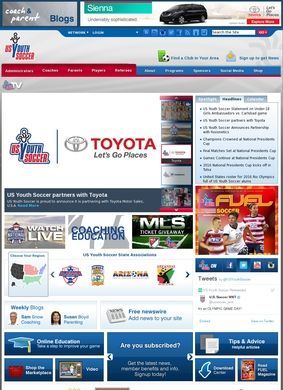
Scope is the first thing to grasp here. National Soccer Clubs and Associations is the public face of US Youth Soccer, the national governing body for age-group soccer across all fifty states. Once you understand that, the rest of the site makes sense: it is the administrative spine of a whole youth pyramid, not a club site or a fan page. Most of what sits on it exists because someone at a state or regional level needs it: rules, brackets, registration pathways, governance text. That is the lens to bring to it.
Three parallel competitive pathways
The competitive structure deserves attention first because almost everything else feeds into it. Three named pathways run in parallel. The National Championships are annual summer tournaments split into Boys and Girls divisions, which is the top-of-ladder title. The National League is a season-long competition for elite club teams, so it functions less as a single event and more as an ongoing schedule that clubs plan their whole year around. Then there is the Presidents Cup, a separate route that climbs from regional play to a national final.
National Championships, National League, Presidents Cup
That third track exists for a practical reason: not every team is realistically chasing the top national title, and having a parallel championship keeps the season meaningful for clubs that sit a tier below the very best. National Soccer Clubs and Associations administers all three, and the distinction between them is worth understanding before you try to navigate where your club fits.
Talent identification through Olympic Development Program
Talent identification is another area where National Soccer Clubs and Associations takes an active role, running through the Olympic Development Program. ODP holds regional identification camps divided into East, Midwest, West, and South. The regional split is sensible for a country this size, since a single central camp would be unworkable for families spread across thousands of miles. The page describes the structure clearly enough; the granular how-to, the practical steps for getting a player in front of evaluators, mostly lives with the state associations and not at the national level. Visitors should expect to follow that thread outward.
State association directories across all fifty states
That points to the real backbone of the operation: state association directories covering all fifty states. For most visitors this is probably the single most useful feature. A family anywhere in the country can find their governing affiliate and from there reach league registration, schedules, and local rules that actually govern their child's season. National Soccer Clubs and Associations sits one level above all of that, setting the framework while the state bodies handle day-to-day administration. The affiliation with the US Soccer Federation places it inside the formal national structure, not outside it as an independent network.
Development and educational resources
Beyond competition, National Soccer Clubs and Associations carries a spread of development and educational content on the site. Coaching education is offered through partnerships, including an arrangement tied to the IberCup Convention. Referee development includes international training opportunities, which is more ambitious than the usual local certification clinic. USYS University gathers educational and wellness resources through partner organizations, aimed at the off-field side of youth sport. A digital magazine, news, videos, and member resources round out the publishing side. None of these are large in isolation, but together they describe an organization trying to support coaches, officials, and players rather than only running tournaments.
Coaching education and referee training
One genuinely useful feature is transparency on governance. Bylaws and policy documents are publicly accessible, which is more than many large sport bodies bother to make plain. For a parent or club administrator who needs to cite a rule in a dispute, or who wants to understand how decisions get made, having those documents in the open is practical. It is the kind of openness an organization shows when it expects its own membership to actually read the paperwork.
Public bylaws and governance documents
The sponsor and partner list reads about as expected for a body of this scale: New Balance on the apparel and equipment side, NCSA on college recruiting, New York Life as a corporate backer, and US Soccer as the parent federation. The NCSA link has the most direct bearing on the audience, since college recruiting is exactly the concern of families whose kids are climbing the competitive ladder that National Soccer Clubs and Associations administers. The others are standard institutional support.
From New Balance to US Soccer partnerships
No independent review platforms carry a rating or review count for National Soccer Clubs and Associations. That is unsurprising for a governing body of this kind, which is accountable to its member associations and not to consumer review sites. The practical reputation check here is the organization's standing within the US Soccer Federation structure, which is public and documented.
The site's main limitation is breadth over depth. A lot of the actionable steps, the things a coach or parent actually needs to do next, end here and continue on a state affiliate's own pages. That is structurally correct for a national governing body and would be unfair to call a flaw, but a first-time visitor should expect to keep clicking through to their state association before reaching anything they can register for. The national layer is the map, not the trailhead.
My overall read is positive but measured. For its actual job, organizing competitive pathways, pointing families to state affiliates, and publishing the rules and development resources that hold the system together, National Soccer Clubs and Associations does what it sets out to do. The governance transparency adds real value. The most actionable specifics often live a layer down at the state level, so treat this as the front door to the national structure rather than a self-contained answer to a local question, and it holds its purpose well.