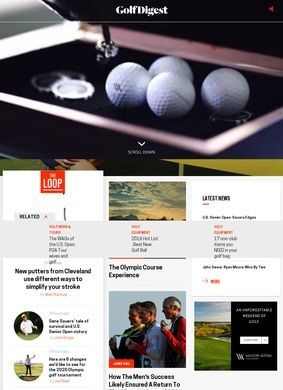
Every spring, hundreds of golf clubs get fired by swing robots and hit by human playtesters so that Golf Digest can publish its Hot List, the equipment report that much of the industry treats as a benchmark. That single exercise tells you what kind of publication this is. Rather than summarizing what manufacturers say about their drivers and irons, Golf Digest runs the testing and puts a rating on the result. The Hot List has become one of those reference points golfers check before spending money on a new set, and it anchors a much wider body of gear coverage on the site: balls, bags, apparel, and the growing pile of swing-tracking technology that now follows recreational players around the course.
Equipment testing and the Hot List
Equipment is only one lane. Golf Digest has been around since 1950, and across more than seven decades it has built editorial verticals that cover most of how people relate to the game. Instruction is a heavy one, with swing tips and lesson content drawn from touring professionals and certified teachers. Course coverage is another, headlined by the biennial America's 100 Greatest Golf Courses ranking, which sits alongside international course lists and travel guides aimed at golfers planning trips. Tournament reporting runs through the PGA Tour, the majors, and LIV Golf, with player profiles and interviews filling in the human side of the schedule.
What separates a modern golf publication from an archive of articles is the set of tools wrapped around the writing, and Golf Digest leans into that. There is a course-finder for locating places to play, and a fitting quiz that walks a golfer toward equipment suited to their game, which is a sensible companion to the reviews themselves. Reading that a club tested well is one thing; being pointed toward the model that fits your swing is more useful for someone who has no intention of visiting a fitting bay.
Instruction programs and teaching resources
Instruction is where the brand pushes hardest into paid territory. Golf Digest+ is the digital subscription that opens up premium instruction video, and Golf Digest Schools extends the teaching into structured programs, both online and in person. The site also compiles rankings of the best teachers in each U.S. state, which doubles as a directory for anyone trying to find a coach near them and as a credential for the instructors who make the list. A substantial video library and podcast catalog round out the formats, so the same lesson on, say, bunker play might exist as an article, a clip, and an audio segment depending on how someone prefers to take it in.
Building content for different skill levels
The content is built to serve a wide span of players. A weekend golfer trying to break 100 and a low-handicapper chasing a club championship are both clearly in the audience, and the rules and handicap guidance reflects that, sitting next to fitness and training material for people who want to treat the game more seriously. Golf Digest does not assume you are already an expert, but nothing here talks down to the committed player either.
Checking affiliate links in gear recommendations
There is a commercial side, and the site does not hide it. A merchandise shop sells branded goods, and a good deal of the gear writing carries affiliate links, meaning a recommendation can turn into a purchase without leaving the page. That arrangement is worth keeping in mind when reading buying advice, though the Hot List methodology, with its robot testing and panel of playtesters, is more transparent about how it reaches a verdict than affiliate-driven gear roundups that rely entirely on manufacturer claims.
From daily coverage to monthly magazine
The print magazine still publishes monthly, which is a notable thing to say about any title in the current media climate. Plenty of legacy magazines have gone web-only or folded; Golf Digest keeps a physical edition running in parallel with the digital operation, and the monthly cadence gives the editorial calendar a rhythm that the constant churn of tour news does not. The relationship between the two is the familiar one for a Conde Nast property: the website carries the daily volume and the breaking coverage, while the magazine collects the longer features and the marquee rankings.
If there is a critique to make of a site this large, it is the sheer breadth. A publication trying to be the authority on equipment, instruction, course rankings, tour news, travel, fitness, and rules all at once asks a reader to do some navigating, and the line between editorial recommendation and commercial placement is not always clear. The Hot List and the course rankings are the clearest examples of where Golf Digest's weight is fully earned, because the work behind them is visible. The general gear-buying funnel is where a reader should stay more alert to the affiliate machinery underneath.
Tools for planning trips and finding coaches
For someone who plays golf and wants a single starting point, the value of Golf Digest lies in the depth of those flagship projects rather than in any one article. The course rankings reward a player planning where to spend a golf vacation. The Hot List rewards anyone about to replace a club. The state-by-state teacher lists give a concrete way to find instruction, and Golf Digest Schools and Golf Digest+ extend that for people willing to pay for structured coaching. The tour coverage keeps a casual fan current without much effort.
The full picture is a long-running golf institution that has translated a print legacy into a working digital operation, with testing-based equipment verdicts and ranked lists as its strongest assets and a clearly commercial storefront layered on top. A golfer comparing two drivers, picking a course for a trip, or hunting for a nearby coach will find tools in Golf Digest built for exactly those decisions, and the Hot List robots are still swinging away every year to keep the gear verdicts fresh.