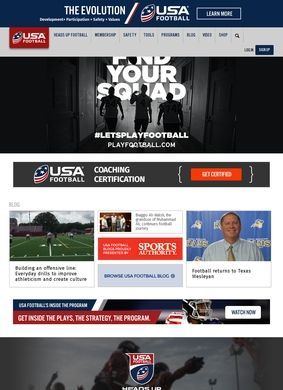
Who actually sets the rules and trains the people behind organized American football across the country? That job belongs to USA Football, the national governing body for the sport in the United States and the country's sole member of the International Federation of American Football. The site is built around that mandate, and it reads like a working hub for the people who keep the game running: coaches first, then officials, league administrators, parents, and the athletes themselves. If you arrive expecting scores and highlight reels, this is not that. It is the operational backbone, the place where a youth coach gets certified before stepping on a field and where a small league finds the structure it cannot build alone.
Coaching certification and official training
The certification work is the spine of everything here. USA Football runs Youth Coach Certification for both tackle and flag football, which means a parent volunteer and a seasoned high school coach can both find a track aimed at their level. There is an Advanced Flag Coaching Course for those who want to go deeper into the version of the game that has been growing fastest, plus dedicated training programs for officials and referees. That last category often gets overlooked elsewhere. A youth league can scrape together enough adults to coach, but finding people who know how to officiate correctly is a separate problem, and USA Football treats it as one worth solving directly.
From identity cards to insurance coverage
Beyond teaching, USA Football handles a lot of the administrative machinery that leagues quietly depend on. It issues Athlete and Coach ID cards, manages age verification and roster cards, runs background checks, and provides insurance services. None of that is glamorous, and that is precisely the point. These are the tasks that expose a league to real liability if they are done badly or skipped, and centralizing them through USA Football removes a genuine burden from volunteers who would otherwise be guessing. The presence of background checks and insurance under the same roof as coaching education tells you the organization understands that a youth sport stands or falls on trust as much as on talent.
National team development and Olympic pathways
The competitive and developmental side has gained obvious weight lately. The organization oversees national team selection and development programs across both tackle and flag, and the flag pathway now connects to something concrete: flag football's inclusion in the 2028 Los Angeles Olympic Games. That is a real change in the sport's trajectory, and the site leans into it with talent identification camps, digital combines, and the structures a young athlete would follow to move from a local field toward a national roster. For a parent or coach trying to understand what an Olympic path even looks like for this sport, having USA Football lay out the steps is far more useful than scattered speculation across forums.
League support and grassroots resources
USA Football also builds out a service layer aimed squarely at the grassroots. A league finder and placement tool helps families locate a program that fits, and an enrollment support function exists for leagues and associations that want to formalize their standing. USA Football also administers football grants, and the effect is felt most in under-resourced communities where equipment and field costs are exactly what keep some programs from existing at all. Pair that with the broader collection of football program resources for organizers, and what USA Football offers starts to look less like a website and more like the operating system a league plugs into.
How does USA Football approach player safety?
Safety gets treated as a discipline rather than a disclaimer. The Director of Player Safety Initiative anchors a body of health and safety education, which is a deliberate stance for a governing body tied to a contact sport that has spent years under scrutiny over head injuries and youth participation. The emphasis on a named, structured safety program, with education resources behind it, shows that USA Football is not waiting for the conversation to come to it. Whether that fully answers every parent's concern is its own debate, but the material is present, organized, and prominent on a site that could easily have buried it.
Connecting certification to league operations
What ties the whole thing together is coherence. USA Football is doing many distinct jobs, certification, identity management, national team development, grants, safety education, officiating, and yet they hang off a single clear purpose: making organized American football work at every level from a backyard flag league to an Olympic squad. The breadth could read as scattered, but each piece answers a need a real coach or administrator actually has, and the connections between them are visible. A coach who certifies here can run a league that enrolls here, whose players carry ID cards issued here, insured through here, learning safety practices written here.
The version of the game on offer matters to who should pay attention. Flag football's expansion is not a side note on this site; it runs through the coaching courses, the development programs, and the Olympic framing, making USA Football a natural first stop for anyone entering that side of the sport at a moment when it is being taken far more seriously than before. Tackle football is served just as fully, with its own certification and national programs, so a community can use the same body whichever form of the game it fields. That dual coverage is genuinely useful, since plenty of leagues now run both.
For its intended audience the answer is plain. A coach who needs a recognized credential, a league that wants background checks and insurance handled properly, an official looking for real training, a family hunting for a nearby program, or an athlete chasing a national or Olympic spot will find the relevant machinery here and find it organized around a single authority that the sport recognizes. The site is not trying to entertain a casual fan, and it does not pretend to. It is a tool for people responsible for the game, and the depth of what USA Football has assembled gives those people no good reason to look elsewhere first.