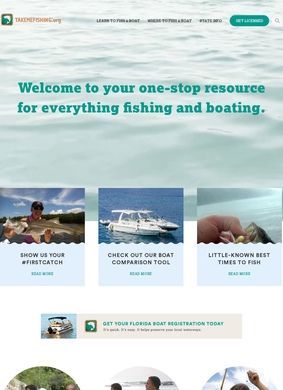
Somebody decides on a Friday night that the family is going fishing tomorrow, and within minutes the questions pile up. Where can you legally drop a line? Do the kids need a license? Is there a boat ramp anywhere close, and what species are even biting this time of year? Take Me Fishing is built to answer exactly that scramble, and it does so for every state in the country, which is the part that turns a vague plan into something you can carry out before breakfast.
The site is the public face of the Recreational Boating and Fishing Foundation, a national nonprofit whose stated job is getting more Americans onto the water. That mission shapes what you find. Instead of selling gear or pushing a single region, Take Me Fishing organizes the practical knowledge a new or returning angler needs and points them toward the official channels for licenses and boat registration. The state-by-state regulations and licensing section is the spine of the whole thing. You pick your state, the site lays out the rules that apply, then hands you off to that state's actual portal for buying a fishing license or registering a boat. That handoff is necessary because the rules and the purchase points genuinely differ across state lines, and a generic national explainer would only get you halfway there.
Finding fishing spots and boat launches
Alongside the paperwork sits an interactive map of places to go. Take Me Fishing marks nearby fishing spots and boat launch sites, so the abstract idea of "let's go fishing" gets pinned to a real location you can drive to. For anyone who has stared at a county map trying to guess where public access exists, having those points already plotted removes the guesswork that usually kills a spontaneous trip. The same logic extends to the launch sites, which is the detail boaters care about most when they are towing a trailer and need somewhere to put in.
Learning fishing techniques across multiple disciplines
The instructional library is broader than you might expect from an organization that could have stopped at the basics. Take Me Fishing covers freshwater and saltwater fishing as distinct disciplines, and it goes further into fly fishing and ice fishing, two specialties that often get skipped on beginner-oriented sites because they demand their own techniques and gear. Boating safety gets its own coverage too, which fits the foundation's dual focus on fishing and boating as linked activities. Someone moving from a stocked pond to coastal water, or from open-water casting to a frozen lake, will find Take Me Fishing already speaks to that next step. The how-to content reads like it was written to teach a skill, with a progression that assumes you know nothing and will eventually know something.
Researching boat types before buying
For people weighing a bigger commitment, the Boat Explorer tool lets you research different boat types before you ever talk to a dealer. Buying a boat is a confusing first purchase, and a neutral place to compare categories, what they are good for, and what they involve is genuinely useful when the alternative is sorting through sales pitches. The blog rounds out the offering with tips, techniques, and articles from people who know the subject, refreshed often enough to keep Take Me Fishing from feeling static. A free monthly newsletter gives anyone who wants a steady drip of ideas a way to stay connected without hunting the site down each time.
Spanish-language access through Vamos a Pescar
One choice that says something about who the foundation thinks fishes in America is the Spanish-language companion brand, Vamos a Pescar. Take Me Fishing did not run its English content through a translator and call it done. The companion brand is aimed squarely at Hispanic audiences, which is a meaningful slice of the fishing and boating public, and treating that audience as a first-class group with its own brand reflects the foundation's stated goal of broadening participation. It is the sort of decision a commercial site rarely makes because it costs effort that does not show up on a balance sheet, but for a participation nonprofit it lines up perfectly with the mission.
Tracking participation through research and partnerships
Behind the consumer pages, the foundation does the less glamorous work of measuring whether any of this moves the needle. It publishes research reports and annual stakeholder reports tracking participation trends across fishing and boating. That output is aimed less at the weekend angler and more at the state wildlife agencies, conservation groups, and industry players the foundation works with, but it is worth knowing the data exists. The whole operation runs on partnerships with those state agencies, conservation organizations, and the fishing and boating industry, which is how a nonprofit can sustain a free national resource at this scale without charging the people who use it.
Reaching millions of anglers annually
The scale is not trivial. Take Me Fishing draws close to four million unique visits a year, and the broader campaign reportedly generates more than 638 million consumer impressions annually. Numbers like that describe a platform doing real outreach work, not a quiet corner of the web. A site reaching that many people has to keep its regulations current and its maps accurate, because a wrong answer at that volume causes real problems for real people on the water.
Matching purpose to design
What keeps coming back into focus is how cleanly Take Me Fishing matches its purpose to its design. A person trying to increase the chance they will fish this season needs three things in fast succession: permission to do it legally, a place to do it, and enough knowledge not to feel lost. Take Me Fishing arranges those three in roughly that order and then layers the deeper material on top for whoever keeps coming back. The boat research tool, the specialty techniques, and the bilingual track are not afterthoughts. The freshwater novice and the ice angler are both served by the same structure, which is harder to pull off than it looks.
If there is a limit to the site, it is the one baked into its model. Take Me Fishing is a gateway, not a transaction engine. You research and learn here, then you finish the license purchase or boat registration on a state system, and you catch your fish somewhere out in the world. For its intended job that is the right design, and treating Take Me Fishing as a launching point rather than an endpoint sets the right expectation going in. The state handoffs are the feature, not a gap, even if it means your journey continues elsewhere.
Take Me Fishing reads like what it is: a well-funded, well-organized effort to lower the barriers between a curious person and a day on the water. The regulations are localized, the maps are practical, the instruction spans the easy and the specialized, and the Spanish-language track widens the door further. The research arm gives the whole thing a backbone of evidence rather than enthusiasm alone. For a beginner, a lapsed angler, or someone eyeing their first boat, Take Me Fishing covers the ground that usually trips people up early, and does so without asking for anything in return. There is enough here to move someone from wondering whether fishing is for them to standing at the water's edge with the right license in hand.