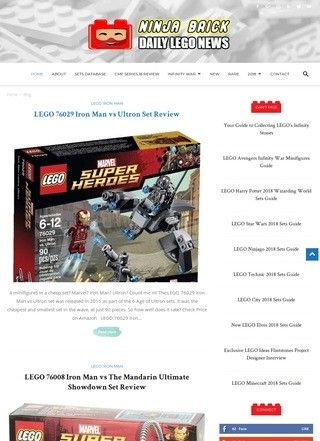
Where does a LEGO collector go when the box art has stopped telling them anything useful? Ninja Brick aims to be that stop. It is a fan-run editorial site about LEGO sets, minifigures, and the accessories that orbit the hobby, and it reads like the work of people who actually own the bricks they write about. The homepage splits into four lanes you can name without squinting: Latest News, Sets, Minifigures, and Accessories. That clarity tells you within a few clicks whether you are here for a release update or to settle an argument about which modular building is worth the shelf space.
Ranked guides for collector decisions
The bulk of the writing leans toward purchasing decisions, which is where a site like this either helps or wastes your time. Ninja Brick produces ranked guides on subjects collectors genuinely lose sleep over: the most expensive sets, the modular buildings, the military and army themes, Harry Potter advent calendars, Jurassic World, Star Wars, and Ninjago. These are not vague roundups thrown together to fill a category. They pick a theme a buyer is already weighing and try to put the options in some order, which is more practical than a feed of press releases.
Sets, minifigures, accessories organization
The structure helps here too. Because Ninja Brick sorts its work into Sets, Minifigures, and Accessories, a collector who only cares about one of those can stay in their lane without wading through the rest. Minifigure coverage in particular tends to get treated as an afterthought on broader hobby sites, so giving it its own section is a small sign that whoever runs the place understands how the audience actually splits. A figure hunter and a set completist are not the same reader, and the site does not pretend they are.
Video games, interviews, storage coverage
Beyond the buying guides, Ninja Brick's editorial range is wider than a typical hobby blog tends to offer. There is coverage of LEGO video games, interviews with collectors, and reviews of odder corners of the catalog, including books built around LEGO Mindstorms EV3 and the storage gear that serious builders end up needing once a collection outgrows a single bin. That last category is a small tell of authenticity. Writing about how to store the stuff is the kind of unglamorous topic only an actual collector bothers to cover, because only an actual collector has hit the problem.
Amazon affiliate commissions and bias
It would be dishonest to skip the commercial layer, because it shapes how the recommendations should be read. Ninja Brick runs as an Amazon Associate and earns a referral commission when a reader clicks through and buys. That is a common and legitimate way for an enthusiast site to keep going, but it does mean the ranked guides have a built-in nudge toward purchases that pay. None of that makes the content worthless. A guide that knows the Star Wars range well can still be the fastest way to narrow a decision. It just means a reader should treat the rankings as informed opinion with a financial interest attached, the same caution you would apply to any review site funded by links.
The fairer way to read Ninja Brick, then, is as a hobbyist's pinboard with a checkout button. The video game pieces and the collector interviews are not products to push, so they sit there as evidence the site cares about LEGO beyond the affiliate link. That mix changes how the whole site reads. A site that only ever ranks things to sell would read as a storefront in disguise. The interviews and the news pull it back toward something that resembles a community publication, and that balance is what keeps the buying guides from feeling purely transactional.
Fan-made resource disclosure
To its credit, the site does not pretend to be something it is not. Ninja Brick states plainly that it is a fan-made resource and not an official LEGO publication. That single line of honesty counts for a lot, because the LEGO name draws plenty of sites that blur the line and hope visitors assume an official connection. Setting the record straight up front earns a measure of trust that the slicker imitators never bother to.
Network ownership and contact options
Who runs it sits one step behind the curtain. Ninja Brick is described as part of the Hopnetic affiliate network, so it operates inside a larger publishing setup rather than as a lone hobbyist's passion project. Whether that reads as reassuring or slightly impersonal probably depends on what you came for. If you want a single trusted voice you grow to recognize, a network site may feel less intimate. If you just want the guide to be there and to be reasonably thorough, the backing arguably makes the lights more likely to stay on.
On the matter of who you can reach, the site keeps things light. There is a Contact page and an About page, both easy enough to locate, which is the baseline you want from any site asking for your attention and your clicks. What you will not find is a phone number or a physical address anywhere on the homepage or in the usual places. For a content and reviews operation that is no real failing. Nobody calls a LEGO blog. A working contact form and a stated identity cover what a reader actually needs, and an editorial site has little reason to publish a street address.
Third-party reviews and outside validation
Outside validation is where the picture goes quiet, and I will not dress it up. Ninja Brick does not appear in any business directory of established hobby publishers, and a search for third-party opinions turns up mostly the site's own pages. There are no Google, Trustpilot, or Yelp ratings to point to, and the one social result that surfaces is an unrelated Facebook page with a similar name and no reviews of its own.
That absence is worth naming honestly. It does not prove the content is weak, since plenty of useful niche sites never accumulate formal reviews, but it does mean a first-time visitor has little third-party signal to lean on and has to judge the writing on its own merits. A site of this kind tends to build its standing through repeat readers rather than star ratings, and that reputation, if it exists, stays mostly invisible to a search engine.
Judging the guides on their merits
So judge it that way. The substance is in the guides and the reviews, and those are concrete, theme-specific, and clearly written by someone who knows the difference between a UCS Star Wars set and a holiday impulse buy. The honesty about being fan-made and affiliate-funded is a point in its favor, the more so because that disclosure is exactly what the less trustworthy LEGO sites tend to hide. The weak spots are the missing outside reputation and the slightly faceless network ownership, neither of which is disqualifying for a site you are using to research a purchase.
Solid content with limited external credibility
Ninja Brick is a competent, genuinely useful corner of the LEGO web that has not yet earned much external proof of its reputation. The content is solid; the outside credibility scaffolding is underdeveloped, and that gap is a real limitation for a first-time visitor with no prior frame of reference. For someone deciding between two Ninjago sets or trying to figure out whether a particular advent calendar is worth buying, the guides are a fair and specific starting point. Factor in the affiliate angle, hold the rankings loosely, and the site does what it promises.
Business address
United Kingdom