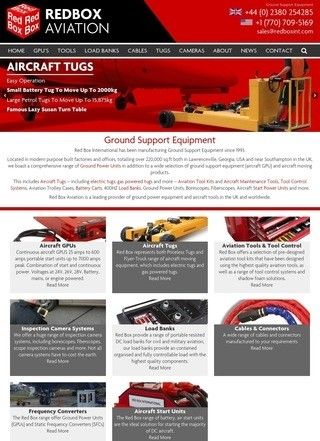
Ground power is what an aircraft at a gate or in a hangar needs before its own systems are running, and that is the entire job Red Box Aviation has built itself around. The UK firm designs and manufactures the equipment that feeds power to aircraft when the engines are off: continuous DC power units rated from 25 up to 600 amps, and start power units that peak as high as 7,000 amps. Those units come in 24V, 26V and 28V configurations, which lines up with the spread of civilian and military airframes a ground crew might be servicing on any given day.
Converters, cables and offshore equipment
The catalogue runs deeper than the headline GPUs. There are static frequency converters, transformer rectifier units, and a range of aircraft cables and connectors, including extension harnesses and power harnesses that tie the units to the airframe. For operations in tougher settings, Red Box Aviation also makes offshore and hostile-environment power equipment, which is a meaningful distinction because power gear that works fine on a dry apron behaves very differently exposed to salt air and weather. The company describes its units as solid-state and environmentally friendly, and the solid-state point is the one worth weighing: fewer moving parts tends to mean cleaner output and less to go wrong in the field. For a maintenance team, that translates into equipment that is easier to trust on a long shift and simpler to keep running once it is in service.
Three decades of certified manufacturing
Red Box Aviation has been making ground power equipment since 1993, so this is not a recent entrant testing the market. That length of trading sits behind ISO 9001 and ISO 14001 certifications, covering quality management and environmental management respectively, both of which matter to the procurement teams that buy this kind of equipment. For a buyer comparing suppliers, those certificates are a checkable baseline rather than a marketing line. Longevity in a niche this technical is itself telling, since a manufacturer that has kept the lights on for three decades has had to keep its products airworthy and its customers returning.
Which airlines and manufacturers use Red Box?
The client list does a lot of the talking. Red Box Aviation names Boeing, Airbus and Lockheed Martin among its customers, alongside airlines including British Airways, easyJet and Delta. Names of that calibre are hard to put on a page without the relationships to back them, and the mix is useful: airframe manufacturers, flag carriers and a budget operator all draw from the same catalogue, which points to equipment that scales across very different fleets and budgets. The military side of the business sits alongside the civilian work, widening the range of standards the kit has to meet. Membership of the LPA Group, which acquired Red Box Aviation, adds a larger corporate structure behind the brand and the kind of backing that reassures buyers signing multi-unit orders.
Reaching global markets through distributors
Reach beyond the UK is handled through an international distributor network, and the trade footprint shows up in the wider market. Red Box Aviation turns up in distributor references such as Adams Aviation and Aston Aviation, and its products are stocked by Aircraft Spruce. That is the pattern you would expect from a manufacturer that sells largely business to business: visible through trade channels and resellers more than through a consumer storefront.
One thing worth being straight about: there are no aggregated consumer review scores to point to here. The usual platforms, Google, Trustpilot, Yelp and the like, carry no ratings or review counts for Red Box Aviation, and an Aircraft Spruce product listing shows zero reviews. For a supplier of specialised aviation hardware that is unsurprising. Procurement in this field runs on certifications, technical specs, distributor relationships and customer references, not on star ratings left by the public, so the absence is a quiet note rather than a strike against the firm.
Inside the technical documentation hub
The Red Box Aviation website is built for people who already know what they are looking for. Product pages are backed by technical resources and downloadable operating manuals, the latter also hosted on the LPA Group site, so an engineer can pull a spec or a manual without filing a request first. That kind of open technical documentation is genuinely helpful when you are matching a unit to a specific aircraft or trying to work out whether an existing piece of kit can be serviced.
Contacting Red Box Aviation directly
Contact details are easy to find. There is a phone number reaching the UK office, a contact email, and a contact route on the site, which is what you want from an equipment maker whose buyers tend to ask detailed questions before placing an order or arranging a distribution agreement. Nothing about reaching Red Box Aviation requires hunting, and the international distributor network means buyers outside the UK have a local point of contact too.
Taken together, the 1993 start date, the two ISO certifications, and customers spanning Boeing through to easyJet give Red Box Aviation a footing that is hard to dismiss. Specialist buyers will want technical specs and operating manuals in front of them before comparing against other suppliers, and this is a company set up to provide exactly that. The published documentation is detailed enough that a procurement team can do most of its groundwork before a call is ever placed.
Business address
Red Box Aviation UK
Units 12 & 13, South Hampshire Industrial Park, Totton,
Southampton,
Hampshire
SO40 3SA
United States
Contact details
Phone: 02380254285