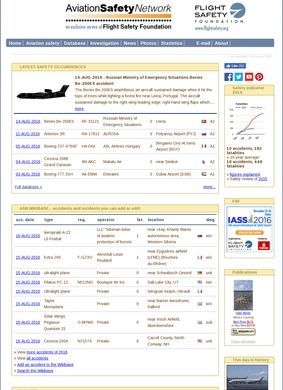
More than 23,000 airliner accidents, incidents, and hijackings sit catalogued in a single database here, each entry built from official investigation reports, contemporary news, and photographs. That figure is the core of Aviation Safety Network, an online reference run as an exclusive service of the Flight Safety Foundation, the Washington-based non-profit that has worked on civil aviation safety for decades. Harro Ranter started the project in January 1996, and it has grown into one of the standard places people go when they need to check the facts of a specific crash.
Accident database with detailed investigation records
The Aviation Safety Network accident database is the part most visitors come for, and it does the obvious thing well: it lets you look up a flight, an airframe, an operator, or a date, and read a structured account of what happened and what the inquiry concluded. Because the records lean on released investigation reports, the entries tend to carry the detail that casual news write-ups drop within a week of an event. That is why journalists reach for it when a story breaks, why regulators and researchers cite it, and why it has quietly become a reference that other references point back to.
Military aircraft and drone incident tracking
Aviation Safety Network also maintains separate military aircraft accident records alongside the airliner database, and it runs an ASN Drone Database that has passed 15,000 entries covering unmanned aircraft sightings and incidents. The drone collection is worth singling out, since this is one of the harder corners of aviation to track in any organised way, and having a dedicated, searchable record of it is genuinely useful as drone traffic keeps climbing. The military records fill another gap that general accident reporting usually treats as a footnote.
Statistics and safety news updates
Beyond the raw case files, Aviation Safety Network publishes accident statistics and yearly summaries that turn the underlying records into something you can reason about across time. If you want to know how a given year compared with the ones before it, or you are trying to support an argument with numbers instead of impressions, the summaries do that work. There is also an ongoing stream of news on civil aviation safety issues and investigation reports, so the resource reads as a living record and not a frozen archive.
Comparing free and membership access tiers
The interactive accident dashboards come in two forms, and the split is worth understanding before you rely on them. A Basic version is free to anyone, which covers most general curiosity and a good deal of serious research. A Plus version is updated weekly, includes released accident data, and is reserved for Flight Safety Foundation members, as are the raw accident dataset downloads. Anyone who needs the full machine-readable data for their own analysis will run into that membership wall, so it pays to know going in whether the free tier holds enough for the question you are asking. For most readers it does; for an analyst who wants the whole spreadsheet, the line is drawn at membership.
That tiering is a fair arrangement rather than a hidden catch. The bulk of the descriptive record stays open, and the weekly, downloadable, members-only layer is the part that takes sustained effort to maintain. It is the kind of model you see across serious reference work, where the public gets the substance and the institution funds itself through the deeper access.
Why investigation sourcing builds credibility
What gives Aviation Safety Network its weight is the sourcing discipline. The entries trace back to formal investigation findings, which means the database is closer to a curated record than a crowd-sourced wiki. Errors in any large dataset are inevitable, and aggregating thousands of separate inquiries always carries some risk of a stray detail, but the practice of tying records to released reports is exactly what keeps a resource like this trusted over the long run. The global citation by media and aviation authorities is a reasonable proxy for how well that discipline has held up.
There are limits worth naming plainly. The scope is accidents, incidents, and safety events, so Aviation Safety Network is not a place to research routine fleet history, manufacturer specifications, or the commercial side of airlines. The presentation is functional and dense, built for someone who knows what they are looking for, not for browsing. None of that is a flaw so much as a reflection of the job the site set out to do, which is to be accurate and complete on a narrow, important subject. It does that, and does not pretend to be a general aviation portal.
Who should use it? Anyone investigating a specific accident, anyone tracking accident trends over years, students and writers who need a citable factual base, and increasingly anyone trying to make sense of drone incidents. Aviation Safety Network's free tier alone answers a surprising share of those needs, and the membership tier exists for the people whose work depends on the underlying data.
It is fair to set Aviation Safety Network beside the NTSB's own accident database, which is the natural alternative for anyone digging into crash records. The NTSB carries the primary authority for events it investigates and publishes the original reports, but it is bounded by its jurisdiction and its interface is built around its own case numbering. Aviation Safety Network casts a wider net across countries, operators, and decades, pulling those threads into one searchable place and adding the drone and military records the NTSB does not cover. For a global, cross-referenced starting point, this is the one I would open first, then follow its citations back to the original reports when a particular case demands the source document itself.