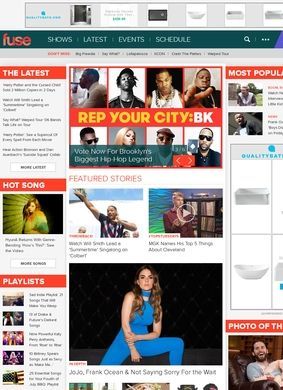
Point a Roku at fuse.tv expecting nothing to pay, and you get a free, ad-supported feed of music and entertainment that asks for no card and no login. The platform runs two ways: a linear cable and satellite channel, and an on-demand service called Fuse+ that lives as an app on iOS, Android, Roku, Amazon Fire TV, and Apple TV. Both run on advertising, so the trade is the usual one: you watch the breaks and keep your wallet shut.
Fuse app and live channel access
The site sorts its catalogue into sections readable at a glance: Shows, Episodes, Films + Docs, Celebrities, Sports, and Live TV. That last tab is the thing that separates a real network from a folder of clips, because a working live feed means Fuse has actual schedules to fill, with a backlog sitting underneath it.
Themes across shows and specials
The programming centres on music, celebrity culture, and lifestyle, with sports threaded through. Original titles like "Big Freedia Means Business" and "KevOnStage" give it a recognisable spine instead of the wall of licensed reruns that fills out a lot of free tiers. There are also themed calendar runs, Pride Month and Black Music Month blocks among them, which tell you who the network is programming for and what it cares about. A human programmer picked those blocks, and they give the channel a point of view that most ad-supported streamers skip entirely.
From MuchMusic to independent network
Some history helps frame what Fuse is. The network started life as MuchMusic USA and took its current name in the early 2000s, so the music-television DNA is not a marketing pose. It is run by Fuse, LLC, described as an independent, minority-owned media company, and that independence shows in the themed blocks. Going in half-expecting a generic free-streamer clone, what you find instead is an identity that is genuinely its own, which is rarer than it should be in this corner of TV.
Primetime viewership decline
This is where an honest read gets uncomfortable. Nielsen primetime figures, surfaced through ustvdb.com, put average viewership at roughly 8,000 viewers, down about 38 percent year over year. For a national network those are small, shrinking audiences. Linear TV is bleeding eyeballs across the board, so Fuse is not alone in this, but the slide is steep enough to note plainly.
Website traffic tells a different story
The web side tells a different story. Traffic estimates from Kochava put the site at around 219,000 monthly visits, which points to the streaming and on-demand half carrying more of the weight than the broadcast channel. A modest linear audience and a busier website can coexist, and they show where the company is putting its energy. The advertising inventory on the site is consistent with a business that has decided the app and the browser are the future, not the cable box.
Where are the consumer reviews?
Outside opinion is the missing piece. The Apple App Store carries a listing, but no aggregate rating count turned up in search. Indeed.com shows seven employee reviews, which speak to working at the company and not to watching it, so they tell a prospective viewer almost nothing. No consumer-facing ratings appeared on Google, Trustpilot, Yelp, or the BBB. That absence is not damning for a free product people dip into without ceremony, since nobody files a star review after twenty minutes of background music television. It does mean the reputation rests on the content and on the viewership data, with no crowd of voices behind it.
Reaching Fuse through support channels
Reaching the company is the weaker spot. The landing page shows no phone number, no street address, and no readily visible way to reach a person. Support runs through a Zendesk Help Center and careers through an ADP portal, both of which work as far as they go but keep the company at arm's length. For a free ad-supported service the arrangement is defensible, since you are not a paying customer chasing a refund. A viewer who hits a playback problem will still feel the distance, though. A help center handles common issues; it does not replace knowing how to reach the organisation directly.
Put the pieces together and a clear picture forms. The catalogue is substantial, the live feed and cross-device apps are genuine conveniences, the editorial identity is distinct, and the price is nothing. Against that sit a shrinking broadcast audience, almost no consumer reviews to lean on, and contact paths that prefer a ticket queue to a phone line. None of that makes Fuse a bad pick for what it is.
The closest free-streaming comparison is probably Pluto TV, which offers a far wider grid of ad-supported channels and a much larger live lineup. Pluto wins on breadth and on the comfort of a large backer. Fuse answers with focus: if your interest is music, celebrity culture, and a handful of named originals rather than an endless channel wall, Fuse gives you a curated lane that Pluto's scale tends to flatten out. The two are answering different questions, and knowing which question you have makes the choice straightforward.