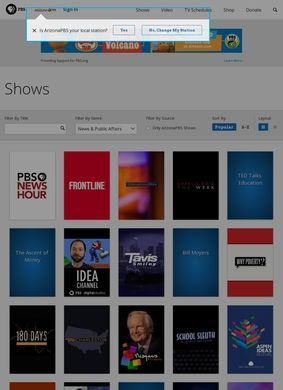
Frontline sits near the center of what makes pbs.org worth opening: long-form investigative documentaries that run an hour or more, available in full and at no cost, alongside back catalogue from American Experience, Nova, Nature, and the NewsHour. The News and Politics corner of the site is where current affairs coverage lives, but it shares a roof with one of the deeper archives of factual programming an American viewer can reach without a subscription, and that combination is the real draw. You come for a single news segment on PBS: News and Politics and find a Ken Burns series sitting two clicks away.
Streaming library with news, documentaries, drama
The streaming library is the spine of everything here. PBS: News and Politics anchors the public affairs side, while the broader catalogue spreads across News and Public Affairs, Documentaries and Independent Films, Drama, Arts and Music, Science and Nature, History, Culture, Food, and Home and How-To. Full episodes and clips coexist, so a viewer can sample a few minutes of something or settle in for a complete program. The flagship titles are the names viewers already know: American Masters profiling cultural figures, Masterpiece carrying British drama, Nova working through science, and the NewsHour handling the daily political ground that gives PBS: News and Politics its name.
Multi-part Ken Burns series and deep archives
Where the site rewards patience is in its documentary depth. The multi-part Ken Burns productions are all here, and the range of them is genuinely large: Benjamin Franklin, Muhammad Ali, Hemingway, The U.S. and the Holocaust, The National Parks, and The Black Church. These are not short pieces. Several run many hours across multiple episodes, the kind of programming that public television has built its identity on for decades.
Free access without paywalls or interruptions
A person who works through even a handful of them is getting a serious viewing project, free, with no paywall interrupting the third installment. The same shelf holds American Experience working through chapters of national history and the Independent Films strand giving room to smaller documentary voices that rarely surface on commercial streaming. Frontline, in particular, keeps adding investigative hours, so the archive keeps growing instead of sitting as a fixed pile. That alone separates PBS: News and Politics from a lot of what passes for free streaming elsewhere.
Separate platforms for kids, educators, creators
The platform splinters into several distinct properties, and they serve clearly different audiences. PBS KIDS holds the children's educational programming, kept separate from the adult-facing catalogue, which parents will appreciate. PBS LearningMedia is aimed squarely at educators, packaging classroom resources for teachers who want vetted material tied to actual lessons. PBS Digital Studios produces original content made for online viewing rather than broadcast, and Black Culture Connection gathers programming around a specific cultural focus. These are not afterthoughts bolted onto the PBS: News and Politics homepage; each is a developed section with its own purpose, which says something about how the organization thinks about its audience beyond the prime-time documentary crowd.
Watchlist, app, newsletters keep viewers connected
On the practical side, the viewing experience has the features a modern streaming service is expected to carry. A personalized watchlist, labeled My List, lets a registered user save programs to return to, useful when the catalogue is this large and a half-watched six-part series is easy to lose track of. The PBS App extends all of this to phones, tablets, and connected televisions, so the experience does not stay chained to a desktop browser.
For anyone whose television is the natural place to watch a Nature episode, that app is the difference between a useful service and a curiosity. Resuming a documentary on the living-room screen after starting it on a phone is the kind of small continuity that decides whether a viewer comes back, and the cross-device setup handles it. Newsletters and podcast discovery round out the ways PBS: News and Politics tries to keep people connected to programming between visits.
Non-profit funding shapes the service model
The funding model is woven into how the place presents itself, and it shapes the offering in ways worth understanding before judging it. This is a non-profit network that has operated since 1970, member-supported and publicly funded, with individual member stations across the country affiliating under the national umbrella. The PBS Shop sells branded merchandise, and the proceeds feed back into the network instead of a shareholder's pocket. That structure is why the documentaries stream free in the first place. It also explains the slightly civic, slightly institutional tone that runs through PBS: News and Politics and the rest of the site, a tone that some viewers will find reassuring and others a little dry.
For a viewer trying to decide whether PBS: News and Politics deserves a regular spot in their rotation, the calculation depends heavily on what they want from it. As a destination for serious documentary and factual programming, it is hard to beat at the price, which is nothing. The archive runs deep, the flagship brands have decades of credibility behind them, and the split into KIDS, LearningMedia, and the other verticals means the same login serves a household with very different needs. The News and Politics vertical gives current-events viewers a reason to check in daily, and the documentary catalogue gives them a reason to stay once they arrive.
A household that already trusts the NewsHour for its evening politics is being handed Nova, Nature, and Masterpiece on the same account, which is a quietly generous bargain for a service that charges nothing at the gate. PBS: News and Politics functions less as a single channel and more as a front door to a large, varied building.
Food, arts, music expand beyond documentaries
Genre breadth is one of the quieter strengths. The catalogue does not stop at news and history. Food programming, home improvement and how-to content, arts coverage, and music all sit within reach, which broadens the audience well past the documentary purist. A person who came for the NewsHour might end up watching a cooking series or a music special, and PBS: News and Politics is clearly built to encourage exactly that kind of wandering. The genre tags are doing real navigational work, steering visitors toward corners they would not have gone looking for.
Current events coverage mixed with broader catalog
What gives pause is harder to pin down, and it sits in the gap between scope and focus. PBS: News and Politics is filed here under a single category, Television, and as a news-and-politics resource specifically, it is one slice of a much larger pie. A reader arriving with a narrow interest in current-affairs coverage gets the NewsHour and the News vertical, which are strong, but they also wade through a homepage built to sell them documentaries, drama, and a merchandise shop. The sprawl that makes the wider site valuable as a general public-media hub can make the news-and-politics promise feel like one tenant among many.
Does the news section justify the visit?
The catalogue is enormous, the brands are trusted, the app works across screens, and the price is unbeatable. Whether the news-and-politics half of PBS: News and Politics holds a viewer's attention on its own, or whether it mainly opens the door to everything else the network would rather they watch, is the question the listing leaves genuinely open.