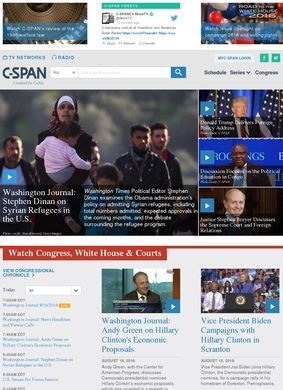
Washington Journal opens every weekday at 7am Eastern, taking live phone calls from the public before the rest of the political news cycle has properly woken up. That single program tells you something about what The C-SPAN Network is built to do: put viewers in direct contact with the machinery of American government, without a host steering them toward a conclusion. The site carries this through with three television channels (C-SPAN, C-SPAN2 and C-SPAN3), a radio service, and a video library holding decades of floor debates, hearings and interviews. None of it is dressed up. The footage runs at its real length, and the viewer is left to make sense of it.
Live coverage of Congress and courts
The spine of the operation is gavel-to-gavel coverage of the U.S. Congress. House and Senate floor proceedings run in full, committee hearings are carried at length, and the site streams them live while filing them into a searchable archive afterward. Supreme Court oral arguments sit alongside that material, as do White House and Executive Branch events. For anyone who has tried to find what a member of Congress said on a given afternoon, the value of an uncut, time-stamped record is immediate and practical. The C-SPAN Network shows these sessions in full instead of handing viewers a summary, and that distinction is the whole point.
Gavel-to-gavel House and Senate proceedings
Programming beyond the live feeds gives the network a different texture on weekends. Book TV runs Sundays on C-SPAN2 with author interviews and literary events, and American History TV takes the Saturday slot on the same channel. The Q&A interview series and In Depth handle longer-form conversations, and Ceasefire airs on Fridays. These are slower, more deliberate shows than the rolling political coverage, and they widen the reasons someone might keep The C-SPAN Network on in the background. A person who came for a Senate vote may stay for an author talking through a new book.
Weekend programming beyond floor debates
A large archive is only worth as much as the tools that let you move through it. The site leans on a searchable video archive, so locating one exchange inside thousands of hours of recorded proceedings is feasible and not a matter of guesswork. A MyC-SPAN account adds a personal layer: registered users can purchase video downloads, which is the kind of feature a researcher or journalist needs when a clip has to live somewhere permanent beyond a browser tab. The C-SPAN Network treats its own footage as a reference collection that stays put once it has aired.
Book TV and American History TV
Delivery is spread across formats. Live TV and live radio both stream from the site, podcasts package the interview and call-in material for offline listening, and mobile apps carry the feeds onto a phone. Email newsletters round out the distribution. The content stays the same across every one of these routes; The C-SPAN Network meets people on whatever device they already use, which is sensible for an audience that ranges from a retiree watching cable to a student pulling a clip on a laptop.
Searchable archive with download options
The C-SPAN Network also reaches past the strictly federal. Campaign coverage is organized around named cycles, with Campaign 2026 and Campaign 2028 pages, and election results pages are published for primary cycles as votes come in. International material appears too, the clearest example being the UK Prime Minister's Questions, which gives American viewers a window into how another legislature handles its weekly accountability ritual. The network could have stayed entirely inside Washington; instead it points outward when the comparison is useful.
Multiple delivery formats available
It is worth being honest about what this is. The C-SPAN Network was founded in 1979 as a nonprofit, funded by the U.S. cable industry, and that funding model shapes the editorial character of the whole thing. There is very little packaging. A committee hearing is shown as a committee hearing, at its real length, with none of the compression a commercial news channel would apply. For a casual viewer that can feel dry. For an educator building a lesson, a policy professional checking a quote, or a researcher tracing how a bill moved through committee, the absence of editing is the entire appeal. The C-SPAN Network has held to that approach for more than four decades, and the consistency is part of what makes the archive trustworthy as a record.
International legislative coverage
Commerce sits at the edges and stays there. An online shop carries network merchandise, but it never crowds out the programming. The C-SPAN Network does not turn its home page into a storefront, and the shop reads as a small adjunct to the public-service mission. That restraint is consistent with how the rest of the site behaves, and it keeps the focus where the network wants it.
Nonprofit model shapes editorial approach
On external reputation, a search turns up no aggregated user ratings or review-platform entries for The C-SPAN Network in the usual places. That is not surprising for a public-affairs broadcaster; the four-decade publishing record speaks more plainly than any star average would. The C-SPAN Network has been cited in academic work, legislative research and journalism for long enough that its standing already sits in the published record where readers can check it.
No commercial editing of proceedings
The practical reality of using the site is that everything points back to the same underlying footage. A clip watched live can be found again in the searchable archive, replayed on the radio service, pulled into a podcast feed, or downloaded through a MyC-SPAN account. That single source feeding many outputs is what separates a working reference tool from a channel you simply leave on. The C-SPAN Network has built its delivery so that a hearing recorded once can be reached a dozen different ways depending on who needs it and why.
From one source to many outputs
Across the whole offering, The C-SPAN Network is consistent about one thing: it shows the proceedings and lets the viewer do the interpreting. Washington Journal puts ordinary callers on the same air as the day's officials. The Q&A and In Depth slots make room for longer conversations that get cut everywhere else. The archive keeps the record open long after the cameras have moved on, and a MyC-SPAN account turns that record into something a person can download and keep. The Friday slot for Ceasefire and the 7am start for Washington Journal are fixed points a regular viewer can plan around, and the depth of the searchable archive gives the whole thing a usefulness that outlasts any single news cycle.