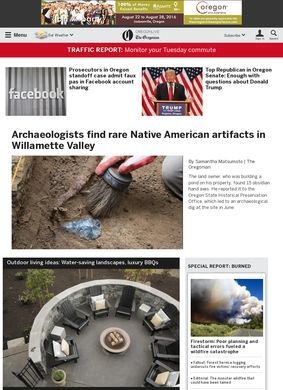
Since 1850, The Oregonian has been putting out a daily paper, and it now calls itself the largest news organization in the Pacific Northwest. That long run sits behind everything on OregonLive.com, the digital home where the paper's reporting reaches most readers today. Print built the name; the website carries it now.
What OregonLive puts in front of readers
The site works as a general-interest news hub for Oregon and the wider Northwest. Coverage runs across local news, sports, weather, entertainment, and breaking updates, pulled from Portland, Salem, and the towns beyond them. It is the standard spread of a metropolitan daily, moved onto the web and refreshed through the day instead of fixed to a single morning edition. A reader can open the same page in the morning and again at night and find the top stories reshuffled, which is the basic rhythm that separates a live news site from a static copy of the day's print.
Portland anchors the coverage, but the reach stretches past the city line. A reader in Salem or a smaller Willamette Valley town can find state politics, high school and professional sports, and arts and entertainment listings in the same place they check the forecast. The Oregonian keeps those sections front and center, which is what separates a home-state paper from a national feed that treats Oregon as an occasional dateline. The result is a site a Northwest reader can treat as a default home page for the day's local news.
Daily Oregon weather gets its own steady presence, and the Oregonian treats the local forecast as a fixture rather than a widget. For a state that watches the sky the way this one does, a reliable forecast is a practical daily draw, and it is the kind of habit that brings a reader back whether or not a big story is breaking.
Local news, sports, and weather
The bread and butter is regional. Sports coverage spans the local teams and the college scene; the news pages track city and state government, courts, and the day's events; weather threads through all of it.
These are the pieces a Northwest reader checks by reflex, and the Oregonian keeps them prominent instead of burying them under national wire copy. A resident deciding whether to subscribe is really asking whether this steady local coverage is worth a monthly fee, and the breadth on offer is the paper's answer.
The reader e-edition app
Separate from OregonLive, a companion property at reader.theoregonian.com hosts a digital e-edition, a page-for-page version of the printed newspaper delivered as an app. It runs on JavaScript and behaves like software more than a plain web page, so the experience differs from the open news site. For subscribers who prefer the layout of the physical paper, the e-edition preserves that reading habit on a screen, which is a genuine convenience the main site does not try to copy. It is a second, quieter product aimed at a particular reader, the one who still turns pages in order.
Running it as a dedicated app also keeps the crossword, the comics, and the section breaks a print subscriber expects, laid out the way the paper always was.
The subscription and the journalism behind it
OregonLive runs on a paid-subscription model, and the pitch for it is the reporting itself. The Oregonian markets award-winning journalism, in-depth reporting, investigations, and analysis on issues that affect people living in the state. That is the trade a reader is asked to make: pay for access and get depth that a quick headline scan cannot provide. There is no free tier promising the same reporting, so the paywall is the mechanism, and the journalism is plainly what a subscriber is paying to reach.
Whether the depth justifies the paywall is a judgment each reader makes, but the categories are stated plainly. Investigations and analysis take time and staff, and a subscription is how a regional paper funds them in an era when advertising alone no longer covers the newsroom. The Oregonian is upfront that the serious work sits behind the sign-in, and that clarity is worth something to a reader deciding where to put a subscription dollar.
In-depth reporting and investigations
The investigative and analytical work is the part the paper leans on to justify itself. It is the reporting a wire feed cannot supply, tied to Oregon institutions, local budgets, and regional decisions that a national outlet would skip. For readers who want more than a summary of what happened, this is where the Oregonian aims to earn the fee, and it is the clearest reason to pick a home-state paper over a national aggregator for state and local news. Depth is the whole argument for a metro daily surviving into the digital era.
Tie that to named Oregon institutions and local budgets and the value is concrete: this is coverage no national desk is going to produce for a Salem school board or a Portland city contract.
One newsroom, two operating halves
Behind the brand sits a corporate structure worth knowing. The digital content and OregonLive.com come from Oregonian Media Group, while production and distribution run through Advance Central Services, both under the umbrella of Advance Publications. So the byline a reader sees and the logistics that once put a paper on a porch trace back to separate arms of the same parent.
That split is common among modern newspaper groups shifting weight toward digital, and it explains why the website, and not the printed sheet, is now the front door. The editorial operation and the physical delivery machinery have been pulled apart so each can be run on its own terms, and the Oregonian name rides on the digital half.
Oregonian Media Group and the digital shift
The Media Group half is the reason OregonLive exists as the primary reading surface. Digital content leads now, and the print edition is mirrored through the reader app instead of driving the operation. It is a working example of how a paper that began in the age of the printing press has moved its center of gravity onto the web while keeping the older format available for readers who still want it. The Oregonian brand covers both surfaces, but the weight has clearly shifted online.
The social reach fills out the footprint. The Oregonian maintains a YouTube channel for breaking news, weather, and entertainment video, a Facebook page with more than 765,000 followers, and a LinkedIn presence in the low thousands. These feeds push the coverage outward to people who may never open the home page directly, and they describe the operation, in its own words, as the top news source in the region. Those follower counts describe reach more than reputation, but they mark the paper as a genuinely large regional operation with an audience well into the hundreds of thousands.
So the operation runs on two surfaces at once: the daily news lives on OregonLive, refreshed through the day, while the printed page lives on inside the reader app for those who want it. Both trace back to the same newsroom in Portland, and both carry the Oregonian name into a format the paper's first readers would not recognize.