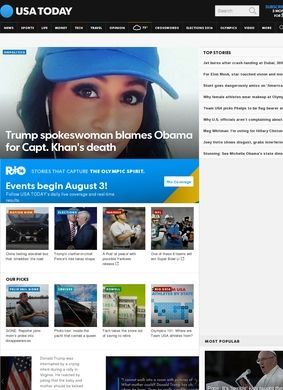
A reader who opens USA Today at breakfast usually wants the same thing: the day's national story told quickly, without a paywall slamming shut on the first paragraph or a home page buried under autoplay. The paper is built around that impatience. Its front page and section fronts stay open without a subscription, and the writing favors a fast read over a long one, which is the trade it has made since the print edition first hit newsstands. A reader gets the shape of the news in a few minutes and can dig deeper by choice, not by force.
It is the flagship title of Gannett, the largest newspaper group in the country, and the homepage describes its own beat plainly: national and local news, sports, entertainment, finance, technology, and more, delivered through award-winning journalism, photos, and videos. That is a wide mandate, wider than the single-location entry a business directory usually carries, and the site reads like a national wire desk with a consumer streak running through it.
How the paper is organized
In print, USA Today has always run on four named sections, and that skeleton still shapes the site. The structure is simple enough to describe in a sentence, which is part of the appeal for a reader who does not want to learn a new navigation every morning.
The digital edition then extends each of those sections into deeper verticals, so the home page works as a gateway and the real depth sits a click below it. Someone can stay on the surface and skim, or drop into a subject and stay there, and the layout supports both habits without forcing either.
The four print sections
The four print sections are News, Money, Sports, and Life, and they map cleanly onto what most people open a paper for: what happened, what it costs, who won, and what to do with the rest of the day. USA Today keeps them distinct, so a reader chasing markets is not routed through celebrity coverage to get there. Money carries the finance and business reporting.
Sports runs national scores, standings, and analysis. Life folds in the softer culture and lifestyle material that rounds out a general daily. It is a broad, general-interest spread, and the paper does not pretend to be anything narrower.
The four-part frame is old, but it holds up because it matches how people actually sort news in their heads. A reader rarely wants everything at once; they want one of those four things on a given morning, and the paper lets them go straight to it.
Entertainment, TV, and the Reviewed tech desk
Online, the verticals go further than the print sections can. The Entertainment and TV coverage runs show news, ratings, and reviews, aimed squarely at people deciding what to watch tonight. The technology side is more unusual: USA Today owns Reviewed, a consumer-electronics and appliance operation that publishes hands-on product reviews and buying guides. That gives the site a service function most newspapers outsource or skip, and it is one of the more concrete reasons to bookmark USA Today beyond the daily headlines.
A shopper comparing air fryers ends up under the same roof as someone reading the front-page lead, and the buying guides are written to steer a purchase instead of filling a page. Reviewed tests the products rather than repackaging press material, which is the part that separates it from most content built around affiliate links, and it gives the technology vertical a weight the entertainment pages do not carry.
What kind of reader it fits
USA Today has a specific temperament. It is broad, quick, and national, and it became one of the most widely read newspapers in the country within a decade of launching. That reach is the product. A story here is written to be understood by a reader in any state, not a local one, which is why it travels well and why it has anchored hotel doorsteps and airport newsstands for so long.
The flip side is depth. A reader who wants long investigative essays or dense regional reporting will find USA Today lighter than a metro daily built for one city. The paper trades column inches for clarity and speed. Whether that suits you depends entirely on what you open a newspaper to do, and there is no shame in wanting the quick version most mornings.
For a lot of readers, the honest use case is a first read of the day rather than the only one. It gives the national picture fast, and a specialist can go elsewhere afterward for the deep cut on a single beat.
The subscription line
USA Today runs on a subscription model, with some coverage held behind a paywall and the home page and section fronts left open. That halfway arrangement is worth understanding ahead of subscribing. A casual visitor can read a great deal without paying, while the exclusive and in-depth pieces sit behind the login.
For a daily headline habit, the free tier goes a long way. For full access to everything USA Today files, including the pieces it markets as members-only, the subscription is the gate, and the paper is upfront about where that line falls.
A national desk with local reach
Because it belongs to Gannett, USA Today can pull local news up into a national frame, drawing on a network of regional titles under the same owner. National and local coverage share the same site, which means a single visit can move from a countrywide story to something closer to home without leaving the page. Sports and money coverage benefit most from that scale, since scores and markets are national by nature and the network feeds them constantly, so a reader gets both the league-wide view and the item from their own city in one place.
That network is also why the paper can claim genuine local reach without maintaining a bureau in every town. The reporting flows up from Gannett's regional papers, and USA Today packages it for a national audience. It also means the same event can appear twice at different scales, once as the local paper filed it and once trimmed and reframed for readers who have never heard of the town, and the site is comfortable holding both versions.
The front page and the section fronts still load without a login, and the paywall only closes partway into certain articles. What the free reader gives up is the exclusive and long-form material, and what the subscription buys back is the rest.