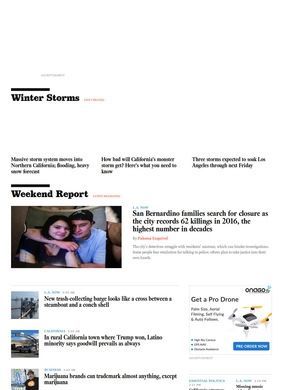
How much of a metropolitan newspaper still lives on its website when the print era is supposed to be over? At latimes.com the answer is most of it, and then some. The Los Angeles Times runs a full digital operation out of El Segundo, with original reporting that spans California coverage, national and world news, politics, business, sports, and entertainment, plus the softer beats that a paper this size can afford to keep staffed: food, travel, home and garden, arts, science and health. The Los Angeles Times reads like a place that still files copy every hour, not a brand coasting on a name.
Reporting across California, national, world news
The reach of the sections is what struck me first. A reader who comes for the wildfire or city-hall story tends to stay because the next tab over is a restaurant review, a column, or an investigative piece carrying real bylines from staff reporters and photographers. The opinion pages sit apart from the news desks, which is the arrangement you want. National and world coverage runs alongside the California reporting, so the site works as both a metro paper and a general daily depending on what you came for. The Los Angeles Times also runs a Spanish-language section, En Espanol, for readers whose local market otherwise gets very little original reporting in Spanish. None of this is decoration. It is the spread of a newsroom that remains one of the largest in the country.
Spanish-language coverage for local readers
Access is the part most visitors hit within a minute. The site runs a partial paywall: some articles are free, others sit behind a subscription, and the line between the two is not always obvious until you click. Plans come in tiers, digital-only and a print-plus-digital bundle, handled through a subscriber portal where billing and delivery are managed in one place.
Subscription access and paywall structure
For people who like the paper itself, The Los Angeles Times publishes a daily e-newspaper, a replica edition that mirrors the printed pages rather than reflowing them into web columns. That format has a steady following among readers who grew up turning pages and want the section fronts intact. Breaking-news alerts and a set of newsletters fill the gap between visits, so the site can reach you without you opening it first.
E-newspaper replica and alert options
The Los Angeles Times has built out a few things that sit outside the standard news grid. Image is its magazine on fashion and culture in the city, with a visual identity distinct from the main paper. There is a dedicated cooking section built on recipes and technique, and an events and ticketing platform that ties the brand to things happening around Los Angeles. That last piece is an interesting move for a newspaper, turning coverage of the city into a way to actually attend it. Podcasts round out the audio side for readers who would rather listen on a commute. These are not afterthoughts bolted onto the homepage; each carries its own editorial voice, and together they give the title a reason to exist beyond the daily news cycle.
Magazine, cooking section, events platform
The ownership is worth knowing because it shapes the paper's footing. Patrick Soon-Shiong, the biotech billionaire, bought The Los Angeles Times in 2018, which pulled the title back into local hands after a long stretch under out-of-town corporate owners. The masthead at The Los Angeles Times carries columnists and investigative journalists, and the trophy case holds multiple Pulitzer Prizes earned across decades of that work. Advertising runs alongside the journalism, as it does at any paper of this scale.
Local ownership and Pulitzer Prize history
One honest note on the experience: the mix of free and paywalled content can be a guessing game, and the site carries the usual ad load that comes with supporting a newsroom this big. Neither is a surprise for a paper of this weight, and neither changes what the reporting is. On Trustpilot the title has a few hundred reviews, most of them subscriber complaints about billing and delivery rather than editorial quality, which is a familiar pattern for a paper at this scale. The Los Angeles Times still does the slow, expensive kind of journalism, the investigations and the on-the-ground California coverage that smaller outlets cannot match, and the website is where most of that now lands first.
What you get, then, is a daily that did not shrink itself to fit a screen. The Los Angeles Times kept its sections, kept its columnists, added the cooking and culture verticals, and wrapped it in a subscriber system that lets you read on the web, in a newsletter, or as a page-faithful replica of the print edition. A reader landing on a single article will find the rest of the paper one tab away, which is the whole point of a newsroom this size still publishing every day.