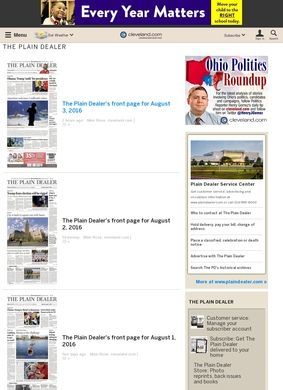
Is the Cleveland Plain Dealer still a newspaper a reader can hold in two hands, or has it quietly become a website wearing an old masthead? The honest answer sits somewhere in between. The Cleveland Plain Dealer is the long-running daily paper of Cleveland, Ohio, and it still publishes, but most of its journalism now reaches readers through the affiliated site cleveland.com, and the printed edition has trimmed its schedule over recent years. Anyone picturing a fat daily thumping onto the porch every morning is picturing an earlier version of it.
What the paper covers has changed far less than how it arrives. The Cleveland Plain Dealer reports local and regional news, sports, business and entertainment, the standard range of a metropolitan daily tied to one city and the counties around it. For a reader following Cleveland city hall, the local teams, or which restaurants and businesses are opening and closing downtown, this remains one of the primary places that reporting actually gets done, whether the story is read on newsprint or on a phone.
The sports coverage alone carries a city that lives and dies by its teams, and the business and entertainment desks fill in much of what a local reader checks from one day to the next.
The move toward cleveland.com is the defining fact of the modern Cleveland Plain Dealer, and it cuts two ways. The digital operation keeps the reporting current in a way a once-a-day print run never could, with stories updated through the day as they develop. It also means the website is where the audience and the advertising now sit, while the printed edition has become the smaller partner in its own name. The cost is that the print product, the thing many longtime subscribers actually want, has turned into a slimmer and less frequent object.
Someone signing up expecting the old daily habit needs to know that upfront, because the brand name promises a continuity the physical paper no longer fully delivers.
For all that, the Cleveland Plain Dealer still functions as the paper of record for a major American city, the outlet other local media and national reporters tend to cite when a Cleveland story breaks. That role is not a small thing. A city without a strong daily loses the beat reporters who sit through the zoning meetings and read the court filings nobody else will, and this paper, in print and through cleveland.com, is still doing a version of that work.
Some of that comes down to regional reach. Cleveland anchors a metropolitan area that spills across several counties, and a daily covering that spread takes on the civic role of being the common reference point, the place a school board decision or a county corruption case first gets written up at length. National outlets parachute in for the marquee story and leave; a local daily is what stays on the smaller ones that never make the network news. Whatever the print schedule now looks like, that function is the strongest case for the Cleveland Plain Dealer's continued existence.
It is easy to place as an institution, too. The Cleveland Plain Dealer has long operated from a headquarters on Superior Avenue in downtown Cleveland, and that location turns up on outside business listings that file it under print media. For an organization this well established, being findable and identifiable is a given, so the transparency worry that dogs smaller or newer outfits barely applies here. A reader can find out who publishes it, where they sit, and how to reach the newsroom, which is more than can be said for plenty of sites trading in local news today.
What the ratings really measure
Search for the Cleveland Plain Dealer and the scores that come back are measuring several different things at once, which is exactly why they need pulling apart before any single one of them means much.
Some rate the customer experience of the Cleveland Plain Dealer, one rates it as a place to work, and others rate the journalism on its own terms. Blend them together and the result is a number that describes nothing accurately.
Delivery gripes and workplace reviews
The consumer-facing figures are not flattering. PissedConsumer carries 73 reviews of the Cleveland Plain Dealer at an average of 2.0, with a recurring theme of delivery problems, and Yelp adds roughly 60 reviews in a mixed-to-critical tone. Read them closely and most are complaints about service: papers that never arrived, billing snags, the whole business of getting a physical edition onto a doorstep.
They say little about whether the reporting inside is any good. Consumer review sites skew toward the aggrieved by their nature, since a subscriber whose paper lands on time every morning has no reason to log on and rate it, so a 2.0 average is better read as a sign that the service side has a genuine problem than as a precise grade on the enterprise.
Even allowing for that skew, though, delivery complaints turning up again and again across two separate platforms is a pattern, and patterns are worth believing. A separate pool of reviews on Indeed, 19 on one name variant among several the paper is listed under, comes from employees rating the Cleveland Plain Dealer as a workplace, and that sentiment lands mixed as well. Three different lenses, and not one of them is actually looking at the journalism.
Bias and factual reporting
The measures aimed at the journalism tell a steadier story. Media Bias/Fact Check places the Cleveland Plain Dealer at LEFT-CENTER on its scale, scoring the bias at -3.3, a moderate lean well short of either edge, and rates its Factual Reporting as HIGH, a 1.0 on the same outfit's accuracy measure.
That factual mark is the one I would weight most heavily for any news source, because a paper can carry a political tilt and still report accurately, and a HIGH rating says the facts tend to hold up under checking. AllSides keeps a media-bias rating for the Cleveland Plain Dealer as well, though flagged at low or early-stage confidence, which means it reads as a provisional signal instead of a settled judgment.
So the Cleveland Plain Dealer sits in an odd double position. Its journalism is rated factually high and only mildly slanted, while its customer reviews keep flagging late papers, billing trouble and missed deliveries. One set of numbers describes the reporting on the page; the other describes whether the page ever showed up on the porch.
Someone weighing a subscription for the journalism is reading a different scorecard than someone who just wants a paper delivered without a fight. A reader trying to judge the Cleveland Plain Dealer has to hold those two facts side by side and let neither one stand in for the whole.