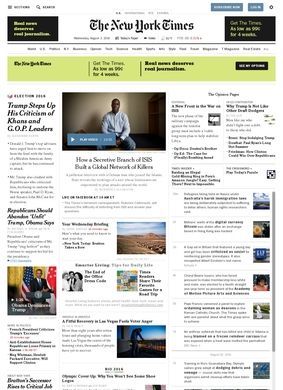
When a push alert lands at 6 a.m. and the headline leaves more questions than it answers, The New York Times is the site most people reach for next. That habit goes back to 1851, and 175 years is a long time to work out how to present a complicated story without losing the thread. The homepage opens onto breaking coverage that runs from Washington politics to international affairs, then continues past the obvious beats into business, technology, science, and health. A reader who arrives for one story tends to stay because the next one is already framed and waiting.
Breaking news and daily coverage
The reporting is the backbone of everything here. International desks file alongside U.S. national coverage, and The New York Times carries the staffing that lets it put correspondents on a story for weeks rather than chase a single news cycle. Politics gets the most visible weight, but the arts, style, food, and travel sections run with the same editing standards as the front-page material. Sports has its own home through The Athletic, which the paper folded in and gave room to operate independently. The science and health writing is some of the most reliable on the open web, partly because it explains methodology rather than just relaying a conclusion lifted from a press release.
Digital formats built for screens
On a fresh pass through the site, what becomes clear is how far The New York Times has moved from being a newspaper that happens to have a website. The opinion and editorial pages still sit where you expect them, distinct from the news desks, and they host columnists across a fairly wide range of argument. Underneath that is a layer of formats built specifically for the screen. Live news briefings update through the day on fast-moving events. Newsletters cover narrow subjects and land in your inbox on a schedule you choose. The interactive graphics and data journalism turn election returns, climate figures, and budget breakdowns into things you can actually read without squinting at a dense table.
How does The Daily podcast work?
Podcasts are a real part of the operation, not a side hobby. "The Daily" anchors that effort, a morning show that takes a single story and gives it twenty minutes of context, drawing reporting straight from the newsroom. Audio, text, graphics, and email all draw on the same original work, so a story you read in the morning might reach you again as a podcast segment or a newsletter note with a different angle. The archives stretch all the way back to the founding, which means The New York Times doubles as a record of more than a century and a half of how events were reported as they happened.
Subscription tiers beyond news
The business model is plain on the page. Print still exists, but the digital subscription is the engine, and The New York Times splits it into tiers that reveal where the company has placed its bets. There is a News-only tier for people who want the journalism and nothing else. Above it sits NYT All Access, which bundles in everything the company has acquired or built over the past decade. That is where the breadth becomes obvious.
Games, recipes, sports, reviews
The bundle pulls in Games, home to Wordle and Spelling Bee, which arguably draw in a wider audience than the news itself. Cooking carries thousands of recipes with a proper search and saving system. Wirecutter handles product reviews and recommendations, the buy-this-not-that research most people would otherwise piece together from a dozen browser tabs. The Athletic supplies the deep sports journalism. None of these started as a newspaper feature, and the decision to stitch them into one account is the clearest indication of how The New York Times now thinks about itself: a daily habit with several doors in, where the news is one room among many.
Entry points for different readers
For a professional or an institution, the calculation is different from a casual reader's. The depth of the politics and business coverage, plus archives that stretch back generously into the historical record, make The New York Times a working reference as much as a morning read. For a general consumer, the bundle is a bet that you will open the app for Wordle and stay for a budget analysis, or come for a recipe and drift into the international section. The products are structured so that almost any entry point eventually exposes you to the rest.
Apps, sites, mobile first design
The app is on both iOS and Android and carries the full range: news, audio, games, cooking. The phone is clearly the primary surface The New York Times is building for, with the desktop site and print edition as the other two legs. The site itself loads cleanly and organizes a genuinely enormous amount of material without burying the day's lead, which is harder to pull off than it appears when a single homepage has to serve a sports fan, a recipe hunter, and someone tracking a foreign election all at once.
Reading across the whole offering, the throughline is that The New York Times treats reporting as the asset that justifies everything attached to it. The games and the recipes and the product guides are real services in their own right, but they sit on top of a newsroom doing original work, and that order is what holds the arrangement together. A reader who wants only the journalism can pay for that and ignore the rest. A reader who wants the whole habit can have it in one login. The catalogue is wide enough that two subscribers can use The New York Times for years and barely overlap in what they actually open.
Finding depth below the homepage
One thing worth naming plainly is the sheer volume. The breadth that makes The New York Times useful also means the homepage asks for some navigation; you do not stumble onto everything by accident, and a lot of the strongest material, the data pieces, the long investigations, the back-catalogue from the archive, lives a click or two below the surface. Someone who only ever reads the top of the page gets a good newspaper. Someone who explores the sections, the newsletters, and the bundled apps gets something closer to what the subscription is actually paying for. The reporting is solid either way, and the rest is there when you go looking for it.