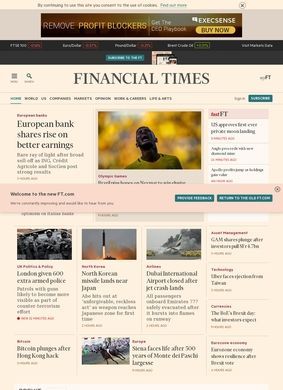
A currency lurches, a takeover breaks overnight, a central bank says something deliberately opaque, and a reader needs more than a headline to work out what it means for their money or their job. That is the moment the Financial Times is built for. Its whole homepage points at markets, economics, and politics, and it reads for the person who has to act on the news, not the one idly following it.
Whether that reader should pay for it is the harder question, and the answer turns almost entirely on who they are.
News, markets, and the daily read
The core of the Financial Times is what the name promises. The World section runs breaking international news across Europe, Asia, the Middle East, and the Americas. Markets tracks global financial markets, corporate earnings, and digital-currency coverage. Financials and Companies handle company-level news and sector analysis, while Tech and Climate carry the two themes reshaping most balance sheets. A reader gets a full daily paper here, weighted hard toward business.
The weighting is the point. Business and finance lead, and the world and political coverage is there in large part to explain what moves the markets the Financial Times built its name on. A general daily buries this material a dozen pages in; here it is the front of the house.
The global spread is real. The correspondents feeding the World section mean a story out of Tokyo, Frankfurt, or Washington arrives with reporting attached, not a rewritten wire snippet. Readers whose interests cross borders get the difference between knowing a thing happened and understanding why it matters where the money sits. Tech and Climate get their own sections because both now drive corporate results as directly as interest rates do.
Markets, Lex, and the numbers
For readers who live in the figures, the depth sits in a few named features. Lex is the paper's short, sharp investment column, the tightly argued take a busy investor tends to read first. The Markets section supplies the earnings and currency coverage underneath it. There is even a Stock Picking Game, a lighter feature that lets readers test their calls without real money on the line. Taken together, this is the part of the Financial Times that a finance professional opens every morning.
Digital-currency coverage sitting inside Markets is a signal the paper tracks where capital actually moves now, and the same section carries the corporate earnings that swing individual stocks. A subscriber checking one company before a trade can usually find the paper's read on it, which is a large part of what the money buys.
Where Opinion and The FT View differ
Commentary is a distinct pillar. The Opinion section carries signed columns, and "The FT View" is the paper's own editorial line, the institutional position rather than a single writer's. That split keeps house judgement separate from individual opinion, which helps a reader trying to gauge editorial consensus instead of one columnist's take. Agreement with that line is a separate matter. The clarity about which is which is the real strength.
Beyond the business pages
The Financial Times is wider than its reputation suggests. Life & Arts covers culture, and "How To Spend It" is the luxury and lifestyle strand aimed squarely at readers with money to move. Special Reports go deep on a single country, industry, or theme, and strands such as FT Wealth dig into how large fortunes get managed.
Those Special Reports are a format worth understanding on their own. Instead of one article, each gathers a cluster of pieces on a single subject, closer to a briefing pack than a news story, and a reader researching a market before a decision can lean on the whole set. FT Wealth is the clearest case, written for people whose problem is managing money rather than making more of it.
None of this reads as filler. It is the paper acknowledging that its audience does more than trade, and it rounds out a subscription that would feel narrow on markets alone. Someone who signs up for the earnings coverage may stay for the long-form Special Reports the Financial Times keeps producing.
The subscription question
Here the honest caveats arrive. The Financial Times runs on a "Subscribe / Sign In" model, which means most of the substance sits behind a paywall. A non-subscriber sees headlines and fragments, and I found the wall goes up fast, well before the good analysis begins. This is a paid product, priced for professionals and expensed by a great many of them, so a casual reader hunting for free breaking news will meet that barrier within a click or two.
Ownership sits with Nikkei, the Japanese holding company, and the paper is produced in London in both broadsheet and digital form. That backing gives the Financial Times the resources for the global bureau reporting the World and Markets sections lean on, which is part of why the coverage holds its weight against cheaper competitors.
The pricing is not casual, and the Financial Times makes no pretence that it is. Access comes in tiers, and the worth of any of them scales with how often a reader truly needs what sits behind the wall. A daily user working in the markets recovers the cost fast. An occasional reader is largely funding the correspondents whose reporting they will rarely open, which is a fine thing to bankroll but a thin way to spend a personal budget.
The verdict splits cleanly by reader. Finance, business, and policy work built around analysis someone needs to act on makes the Financial Times close to essential, and the subscription can pay for itself on a single good decision. Free daily headlines are a different need entirely, and chasing them here runs straight into a paywall that frustrates more than it informs. The paper knows exactly who it serves, and it charges them without apology.