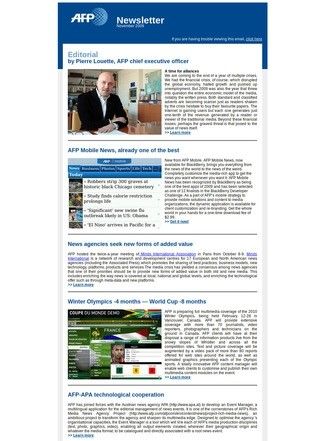
What sits at this address is a frozen moment from late 2009: a single English-language client newsletter issue from Agence France Presse: Newsletter, not a sign-up form or a running publication you can subscribe to today. Anyone arriving expecting to enter an email and start receiving updates will find instead a snapshot of how one of the world's three largest news agencies talked to its media partners more than a decade ago. That gap between what the listing implies and what the page delivers is the first thing worth being clear about.
An archived newsletter from late 2009
The publication the Agence France Presse: Newsletter belonged to was an internal-facing trade bulletin, written for the broadcasters, papers, web portals and institutions that buy AFP's wire output. It is less a reader newsletter and more a briefing aimed at the people who pay for news feeds and want to know what the agency is building next. Reading it now, the value is mostly historical: it captures the priorities of a Paris-based wholesaler of news during a genuinely rough stretch for the industry. The tone is brisk and unsentimental, the tone of an organisation reporting to clients rather than wooing the public.
That mood comes through immediately in the lead editorial of the Agence France Presse: Newsletter, written by AFP's then chief executive Pierre Louette. He addresses the economic crisis bearing down on media companies and argues, in effect, that news has a real cost and a real value that the market was busy forgetting. It is a defensive, slightly anxious piece, which makes it more interesting than the usual house cheerleading. You are reading a senior executive worried out loud, in print, about whether anyone would keep paying for the work his agency produces.
AFP Mobile News and product development
Around that editorial sits a run of product and operational news that tells you what AFP was betting on. The standout is AFP Mobile News, a BlackBerry application offering customizable multimedia coverage, pitched at clients who could re-brand it as their own and sold as a one-time download for $2.99. The detail of the price and the re-branding option is what makes the entry worth reading. It shows an agency trying to push its content past the wire and onto the handsets readers were starting to carry, at a moment when the BlackBerry still looked like the future of mobile.
Cooperation through Minds International
The issue also reports on a meeting of the Minds International Association, a network of seventeen European and North American news-agency research and development centres, with The Associated Press among the members. For anyone curious about how wire services share technical groundwork instead of each reinventing it, this passage opens a concrete window. The Agence France Presse: Newsletter treats that cooperation as ordinary business, which itself says something about how these organisations operate behind the scenes.
Coverage plans for Vancouver Winter Olympics
A large chunk of the Agence France Presse: Newsletter goes to advance planning for the 2010 Vancouver Winter Olympics. AFP describes deploying more than seventy journalists, photographers and technicians, and packaging a video offering of over eighty reports alongside animated graphics and a multimedia content manager aimed at web clients. This is the part of the issue where the agency's scale becomes tangible. Covering a Games is a logistics problem as much as a journalism one, and the issue lays out the headcount and the deliverables in the matter-of-fact tone of an organisation that does this routinely.
Multimedia workflows and rich media integration
Two more items round out the technical picture. One covers a cooperation between AFP and APA on a multilingual Event Manager application, software meant to link text, photo, graphics and video production into a single workflow, framed as part of AFP's Rich Media News Agency Project. The other notes the agency's involvement with the TARA Oceans scientific expedition, a reminder that a wire service also chases long-form, image-heavy stories well outside the daily news cycle. Taken together, these entries in the Agence France Presse: Newsletter show an organisation thinking hard about converging its formats years before that became standard talk across the industry. The recurring theme is integration: pulling text, stills, graphics and video into one production line so that a single event could be sold to clients as a complete package instead of scattered parts.
For all that substance, the reader should keep the format in mind. This is one archived issue, dated and self-contained, covering the concerns of a single month. It does not lead anywhere current. The Agence France Presse: Newsletter as preserved here will not tell you what the agency is doing now, what its present products cost, or how to receive future editions. It is a primary document, useful for what it records, not a doorway to a live service.
That said, the Agence France Presse: Newsletter reads well on its own terms. The writing is clear and specific, the product entries carry real figures, and the editorial has a point of view instead of empty positioning. AFP itself needs little introduction: a global agency distributing news in several languages to media outlets, governments and institutions worldwide, with reach into regions where most rivals have a fraction of the coverage it deploys. The issue is a credible artifact from exactly that kind of operation, and nothing in it reads as inflated.
Value as historical source material
Where the Agence France Presse: Newsletter holds value today is as source material. A media-studies student tracing how news agencies responded to the 2009 downturn will find a dated, attributable account straight from an executive's desk. A journalism historian curious about early mobile-news experiments has the BlackBerry app, its price and its re-branding model laid out plainly. Someone studying Olympic media operations gets concrete numbers on staffing and output for Vancouver. These are narrow audiences, but for each of them the page is genuinely useful, precisely because it is dated and specific rather than a summary written after the fact. Primary sources like this, written in the moment without the benefit of hindsight, give researchers an anchored account that later retrospectives cannot replicate.
How wire services speak to their clients
The Agence France Presse: Newsletter is also an instructive case study in how a wire service markets itself to its own buyers, which differs sharply from how it presents to the public. The candour about the economic crisis, the talk of shared R and D through Minds International, the push toward unified multimedia workflows: these are the conversations a content wholesaler has with its clients, and they rarely surface in the finished news that readers eventually see. Catching that backstage register is part of what makes the issue worth close attention.
Using this archived issue as reference
Subscription is not on offer here. What the page preserves is a fixed, citable record of AFP's product and editorial thinking from late 2009, and that is what gives it a use case. Read the Louette editorial first for the framing, then work through the Mobile News and Vancouver entries for the hard detail. Cite the issue by its date so the snapshot stays anchored to the moment it captures. For everything current about the agency, this is a starting point, not a destination.