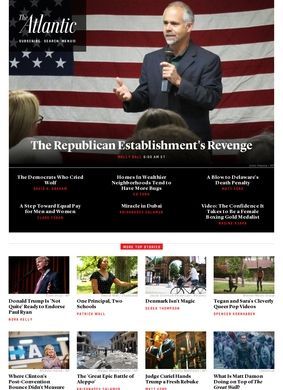
More than a century and a half of monthly print stands behind The Atlantic, and Atlantic Online is where that title now runs as a daily operation instead of a bound archive. The site carries the full print journalism alongside a steady feed of web-first reporting, and a single subscription opens both the print edition and the complete run online.
A magazine running as a daily site
The homepage doesn't lead with a single cover story. Instead it opens on a moving current of pieces, which signals that the web has become the main floor here, with the printed issue just one product among several.
PressReader describes the title as rigorous journalism, in-depth analysis and commentary on politics, culture, technology and global affairs, and Atlantic Online's own remit lines up with that description. A "Latest" section gathers recent articles across every category, so a first-time visitor sees the working mix without guessing which vertical to open first. That single aggregated stream does real work, because the range sitting underneath it is wide enough to confuse a cold visit.
Atlantic Online is trying to be a daily news read and a monthly essay collection at the same time, and the Latest feed is the seam where those two ambitions meet. It mostly holds, though a reader who wants only the long-form pieces has to dig for them under the churn of shorter items.
How the verticals divide the coverage
The section map runs deep, and it splits along lines any longtime reader would recognize. Politics sits up front, and culture and technology each carry a large section of their own, with science, health and global reporting getting dedicated space beside them.
Atlantic Online splits its two biggest verticals in noticeably different ways: politics built for granular tracking, culture and science stretching wide enough to include photography and audio alongside straight text. Each gets a closer look below.
Politics, from Congress to the campaign trail
The politics vertical breaks into President, Congress, House of Representatives, Senate, Elections and Policy, a finer split than the average news site bothers to build. Someone tracking a single chamber or one race can stay in a narrow lane instead of wading through a general politics river, and that granularity is genuinely useful during an election cycle.
A World Edition and broader global coverage sit alongside it, so the political reporting reaches past Washington. This is where Atlantic Online plainly places its weight, and the structure rewards a reader who already knows what they are after.
Culture, science and the visual turn
Culture spreads across movies, books, television, music, sports, art, food and design, a wide beat for one heading to carry.
Technology coverage runs to the day's headlines, with recent pieces touching Apple's AI pricing and the San Francisco "hacker houses" that keep drawing press. Science and health close out the written categories, each with enough room to run long features instead of quick hits. The technology beat in particular reads as current rather than evergreen, tracking the industry week by week, a different job from the reflective cultural essays a few clicks away. Holding both registers under one masthead is part of what Atlantic Online is selling.
Per Wikipedia, Atlantic Online has pushed into visual storytelling through the "In Focus" photo blog and added podcasts and video beside the written work. The site is a genuine mix of formats, then, and a visitor who never opens the printed magazine still has articles, audio and photography to move between. My sense is that the photo work is the piece most likely to surprise someone who pictures the title as text and nothing else.
What the subscription opens
The core pitch on Atlantic Online is unlimited access to all of The Atlantic's journalism, in print and online, behind a paid subscription. That is the trade the site asks every visitor to weigh, and it makes the free experience feel like a lobby more than a library.
Open browsing gets a reader the headlines, the section structure and a fair sense of the range, but the reporting the title built its name on sits behind the wall. None of this maps onto a typical business directory entry with a phone number and a star rating; the currency here is a subscription, and the question is how much journalism a reader can reach before paying for it.
For someone who reads political analysis and long-form culture writing week in and week out, Atlantic Online covers enough ground across enough verticals to justify the cost without much argument. For a casual visitor who lands on one piece a month, the case for paying looks a lot weaker, and the front page does little to make it before asking for a card.
There is also the question of how the multimedia holds up over time. Photo essays and podcasts are cheap to promise and expensive to keep good, and what shows on the surface is the ambition, not whether the cadence stays high once the novelty fades.
The open question is how much of the depth a non-subscriber ever actually reaches. The verticals are broad, the format mix spans text, photography and audio, and the politics section in particular is built with unusual care. Yet the parts that separate Atlantic Online from a fast-moving wire feed are the ones the paywall keeps out of view, and whether that trade lands well depends entirely on how often a reader means to come back.