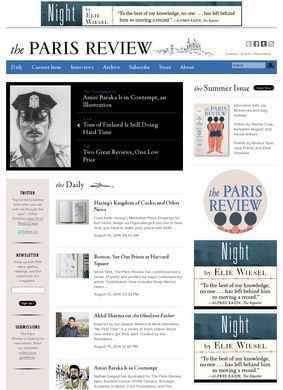
Founded in 1953, The Paris Review is a quarterly American literary magazine, and its website is the digital home for the same body of work that has been appearing in print for seven decades. Entry points are the current issue (number 256) and a deep archive of back issues, both reachable through a clean reading interface. What sits underneath that surface is worth describing in some detail, because the site is less a promotional shell for the magazine and more a working library of fiction, poetry, essays, and visual art the publication has gathered over its history. Visitors expecting a typical media outlet will find the depth here is of a different order entirely.
The Writers at Work interview archive
The signature draw remains the Writers at Work interview series, which The Paris Review pioneered and has kept running with major literary figures across generations. The site gives full access to that archive, and reading through it is closer to study than to casual browsing. These are long conversations about craft, process, doubt, revision, the actual labor of putting sentences together, and having them collected in one searchable place is genuinely useful to anyone who writes or teaches writing. The Paris Review has run early or important work by Philip Roth, Jack Kerouac, Yan Lianke, and Chigozie Obioma, among many others, which gives some sense of the editorial reach across both American and international writing. The interviews alone are worth returning to more than once; the archive of them has no real equivalent elsewhere.
Faster pace of The Daily's columns
Alongside those interviews, The Daily is where the site moves at a faster clip. It is an ongoing stream of columns and editorial commentary, distinct in rhythm from the quarterly cadence of the print object, and it carries the kind of shorter, looser writing that does not fit a numbered issue. The columns vary in subject and voice, which keeps the thing from settling into a single house style, and the editorial pieces give the publication a present-tense pulse that a print archive alone could not. Between issues, The Paris Review stays alive through The Daily, and it is the part of the site most likely to pull you back on a Tuesday afternoon for no particular reason.
Podcasts and poem breakdowns
Beyond the written work, The Paris Review has built out a fair amount of supporting material. There is audio and podcast content, an authors directory that lets you trace a single contributor across issues, and art and photography features that treat the visual work as something to look at properly instead of decoration around the text. The Making of a Poem series is a smart inclusion: it takes a single poem and walks through how it came to be, which is the sort of close attention that pairs naturally with the interview archive. For a reader who wants to understand what was written and how, those two strands reinforce each other in a way that most literary sites never attempt.
Running the magazine's practical operations
The site also handles the practical machinery of running a literary magazine in the open. There is an online store selling back issues and merchandise, magazine subscriptions, and a newsletter signup for people who want the lighter touch of email over a paid commitment. An events calendar tracks readings and gatherings, and a submissions portal opens the door to contributors who want their own work considered. Those two features matter because they show The Paris Review still functions as a living venue rather than an archive frozen in place. The Paris Review also carries donation options and an employer matching gift program. Writers can send work in; readers can show up in person.
How does the magazine fund itself?
That institutional side is not hidden. All of it sits in plain view alongside the editorial content; a reader who wants to understand how the magazine sustains itself will find the information directly. That transparency about funding sits quietly alongside the editorial work without making a fuss about itself.
Community discussion across the web
The Paris Review has an established presence across the web, with reader and subscriber discussion spread across literary communities, Reddit threads on craft and reading, and social media where individual interviews and poems circulate widely. Formal platform review counts are sparse for a publication of this type, which is normal for a literary magazine rather than a consumer service. What exists is almost uniformly positive, with the Writers at Work archive cited repeatedly as a resource people return to over years. The absence of a large Yelp or Google review pool says nothing about quality; it reflects the kind of audience the publication attracts, one that discusses books in newsletters and forums, not on star-rating platforms.
If there is a fair caution to raise, it is that the depth can be intimidating. This is not a quick-hit site you skim in five minutes and leave. The archive rewards time, and a first-time visitor without a specific writer or interview in mind may feel slightly adrift in the sheer volume of material. That is a consequence of seventy years of accumulated work, so it reads more as abundance than as a flaw, but it does mean the site serves the committed reader better than the casual passerby. The search and the authors directory help considerably, and using one of them as an entry point makes the whole archive far easier to navigate.
Comparing The Paris Review to The New Yorker
Weighed against something like The New Yorker, which also publishes ambitious fiction and poetry, The Paris Review trades broad cultural reach and weekly volume for depth and a single-minded focus on imaginative writing and the craft behind it. The New Yorker folds its fiction into a much wider magazine of reporting, criticism, and humor; The Paris Review keeps the literary work at the center and builds everything else around that core, the interviews, the poem breakdowns, the daily columns. Writers looking to study craft through the archive will get concentrated value here. Poets, students, and teachers will find it an unusually rich teaching resource. The global contributor base means the writing is not narrowly American despite the magazine's origins, and the interview series in particular has earned its reputation over decades of consistent editorial work.