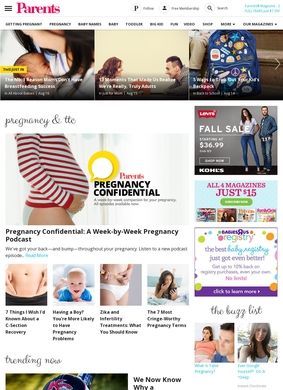
What does a parenting magazine give a new mother or father that a quick web search does not? Parents Magazine answers with curation: pregnancy and baby guidance, family health, children's activities and child-development content, gathered and edited into one place instead of scattered across a hundred competing blogs. The brand runs in print and online at Parents.com, and it has been a fixture of American family media for long enough that most parents recognize the name before they read a word.
Curation is the whole promise here, and whether it holds up is the question a prospective reader is really asking.
One honest caveat comes first. During this review the website would not load. A direct fetch failed, and a fallback attempt returned a server error, so nothing here rests on reading the Parents Magazine site firsthand. Everything below is assembled from third-party descriptions and reader reviews, which is a real limitation for a publication whose value lives in the articles themselves.
A reader trying to open a page during the same window would have hit the same wall, a small mark in itself, though one failed load says little about a large site's long-run reliability. What it does mean is that the specifics of sections, tools and bylines could not be verified here.
What the magazine covers and how readers grade it
Parents Magazine sits in a crowded, durable category. Parenting media is one of the steadiest niches in publishing, because every new parent arrives anxious, sleep-short and hungry for answers, and a trusted editor promising vetted guidance has a clear pull on that reader. The wider web has made raw information free and endless, which sounds like it should have killed the parenting magazine, and instead it raised the value of a filter: someone to sift the noise and hand a parent a shortlist.
The long presence of Parents Magazine gives it name recognition that a fresh blog cannot buy, and at two in the morning a familiar masthead carries a reassurance of its own. That reassurance is an asset. It is also a responsibility, because a reader who trusts the name will trust the advice, and the advice is where the harder questions begin.
Because the live site stayed dark throughout this review, the usual checks on contact, a phone line, a contact page, an address, a form, could not be made for Parents Magazine firsthand, so this review cannot speak to how reachable the publication is. For a national title that is a lighter concern than it would be for a corner shop a customer needs to phone, since the exchange with a magazine runs mostly one way: the reader consumes and the publisher publishes.
A magazine's credibility rests far more on its editorial standards than on a working phone line, and that is the ground the rest of this assessment is fought on. The point about contact is left open rather than scored either way.
Advice, activities and coupon pages
The content, going by third-party accounts, spans the parenting lifecycle. Pregnancy and baby topics for the early scramble, family health for the years after, and the children's activities and developmental material a parent digs for on a wet afternoon when the kids are climbing the walls. Parents Magazine covers the arc from expecting a first child through the school-age years, which is exactly the stretch its readership lives through.
Developmental content in particular has a long shelf life, because the milestones of a two-year-old do not change from one year to the next, so a well-written guide stays useful on a parent's screen for years. That repeat usefulness is the practical case for keeping one source on hand instead of hunting a new site for every stage.
A subscription reviewer of the print edition singles out its coupon pages, a small detail that says something true about the model. Parents Magazine has always been a commercial product as much as an editorial one, carried by advertisers who want a direct line to families with money to spend on strollers, snacks and school clothes. That is no criticism. It is the economics of the format, and the reader gets discounts and articles bound into the same issue, which some parents value and others flick straight past.
The coupon pages also place the brand in a longer tradition, back to when a magazine was a physical object a parent clipped from, and that print heritage still shapes what lands in the mailbox.
One point needs separating out cleanly, because it is easy to run the two together. A related "Parents' Magazine" book imprint has published children's books, catalogued on Goodreads, where they hold a 3.78 average across 88 ratings. Those ratings belong to the books, not to the website or the magazine, and reading that figure as a grade for Parents Magazine the publication would be a mistake. I flag it only because the shared name invites exactly that confusion, and a careful reader should hold the two apart.
Scores that pull in different directions
Reader ratings for Parents Magazine are genuinely mixed, and the mix itself is the most useful thing to take from them. On SheSpeaks the brand sits at 4.2 out of five, with 86 percent of reviewers saying they would recommend it, a warm result on a reasonable sample. Sitejabber runs a shade lower at 3.8 from 16 reviews, still solidly positive. Influenster carries reviews without a clear aggregate, and MagsConnect, a Canadian outlet, gathers generally favorable comments about the parenting content and the activity ideas. Across the upper and middle of the scale, the balance leans the magazine's way.
It helps to know what those platforms are. SheSpeaks and Influenster are product-sampling communities, where members receive items to try and tend to review warmly, which nudges their averages upward. Sitejabber and PissedConsumer draw a different crowd, often people moved to write by a subscription or billing snag, which pulls the other way. None of that makes a single score wrong, but it explains why the numbers attached to Parents Magazine sit so far apart.
Sixteen reviews on one site and two on another are not the same kind of evidence, and treating them as equal is how a reader talks themselves into the wrong impression.
Then one corner collapses. PissedConsumer shows a 1.5 out of five, though from just two reviews, a sample far too small to weigh against the broader, warmer counts. A split this wide, high on SheSpeaks, respectable on Sitejabber, dismal on a two-person PissedConsumer sample, tells a reader what a single blended average would bury: experience with Parents Magazine varies enough that the impression you form depends heavily on which platform, and which few reviewers, you happen to read first. That is a reason to read the reviews themselves, not the averages alone.
One assessment sits apart from the consumer stars and matters more than any of them. Media Bias/Fact Check rates the outlet's editorial slant as left-of-center and its factual reliability as mixed. That is a bias-and-accuracy judgment, not a customer review, and it lands hardest on the health and developmental material, the very content a parent is most likely to act on.
A mixed reliability rating is fair reason to treat medical or developmental advice from Parents Magazine as a well-informed starting point to confirm with a pediatrician, not a settled answer to follow blind. For lighter fare, activity ideas, recipes, general encouragement, the stakes are low and the concern barely registers.
So the verdict splits along what a reader wants Parents Magazine to be. As a broad, friendly, one-stop sweep of parenting advice and activities, the warmer ratings suggest it delivers what most readers came for. As an authoritative medical reference to lean on without a second opinion, the mixed reliability mark and the scattered reviews argue for care. Neither answer is wrong; they simply describe two different uses of the same publication, and the reviews above give enough to judge each on its own terms.