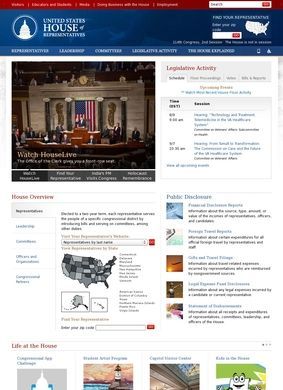
Someone wants to email their congressman about a bill, or find out who actually represents their neighborhood, and they have no idea where to start. The U.S. House of Representatives site answers that on the front page with a Find Your Representative tool: type in a zip code, and it points you to the right member, their personal website, and their contact form. It is a small thing, but it is the question most ordinary visitors arrive with, and the site does not bury it.
Finding your representative
From there the site opens into the working machinery of the chamber. A full directory lists every sitting member, each with a profile page. There is a Leadership section that names who holds which post, and a committees area covering the standing, select, and joint committees, along with their schedules. Hearings and markups are posted in advance, which is genuinely useful for anyone tracking a bill before it moves rather than reading about it after the fact. That kind of forward calendar is the difference between watching the process and reading the aftermath.
Legislative activity tracking
The Legislative Activity pages are where researchers and reporters get the most out of the site. Floor proceedings, recent votes, a bills and reports tracker, and committee schedules sit together, updated as the chamber works. Paired with the Watch Live feature, run through the Office of the Clerk, a person can follow debate in real time on the U.S. House of Representatives site or pull archived video of past sessions. For the 119th Congress in session, the record is not a static archive but something close to a live feed of what the body is doing on a given day.
Civics education and tours
Not everything here is aimed at the policy crowd. The House Explained is a civics primer, walking through how a bill becomes law and offering background on the institution's history. It reads like material built for a curious citizen or a student who needs the basics straight, without the spin you get from secondhand explainers. There is a separate section for educators with lesson plans and a path to scheduling school tours, and the U.S. House of Representatives keeps a visitors area for anyone planning a trip to the Capitol, with guided tour information and practical details about getting in the door.
Media, business, employment resources
The U.S. House of Representatives also keeps doors open for groups most people never think about. Journalists get a Media section with press resources and credentialing details. Vendors find a Doing Business with the House area covering procurement and contractor information. Job seekers can browse Employment listings for staff positions. None of these feel like afterthoughts; they reflect the fact that a legislative body is also a large institution that hires, buys, and deals with the press every day.
Official record and primary source
What makes the U.S. House of Representatives site worth bookmarking is that it is the primary source. Plenty of outlets summarize what Congress does, and some do it well, but the vote tallies, committee rosters, and floor schedules here come straight from the chamber itself, posted by the offices responsible for keeping them. When a secondhand account and the official record disagree, this is the page that settles it. For a student writing a paper, a constituent checking a representative's record, or a reporter confirming a committee assignment, that authority counts for a lot, and there is no third party standing between the visitor and the data.
Navigation challenges for newcomers
The breadth does come with a cost. The U.S. House of Representatives site covers so many audiences that a first-time visitor can feel a little lost choosing where to go, and some of the deeper legislative tracking assumes you already know the vocabulary of bills, markups, and floor procedure. The House Explained softens that for newcomers, but a sizable gap still separates the beginner material from the raw legislative data, and nothing on the site closes it for you. A casual visitor who only wants to find a representative will do fine; someone trying to follow a specific bill through committee may need patience, and probably a second tab open to look up the terms.
Site purpose and design
Judged on what it sets out to do, the U.S. House of Representatives website does the job. It is comprehensive, current, and organized around real tasks people actually perform, from contacting a member to watching a vote to scheduling a tour. It is not designed to be a pleasure to browse, and it does not try to be. The U.S. House of Representatives offers the official record and the tools to act on it. That purpose is narrow in one sense and enormous in another, and the site meets it without pretense, even if the experience asks a bit of effort from the visitor in return.