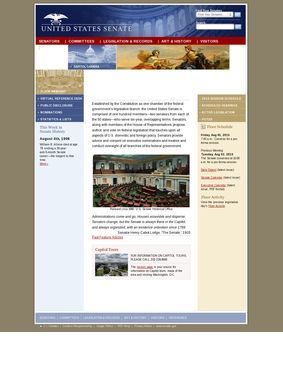
Type a senator's state into the directory at senate.gov and you get that person's office, a contact form, leadership role if any, and a thumbnail of facts about who they are and how long they have held the seat. That single feature, a clean roster of all hundred members organized by state, is the part of the United States Senate site most people actually need, and it works without fuss. From there the United States Senate fans out into something far larger than a contact book, and what fills that space is worth knowing about before you dismiss it as a routine government portal.
Searchable bills and roll call votes
The legislative material is the deep end. The United States Senate provides searchable access to bills, acts, and laws, plus nominations, treaties, and roll call votes recorded by name. The voting records alone make this a reference worth bookmarking, because you can trace how a given member voted on a specific question instead of relying on someone else's summary. Floor proceedings are covered in detail: a live webcast of activity on the floor, the Senate Calendar, the Executive Calendar as a PDF, a Tentative Floor Schedule, the Daily Digest, and the Congressional Record itself. The floor proceedings archive runs from 2014 to the present, which gives you a continuous trail to follow. If you have ever needed to verify a vote and only found secondhand newspaper accounts, the difference is significant.
Committee assignments and hearings
Committees get their own well-organized section. On the United States Senate site you can see full membership and assignment listings, find scheduled hearings and meetings, and read up on the history of each committee. For anyone tracking a piece of legislation, knowing which committee holds it and who sits on that panel is half the work, and the United States Senate puts both facts a click or two apart.
Explaining Senate powers and procedures
What surprised me, given how dry a government portal can be, is how much of the site is given over to history and explanation. There is a long section on powers and procedures that walks through the filibuster, cloture, impeachment, censure, expulsion, declarations of war, the treaty process, nominations, and how voting works. These are written as standing reference, not as news, so they hold up over time.
Origins of the chamber
The origins and constitutional foundations of the chamber are laid out, along with material on the historic buildings and spaces: the Capitol, the Senate Chamber, the historic rooms, and the office buildings. A reader who wants to understand why the institution behaves the way it does can find the procedural logic here in plain terms. The United States Senate does not hide the mechanics of its own operation, which is more than you can say for many official bodies.
Historical highlights on the Senate blog
The historical highlights stretch from 1787 to the present, broken out by era, and there is an oral history project alongside a blog called Senate Stories. That blog and the themed historical features turn what could be a static archive into something you can browse out of curiosity. There is also a searchable Art and Artifacts collection: fine art, decorative art, historical images, physical artifacts, and thematic groupings, with exhibitions and publications attached. It is an unexpected amount of museum-grade material to find on a chamber's official website, and it is genuinely interesting to dig through. The United States Senate has put real curatorial effort into this section, well beyond what a legislative body's web presence usually offers.
Research tools for primary sources
The research tools round things out. Educational resources are gathered in one place, and the United States Senate offers dedicated histories such as Women of the Senate and States in the Senate, plus a feature on the Senate Chamber Desks and practical visitor planning information for the Capitol. The records side includes rules and procedure, a landmark legislation archive, a list of the sessions of Congress, the Senate Archives, and public disclosure filings, so the formal paper trail is reachable without leaving the site. This is the layer most useful to students, researchers, journalists, and staff who need primary documents instead of secondhand accounts. It is also the layer that separates the United States Senate from a business directory or a news aggregator: the primary sources are actually here, not linked away to another system.
A crowded set of menus
If there is a weakness, it is the sheer breadth. The United States Senate site tries to be a constituent service portal, a live broadcast feed, a legislative database, a procedural textbook, a history museum, and a tourism guide at the same time. A first-time visitor can lose the thread, because the path to a roll call vote and the path to an art exhibition both start from the same crowded set of menus. The material is all here and it is authoritative, but finding the exact thing you came for sometimes takes more clicking than it should. A casual reader after a quick fact may feel the structure works against them, while a determined researcher will be rewarded.
The other thing worth saying is that this entry covers an institution, so what you read is the chamber's own account of itself. The procedural explanations and historical highlights are accurate and useful, but they are framed by the body they describe. That is fine for what most people use the United States Senate site for, which is locating a senator, pulling a vote, watching the floor, or checking a rule. It is simply worth knowing the vantage point when you read the longer historical and explanatory pieces.
Reading the chamber's own account
Set against most official portals, this one carries far more than the legal minimum. The combination of a working senator directory, named roll call votes, a live floor webcast, an archive going back years, and a deep stack of procedural and historical writing makes the United States Senate website a primary source rather than a signpost to one. The live webcast and the searchable vote records in particular are the kind of access that used to require a trip to Washington or a subscription to someone else's database.
The verdict is straightforward, with one caveat. As a reference for how the chamber works, who serves in it, and what it has decided, the United States Senate site is comprehensive and trustworthy. The navigation is the main friction: be ready to hunt through layered menus, and know roughly what you are after before you arrive. Students, reporters, and engaged citizens will find it close to essential. Someone who just wants a single quick answer may find it heavier than the question warranted, though the answer is almost always in there somewhere. On balance the United States Senate has built one of the more substantial government sites you will come across, dense enough to frustrate a quick visit but rewarding enough to justify a slow one.