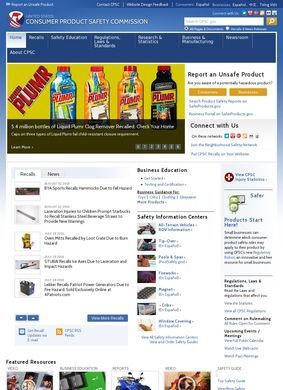
Where does a shopper actually go when they hear a crib or a space heater has been recalled? The US Consumer Product Safety Commission is the federal agency that answers that, and its site is built around exactly that need. The recalls section lists pulled products across a sweep of categories: toys, furniture, electronics, appliances, clothing, recreational gear and a long tail beyond those. Each entry tells a consumer what the hazard is and what to do about it. That is the practical core of the whole operation, and the site puts it close to the front.
Finding product recalls
Behind the recall notices sits the regulatory machinery. The US Consumer Product Safety Commission writes and enforces mandatory safety standards, issues bans where a product crosses into unreasonable risk of injury or death, and runs the rulemaking process that produces those rules. The site keeps a laws and regulations area for people who need the statutory text rather than the summary, alongside business guidance for manufacturers and importers trying to read what compliance demands of them. That dual audience shows in how the pages are split: one path for a parent checking a stroller, another for a company shipping a thousand of them.
Regulatory standards and enforcement
The data side is the part worth knowing about. Injury figures come through the National Electronic Injury Surveillance System, NEISS, which pulls emergency-room data into something researchers and the agency itself can act on. SaferProducts.gov is the more public-facing tool: a searchable database where consumers, healthcare workers, child care providers and government staff can both file reports on dangerous products and look up what others have flagged. It turns the US Consumer Product Safety Commission from a one-way publisher into something a member of the public can query and contribute to, which is a different thing from a static notice board.
Reporting systems for consumers
Product hazards do not respect language or expertise. The US Consumer Product Safety Commission publishes safety alerts, posters and educational guides in both English and Spanish, which widens the reach to households a single-language site would miss. The material is aimed at ordinary readers, not people steeped in regulatory language, so the safety education guides try to translate standards into plain advice a caregiver can use.
Safety information in multiple languages
The agency also reaches groups most sites in this space ignore. Child service providers and healthcare professionals get specific routes into the reporting system, recognising that the people who see injuries first are often not the buyers. These structural choices say the agency thought carefully about who is actually trying to reach it, and from what angle.
There is also a layer most casual visitors never see. The US Consumer Product Safety Commission works at ports of entry through its EXIS program, inspecting imported goods to intercept non-compliant products before they reach store shelves. It develops voluntary standards in coordination with industry, a slower and more negotiated track than outright mandates. And it runs outreach educating manufacturers abroad on what US regulation requires, which is the agency trying to fix problems upstream rather than catching them at recall stage.
For a researcher, the research and statistics section is where the US Consumer Product Safety Commission does some of its quieter but more durable work. Injury data collection, surveillance figures and the studies built on them give journalists, academics and policy people primary numbers to work from. The About CPSC section fills in the structure: an independent regulatory agency operating under statutory authority, which is worth understanding when you are trying to gauge what a notice from it actually carries.
The site does a lot, and the breadth is its strength, but it is also where things get complicated. A recalls feed, a regulatory library, a public reporting database, research statistics, business compliance guidance and bilingual education material all live under one roof. Each is solid on its own. The US Consumer Product Safety Commission has to serve a panicked parent and a customs broker and a public-health researcher from the same set of pages, and those readers want very different things at very different speeds. The architecture tries to accommodate all of them at once, and the strain shows in navigation that asks you to know which section you belong to before you start.
The honest open question is not whether the US Consumer Product Safety Commission has the information. It plainly does, in depth, across more product categories and audiences than almost any single source could match. The doubt is whether someone arriving in a hurry, worried about a specific item in their home, can cut through the regulatory scaffolding fast enough to find the one recall notice that sent them looking. A site this comprehensive risks burying its most urgent function under everything else it carries, and whether the US Consumer Product Safety Commission keeps that urgent path clear is the thing worth watching.