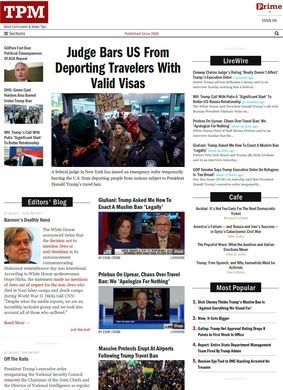
Talking Points Memo occupies an unusual position in U.S. political media: it has been around since 2000, it runs a paid membership program instead of chasing programmatic ad revenue, and it does not pretend to be neutral. Josh Marshall founded the site during the 2000 Florida recount, and Talking Points Memo has spent the years since covering congressional and executive-branch fights past the first news cycle, often in more depth than wire-dependent outlets ever attempt. The directory listing for it landed here, and a closer look at the site itself is worth the time.
Section labels map to editorial functions
The content structure is more specific than a generic news homepage. The Editors' Blog is where staff analysis runs, the kind of running commentary on a developing story that rewards reading over several days. Muckraker is the investigative section, where longer reported work appears. Cafe handles opinion essays, kept distinct from the news desk. Morning Memo and Where Things Stand are the daily and evening newsletter briefings respectively, and The Weekender covers the gap at week's end. The Franchise focuses specifically on voting and elections, a beat that Talking Points Memo tracks year-round instead of only in election cycles. Features holds the long-form work. Each label maps to a real function instead of a cosmetic site division, and that specificity reflects a publication that has had time to develop a deliberate editorial architecture.
Newsletters set the reading pace
The audience this presupposes is someone already paying close attention to politics and looking for the next layer of analysis, not a casual reader wanting a single headline. The newsletters are central to that design. Talking Points Memo pushes editorial judgment into inboxes twice a day, which creates a different relationship with readers than a site that only rewards people who remember to click over. The morning and evening cadence is one of the more practical features for subscribers who follow a particular policy area or investigation across weeks.
Media raters weigh in on bias
The credibility question is sharper for Talking Points Memo than for a site that presents itself as neutral, because the editorial stance is visible and consistent. Media Bias/Fact Check rates the outlet as left-leaning and Mostly Factual, noting proper sourcing alongside one failed fact check across its history. One error on a long record is not a pattern, though it is the kind of data point worth registering. Ad Fontes Media places Talking Points Memo in a different part of its bias grid, reading it closer to center on framing while landing it in the high-reliability band for accuracy. The two assessors do not fully agree on where the bias needle sits, which is itself informative: the framing leans left, but the underlying sourcing passes independent review.
Reporting through a left-of-center lens
The practical reading is this: Talking Points Memo filters well-sourced reporting through a defined left-of-center perspective, and the site does not pretend otherwise. A reader who approaches the Editors' Blog and the Cafe essays differently from the Muckraker pieces will get more out of it. The editorial opinions about power and accountability shape which stories get followed past the first news cycle and which do not. That is a meaningful editorial choice, and a reader who disagrees with the framing will still often find the underlying reporting worth consulting.
Checking consumer review scores
Consumer review data for Talking Points Memo is sparse. Glassdoor lists five workplace reviews with no aggregate score. Smart.reviews shows a single entry at 4.9 out of 5, too small a sample to support any conclusion. There are no Trustpilot, Google, Yelp, or BBB ratings on record. For a news organisation that is fairly typical, since readers argue about coverage on social platforms and rarely leave star ratings, the two media raters are the main external reference points for assessing credibility.
Membership funds the newsroom
Talking Points Memo runs a paid membership program alongside newsletter subscriptions and a merchandise store. A meaningful share of revenue comes directly from readers, which changes the incentive structure compared with advertising-dependent outlets. Reader-funded outlets answer to subscribers in a concrete way, and that accountability differs from chasing page views. The trade-off is also practical: a first-time visitor will encounter a paywall before seeing the full range of what Talking Points Memo produces, since the membership wall covers some of the deeper material. Knowing that going in helps set realistic expectations about what the free tier of the site delivers.
Podcasts extend coverage to audio
On the audio side, Talking Points Memo produces The TPM Show and The TPM Social Club as podcasts, extending the same political coverage into a listening format. The Social Club is members-only, which again points back to the subscriber-first structure. These are not the main reason to pay attention to Talking Points Memo, but they round out the offering for readers who prefer audio analysis to long reads. For a text-first publication, maintaining two podcast feeds alongside a daily newsletter cadence is a reasonable scope of output.
Contact and pitch channels for readers
Contact and submission routes are straightforward. There is a contact form, a dedicated tips page for people with reporting leads, and a separate article-pitch page for outside contributors. That combination is the right set of channels for a working newsroom, and the existence of distinct tip and pitch pages points to a staff that takes inbound leads seriously enough to keep them organised. A phone number and street address are absent, which is standard for a digital-native publication of this type.
Talking Points Memo has a longer publication record than nearly any independent political site still operating today, a reader-funded revenue model, named sections that correspond to actual editorial functions, and two independent media raters who place its sourcing in a credible range. The left-leaning editorial identity is consistent and openly stated rather than obscured, and the paywall restricts access to the deeper work for non-members. Talking Points Memo is a reasonable choice for a reader looking for a political news operation with a defined point of view, durable investigative output, and direct accountability to paying subscribers. The honest limit is that consumer ratings are almost nonexistent, so outside the media-rater assessments, there is no crowd-sourced track record available to weigh alongside the published editorial record.