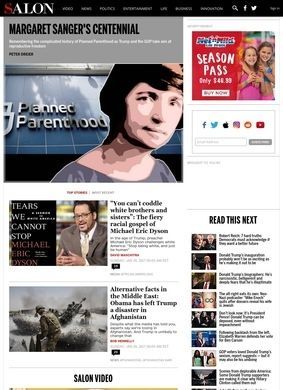
Salon.com has been publishing on the web since 1995, which puts it among the earliest American magazines built for the internet instead of repurposed from print. That longevity shapes what the site is now. It started before the modern news cycle existed and has lived through every shift in how people read online, from the dial-up era of long essays to the present mix of breaking stories, video, and aggressively scrollable feeds. The result is an outlet with a deep back catalogue and a clear editorial personality, headquartered in San Francisco and aimed squarely at adult readers who follow current affairs closely.
Original journalism and politics
The core of the operation is original journalism. News and politics anchors the homepage, and this is where Salon.com has built most of its name, breaking political stories and running a heavy rotation of opinion and commentary alongside straight reporting. The editorial stance is progressive, and the site does not pretend otherwise, so a reader arrives knowing the angle. Whether that is a feature or a drawback depends entirely on what someone is looking for. People who want a wire-service tone with no point of view should look elsewhere. People who want argued, openly political coverage of American events get a great deal of it, updated through the day.
Culture, food, science, money
Beyond politics, the section list is broader than the reputation suggests. Culture coverage runs to film, television, books, music, and the wider churn of internet life. There is a Food section, a Science and Health section, a Money section, and a set of Life Stories that lean into personal essay and first-person reporting. This last category deserves attention, because the confessional or reported personal essay was something Salon.com helped popularize on the web long before it became a staple everywhere, and the site still carries that form. The mix means the homepage on any given day swings between a congressional story, a movie review, a piece on a health study, and a writer working through something from their own life.
Long-form essays and video
Long-form essays sit beside the faster news posts, and that combination is part of what distinguishes the place. A lot of digital outlets have narrowed toward short, quick-turnaround items. Salon.com keeps room for criticism and extended argument, pieces that take a full sitting to read. There is also a dedicated video and TV section, so the offering is not text alone, and an archive stretching back across the site's full run, which means older articles remain reachable instead of vanishing the way so much early web writing has.
Critical reviews of film and television
Cultural criticism deserves its own mention because it is one of the consistent strengths. Reviews of movies, television, and books are written as criticism, with a voice and a thesis, not as ratings-driven blurbs. The same goes for the pop-culture and internet coverage, which treats online phenomena as something worth thinking about at length. A reader who enjoys writers who take a position and defend it will find that across the culture pages as readily as across the political ones.
Free access with optional subscription
On the practical side of how the site sustains itself, Salon.com runs an ad-supported model that keeps most content free to read, with a paid subscription tier offered on an annual plan that periodically carries a promotional discount. There is also a free newsletter sign-up for readers who would rather have selected pieces delivered than navigate the homepage. This is a familiar arrangement for digital magazines, and Salon.com presents it without burying the free access under a hard paywall, so a casual visitor can read widely before deciding whether the subscription is worth it. The ads are the trade-off for that openness, and they are present, as they are on nearly every outlet funded this way.
Social media distribution
The site keeps an active footprint across social platforms, with accounts on X, Instagram, YouTube, Facebook, TikTok, Reddit, and LinkedIn. For a reader who follows news through a feed instead of going directly to a homepage, that spread is useful, since it means new pieces surface wherever someone already spends time. It also shows that Salon.com is putting effort into distribution and is not relying on people remembering to type the address in.
Over the years Salon.com has published work from well-known journalists and cultural critics, and that history of bylines is part of what gives the writing its weight. Salon.com is associated with pointed opinion journalism, the sort that generates argument and gets cited and pushed back against, which is generally a sign that an outlet is saying something with intent. A reader should go in understanding that opinion and reporting both live here, and that the line between them is sometimes a matter of which section they are in.
What someone gets from Salon.com depends heavily on appetite for its politics. For a reader who shares or at least tolerates a progressive frame and wants current events covered with conviction, alongside genuinely good cultural criticism and a strong tradition of personal essay, it is a substantial and steadily updated source. For a reader who wants neutral wire reporting, the editorial voice will read as a constant presence rather than an occasional one. Either way, the range is broad: politics, culture, food, science and health, money, and personal writing all sit under one roof at Salon.com, supported by a long archive and a free-to-read default.
Salon.com has outlasted most of the publications it launched alongside in the mid-1990s, and very little of the early web survives in usable form. Salon.com is still here, still posting, with its archive intact and its sections active across both news and culture.