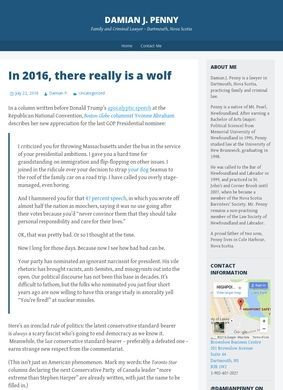
A practising lawyer in Dartmouth, Nova Scotia has kept a political blog running since 2002, and that single fact tells you most of what makes Daimnation unusual. Damian J. Penny writes the commentary, takes Legal Aid certificates by day, and has stacked up more than two decades of posts on Canadian and international politics, civil liberties, law, and the way the media covers all of it. Sites that old are rare. Personal ones written by someone with a day job in court are rarer still.
The blog as political archive
The blog itself is the core of the thing. Daimnation runs on WordPress.com, which keeps the look plain and the focus on words, and the subject matter sits where its author clearly lives professionally: questions of law, free expression, and current affairs, viewed from a Canadian vantage point but reaching well past the border. Anyone who follows political news will recognise the shape of it, a working person's running notebook on the events of the day, accumulated over years into a deep archive. The longevity is the selling point. You can scroll back through twenty-plus years of one person's reactions to the news cycle, which is a kind of record that most blogs abandon long before they get there.
Law practice integrated with commentary
What gives Daimnation an extra dimension is that it doubles as the professional home of Penny's legal practice. The same site that hosts the political writing also lays out the services he provides as a lawyer, and the two sides reinforce each other in a way that is honestly a little disarming. The opinions are not anonymous. They come from a named person whose office address and phone number sit a click away, which is more accountability than political commentary online usually offers.
Legal services offered
On the law side, the offering is concrete and easy to follow. Daimnation lists Penny's practice areas plainly: family law and criminal law, with the family work described in useful detail covering court document assistance, child-welfare cases, and adoption. Beyond litigation he prepares wills, drafts Advance Health Care Directives, and acts as a notary. He also accepts Legal Aid Commission certificates, a fact worth noting because it opens Daimnation's legal services to people who could not otherwise afford representation and who often have nowhere obvious to turn.
Geographic coverage in Atlantic Canada
The geographic reach is spelled out too. Daimnation covers Nova Scotia as well as Newfoundland and Labrador, an unusual two-province footprint that would be easy to miss if it were not stated plainly. For a reader in Atlantic Canada trying to sort out a custody dispute, a child-welfare proceeding, or a straightforward will, that combination of services and coverage is the practical heart of the listing. Notary and directive work in particular tends to be the sort of thing people need quickly and do not want to overpay for, and having it offered by the same lawyer who can also take a family file is convenient.
Dual function as blog and practice site
It is worth being clear-eyed about the dual nature of the site. The political writing and the legal practice are genuinely separate functions sharing one address, and a visitor arriving for one may not immediately care about the other. That is not a flaw so much as a quirk of how Daimnation is built. The blog brings in readers; the practice page tells them who is doing the writing and what else he does for a living. Few legal listings in any business directory come with a twenty-year paper trail of their author's thinking, and that trail does more for trust than any tagline could.
Contact information and accessibility
Contact is one of the stronger parts of the package. There is a clearly marked Contact Me page, a phone number, and a full street address for the Dartmouth office, down to the unit. A Facebook page for the legal side is referenced as well, and the blog offers email subscription for anyone who wants new posts delivered. Nothing about reaching this person is obscured. For a sole practitioner, that openness counts.
Absence of third-party reviews
Independent reviews of Daimnation are scarce. A search turned up nothing relevant, with results pulling toward unrelated companies that merely sound similar. That absence is not damning. A long-running personal blog and a small Atlantic-Canada law practice are not the sort of operation that accumulates a wall of star ratings, and the lack of third-party chatter says more about the niche than about the quality of the work. A prospective client is judging on the strength of the site and the visible track record rather than on a chorus of public testimonials, and that is a fair thing to know going in.
Breadth across multiple practice areas
The trade-off, if you want to call it one, is that the breadth can feel a touch scattered. Daimnation is doing political commentary, family law, criminal defence, wills, notary work, and health-care directives all at once, which is a lot of ground for one name. In practice this reads less like overreach and more like an honest reflection of what a small-town lawyer with a writing habit does day to day. The writing is the public face; the legal services are the livelihood. Someone wanting a polished, single-purpose law firm site will not find it here, and someone wanting a slick media outlet will not either. What Daimnation offers is a real person doing both, in the open, for a very long time.
Authenticity as the defining feature
That authenticity is the thread running through Daimnation. The political posts give the lawyer a documented voice, the legal page gives the blogger a verifiable identity, and the two together make a more credible whole than either would alone. Daimnation does not try to dazzle. It states plainly who runs it, what he believes, what he can do for you, and how to get hold of him, and it has been doing so consistently since before most blogs existed. For readers of political news, the appeal is the archive and the steady point of view; for anyone in the region with a legal problem, the appeal is a named, reachable lawyer who has shown his thinking for twenty years. The person behind Daimnation is fully visible, and that visibility is the case for taking it seriously.