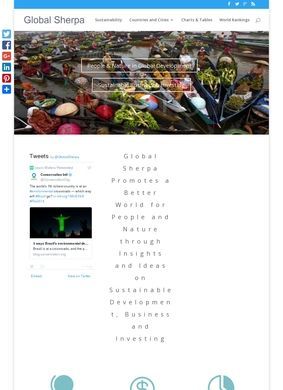
A site that files itself under political news but spends most of its energy on population curves, urbanization data, and whether Beijing's air is fit to breathe that day sets an odd expectation from the first click. Global Sherpa is a WordPress publication built around international development, sustainable business, and investing, and its own tagline reaches for "a better world for people and nature." That framing is earnest and a little sprawling, which turns out to be the honest character of the whole thing.
The reading experience on Global Sherpa is closer to a professor's resource page than a newsroom. You get essays, comparative rankings, and interactive quizzes sitting side by side, held together by a theme from Elegant Themes that gives it a tidy, magazine-ish surface. There is no breaking-news churn here. The material is meant to be studied, not refreshed hourly.
That mismatch between the political-news label and the actual contents is the first thing worth flagging for anyone arriving with a particular expectation. Global Sherpa is not tracking elections or legislation. It is doing something slower and more reference-shaped, and a reader should recalibrate before judging it against the category it happens to sit in.
What the site puts in front of a reader
The spine of Global Sherpa is a set of topic hubs, each staking out a corner of the development conversation. They are broad by design, and the breadth is both the appeal and the weakness.
People and nature in global development
This is the section that carries the stated mission of Global Sherpa most directly. It gathers writing on population growth, economic development, climate change, and urbanization, the sort of interlocking themes that development economists argue about endlessly. The pieces treat these as connected problems, which is the right instinct. Someone trying to understand why a fast-growing city strains its water supply, or how rising incomes and rising emissions travel together, would find the framing useful as a starting map.
How current or how deeply sourced any individual article runs is not something an outside reader can confirm, and with subject matter this time-sensitive, that is a real gap.
Sustainable business and investing
Here Global Sherpa turns toward corporate responsibility and long-term risk management, pitched at readers who think about capital as well as conscience. It is a sensible pairing with the development material, since the money and the environmental outcomes are hard to separate.
The section reads as commentary and orientation, not stock tips, and anyone expecting actionable investing guidance should adjust their hopes downward. What it offers is a way of thinking about sustainability as a business variable, which has its own value even when the specifics stay general.
Countries, cities, and the ranking tables
Global Sherpa devotes real space to place. There are profiles of developing nations, a recurring interest in the BRIC economies, and write-ups on major world cities, all of it feeding into Charts and Tables and a World Rankings area that lines countries up against shared metrics. This is the part of the site that leans most on data visualization, and it is where the "educational reference" ambition feels most fully met.
A student comparing urbanization rates or economic indicators across regions has a plausible reason to land here. The tables are the closest the project comes to something you would cite, though a careful reader will still want to know where the underlying numbers came from and when they were last touched.
Without a citation trail, the visualizations are a fine prompt for further reading and a shaky basis for a firm conclusion.
Quizzes and the read and shop shelf
Two features sit slightly apart from the essays. The quizzes are interactive and genuinely themed to the content, covering things like global water access or the customs of Chinese New Year, and they give Global Sherpa a classroom flavor that fits its aims. The Read and Shop page is more commercial in spirit: it points readers toward books, magazines, and language-learning resources, and it appears to run on affiliate purchase links.
That is a common and unremarkable way for an independent site to support itself, but it is worth naming plainly so a visitor understands that one corner of Global Sherpa is monetized while the rest reads as public-minded writing. The mix is coherent enough. A person who reads about globalization and inequality on Global Sherpa might reasonably pick up a recommended book on the way out.
Taken together, the offering is wide. It spans population science, finance, geography, and light interactive learning under one roof, and that ambition is the most interesting thing about it. The flip side is dilution. A publication trying to cover this much rarely goes deep on any single thread, and Global Sherpa gives the impression of a knowledgeable generalist writing across a very large syllabus. It is wide before it is deep, and a reader should treat it that way.
Standing behind the writing
For a site whose whole value rests on trusting the person doing the explaining, there is almost no trail back to that person. This is where confidence in recommending it starts to wobble.
Search does not turn up outside reviews, ratings, or commentary that speak to Global Sherpa specifically. Nobody, as far as the public web shows, has weighed in on it. The name is a problem in itself: the wider web is crowded with unrelated firms called Sherpa, from car shipping to tutoring to IT services, and none of them are this.
Digging past that noise mostly surfaces data-aggregator listings, the ZoomInfo and RocketReach type of entry, which describe the site from the outside without ever vouching for its content. One of those aggregators pins it to Chicago as an international-affairs and finance operation with zero employees, but that reads like an automated guess stitched together from public signals, not anything the site confirms about itself.
Contact is the sharper concern. There is no phone number, no email, and no physical address, and no dedicated page inviting a reader to get in touch. The only doors are social: a Twitter handle, plus Facebook, Pinterest, and Instagram, along with an RSS feed for people who want new posts pushed to them. Those channels are fine for following along. They are not the same as a way to reach whoever stands behind the analysis, ask a question, or flag an error in one of those ranking tables.
For a personal blog that reticence would barely register. For a resource that presents statistics, country comparisons, and investing commentary as if they should inform a reader's understanding, the absence of any named author, editorial contact, or institutional home is a real limitation. It leaves you weighing the material on Global Sherpa entirely on its own internal persuasiveness, with nothing external to lean on. When a ranking table looks off, or an article on air pollution figures seems dated, there is simply nobody to ask and no correction mechanism a reader can see.
None of this makes the writing wrong. The topic hubs on Global Sherpa are legitimately useful as orientation, the quizzes are a nice touch, and the data tables have a genuine reference quality when they are current. A curious reader browsing for a plain-language on-ramp to development and sustainability themes can get value here and should treat it as a jumping-off point to check against primary sources.
The doubt that lingers is simple and hard to dismiss: on a site built to explain how the world works, there is no visible answer to who is doing the explaining, how recently, or on what authority, and no way to ask.