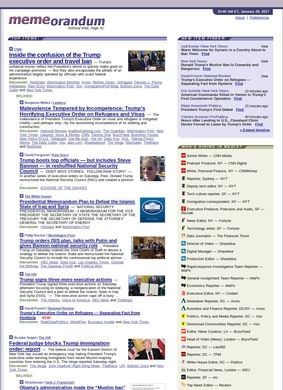
Load the page and you get one long, dense column of U.S. political headlines, each one grouped with the other outlets covering the same story. That clustering is the whole point of Mmemeorandum. A New York Times piece sits beside the Washington Post follow-up, a CNN write-up, and whatever political blogs and independent commentators have picked up the thread, all stacked under the lead item so you can see at a glance how a single event is being framed from different corners. There is no front-page editor's choice in the traditional sense. The ranking comes from how much a story is being linked to and argued about across the web right now, which means the layout reshuffles itself through the day.
How the algorithm ranks political stories
Gabe Rivera built Mmemeorandum in 2004 and the basic idea has not drifted much since. An algorithm does the heavy lifting of pulling and sorting links, with a layer of human editorial judgement on top to keep the rankings sane. The mix of sources leans neither one way nor the other on purpose, pulling from left- and right-leaning outlets in the same view. Major newspapers, cable news sites, and smaller commentary blogs all land in the same feed, and the threaded grouping under each headline is where the value lives. If you want to read three takes on the same vote or scandal without running five separate searches, this saves real time.
Mixing outlets across the political spectrum
It is worth being clear about what that openness costs Mmemeorandum. Media Bias/Fact Check files it as "Least Biased" because it genuinely draws from across the spectrum, but pairs that with a "Mixed" credibility note. The reason is straightforward: the site does not vet the outlets it aggregates, so a link to a careful investigative report can sit a few pixels from something pulled out of a low-quality source. The tool surfaces what is being talked about, not what is necessarily accurate. A reader who treats it as a map of the conversation will do fine. Anyone expecting the aggregator to have done their fact-checking for them is using it wrong.
Beyond the main feed, Mmemeorandum has a bit more under the hood than the spartan look suggests. You can subscribe by RSS. There are two cut-down mobile builds, Mini-memeorandum for basic phones and a smartphone version called memeorandum Mobile, which is a reminder of how long this has been running and quietly maintained. Display preferences let you change the font size, toggle article excerpts on or off, and control how links open. None of it is flashy, and that restraint reads as deliberate to me, given how cluttered most news front pages have become. The plain design keeps the focus on the links themselves.
Sister sites and the aggregation method
The same engine sits behind a small family of sister sites, each pointed at a different beat: Techmeme for technology, Mediagazer for the media industry, WeSmirch for celebrity gossip, and Ballbug for baseball. Knowing they share the same aggregation method is useful, because it tells you the political site is not a one-off experiment but part of a tested approach that has been applied across several subjects. Mmemeorandum is the best known of the group, and it is clearly aimed at a specific crowd: news junkies, working journalists, and media watchers who need a fast, cross-source read on what the political internet is chewing on at any given moment.
Professional recognition without consumer reviews
On reputation, the picture for Mmemeorandum is a little lopsided in an interesting way. The Guardian referenced it years ago as a leading political aggregator, and it keeps turning up in independent editorial roundups from the likes of ThemeIsle and RigorousThemes, plus the RefSeek reference directory. That is the kind of recognition that comes from other people in the field rather than from advertising.
What is missing is any footprint on the consumer review platforms. No Google reviews, no Trustpilot, no Yelp or BBB entry surfaced for the site itself. For a free tool with no checkout and no customer service desk, that absence makes sense; people do not tend to leave star ratings for a news feed. So the case for it rests on professional citation and the Media Bias/Fact Check assessment more than on a crowd of user testimonials.
Getting in touch is the one genuine soft spot for Mmemeorandum. The landing page carries no phone number, no mailing address, no email, and no contact form. There is an "About" link in the navigation, but a visitor who wants to reach the people behind the project has to dig, and even then there is no direct mechanism offered up front. For a service that asks nothing of you and stores nothing about you, this matters less than it would for a shop or an agency. Still, anyone hoping to flag a miscategorized story or ask a question will find the door closed at the surface level.
Two decades in, Mmemeorandum is still doing the same thing it did at launch, and that consistency is its argument. The threading works, the political balance holds across the spectrum, the unvetted-source caveat is genuine and worth keeping in mind, and the design has stayed out of its own way. A reader who already knows how to weigh a source will get the most from it. The headlines refresh; the column keeps moving.