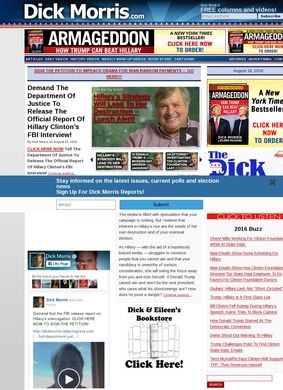
The daily "Lunch Alert" video sits near the top of DickMorris.com, a short piece of spoken commentary that lands around midday and sets the tone for what the rest of the site is doing. This is a political opinion outlet built around one man's voice, aimed squarely at a conservative-leaning readership, and it does not pretend to be anything neutral. Dick Morris was a strategist inside Bill Clinton's orbit before he moved rightward, and that biography colors most of what appears here.
The written columns and archives form the backbone. Alongside them run a stack of video features: history videos, a recurring "50 Shades of Politics" series, and, when it was current, a "2020 Election Alert" segment that dated the material fairly precisely. Dick Morris hosts most of this personally, and his name also turns up in more than one political business directory as a consultant and pundit, a paper trail that predates the website by decades.
Petition campaigns show up too, the kind that ask a reader to add a name to some cause and hand over an email in the process.
What the site puts in front of a reader
Content and commerce are braided together here, and it is worth being clear-eyed about which is which. The free newsletter opens up the videos and columns to a signed-up visitor. The store sells Dick Morris's own books directly. Third-party advertising fills the remaining space. A visitor gets real analysis, but the analysis also functions as a funnel toward a subscription and a purchase, so the reading experience carries a persistent commercial undertow.
That is not a mark against it on its own. Plenty of pundits monetize this way. Whether the substance justifies the pitch depends almost entirely on politics: the site gives a reader plenty to chew on if they already share the frame, and someone outside it will find the framing relentless.
The video and column engine
The "Lunch Alert" format is the most distinctive thing on offer. A regular cadence of talking-head video keeps the site feeling alive in a way that static archives never would, and the history videos add a longer-form counterweight to the reactive daily stuff. The "50 Shades of Politics" series appears to be Dick Morris working through a running thesis across installments, which rewards a returning viewer more than a one-time visitor.
The columns cover the same terrain in text, all written in Dick Morris's own byline. For readers who prefer reading to watching, the archive is deep enough to browse. It is one voice throughout, which is either the appeal or the limitation depending on what a person came for.
Books, petitions, and the store
The book side deserves scrutiny, because it is where outside opinion exists at all. Dick Morris has around thirty titles listed, and Goodreads puts his aggregate at roughly 3.69 out of 5 across more than four thousand ratings. That is a middling score, respectable but far from adored, drawn from a large enough sample to mean something. Dick Morris's television series "Dick Morris Democracy" fares worse, sitting near 3.7 out of 10 on IMDb, though only a couple dozen users graded it. Kirkus, reviewing "Here Come the Black Helicopters!", came down critically.
None of those numbers attach to the website itself. No reviews specific to DickMorris.com surfaced at all, which leaves the site's own reputation essentially unmeasured. A reader is left judging the book author and the TV personality, then inferring backward to the site, and that inference is imperfect. The "Dick's Book Reviews" category and the integrated store make the commercial loop explicit: the books are reviewed here, sold here, and promoted through the same videos a reader came to watch.
The petition campaigns are the softest element. They tend to double as list-building exercises, and a cautious visitor should assume an email handed over there feeds the newsletter machine.
On finding a way to reach the operation, the picture is mixed. A contact page does exist at the site, so there is a route in. The homepage itself carries no phone number, no address, and no email, so a reader has to go looking. It is a minor friction, not a wall, but a site built so heavily around Dick Morris's own voice might reasonably surface that link more prominently than it does.
What lingers after reading is a harder question the site never resolves on its own terms. Everything points inward, toward Dick Morris, his subscription, his books, his predictions. The "2020 Election Alert" is a useful tell: this is a site that stakes its credibility on calls that age fast, and the archived record of those calls is exactly what a skeptical reader would want to weigh before trusting the next one.
That record is here, but the site is not built to invite that kind of audit, and a visitor who wants to know how well the forecasts held up will have to do the checking themselves against a body of work that outside critics have treated with real reservation.