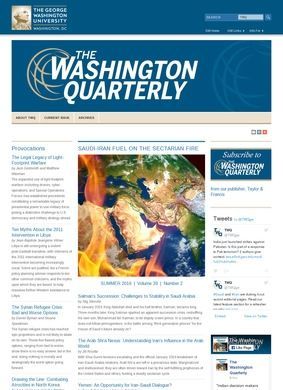
Current issues of The Washington Quarterly are free to read on the site, while the archive sits behind a Taylor and Francis subscription. That split tells you most of what you need to know about who runs this and how it operates: a peer-reviewed academic journal on international affairs, published out of George Washington University's Elliott School of International Affairs, with the commercial publishing machinery handled separately. A reader who lands here looking for the latest thinking on US foreign policy gets the new material at no cost, which is more than many journals in this field allow.
Reassessing China issue takes focus
The subject matter is narrow in the way good scholarship tends to be. Coverage spans international affairs globally, but the gravitational pull is always toward US foreign policy and how Washington reads the rest of the world. The Washington Quarterly's featured issue at the moment is a thematic cluster called "Reassessing China," and the table of contents reads like a syllabus for anyone trying to make sense of Beijing: pieces on Chinese military capabilities weighed against intentions, the state of China-Russia relations, the structure of China's financial system, and the question of regional influence. These are not hot takes. They are the kind of arguments that get cited in policy papers and graduate seminars later.
Provocations section debates security policy
Alongside the headline cluster, a section called "Provocations" handles the harder-edged security questions: nuclear proliferation, deterrence strategy, energy security, and the frameworks holding European defense together. The naming is a small signal of editorial personality. A journal that titles a section "Provocations" is inviting argument, not consensus, and for a field that can drift toward house views, that willingness to publish a contested position is worth something.
Article layout and recurring features
Structure on the site follows the journal's own logic. Articles are organized by issue, with full text available for the current run, so a researcher can move through a volume the way they would a print copy. Two recurring features round out the standard article load. "TWQ Talks" runs in an interview and commentary format, giving readers the voice of a scholar or practitioner directly instead of filtered through a formal paper. "Behind the Headlines" does what its name promises, offering timely policy analysis tied to events as they break. That pairing addresses a real tension in academic publishing: The Washington Quarterly comes out four times a year, and a quarterly cadence can leave a journal looking flat-footed against fast-moving events. These shorter formats let the journal respond to the news cycle without abandoning its scholarly footing.
Editorial board and submission guidelines
The editorial apparatus is laid out plainly. The editorial board and staff are publicly listed, so a prospective author or a skeptical reader can see exactly who is making the calls on what gets published. There is a Submissions page carrying the author guidelines, the page of most use to the researchers The Washington Quarterly exists for, and a Permissions page handling reprint and copyright requests for anyone who wants to quote or reproduce material elsewhere. None of this is glamorous, but it is the connective tissue that separates a working journal from a static archive of PDFs.
What gives The Washington Quarterly its standing is the institutional backing. It carries the name of the Elliott School, an established home for international affairs scholarship in the United States, and it goes out through Taylor and Francis, an academic publisher whose distribution puts the journal into university libraries and databases worldwide. Peer review is the baseline expectation here, and the brief confirms it: submissions are vetted before they run. For a reader trying to gauge whether an argument has been pressure-tested, that process is the difference between a journal article and a blog post with footnotes.
Audience built for policy specialists
The audience is specific and the journal does not pretend otherwise. The Washington Quarterly is built for academic researchers, foreign policy professionals, think-tank analysts, and graduate students working in international relations. A general reader curious about a China headline could certainly learn something from "Behind the Headlines," but the bulk of the content assumes a reader who already knows the vocabulary of deterrence theory and alliance politics. That focus is a strength. The Washington Quarterly is not trying to be a magazine, and it does not water down its analysis to widen its reach.
Free current issues paid archive
The free-current, paid-archive model is worth dwelling on, because it shapes how useful the site is depending on what someone needs. For tracking the present debate, on China, on nuclear posture, on the future of European defense, the site is genuinely open and current articles can be read in full without a paywall. For historical research, a scholar tracing how a debate evolved across past volumes, the Taylor and Francis subscription becomes the gate, which most university affiliates will already have through their library. That arrangement is standard for the field and few readers in the target audience will be surprised by it.
There are limits worth naming. The Washington Quarterly publishes on a quarterly schedule, so even with the faster "Behind the Headlines" pieces, this is not a place for daily news. Its lens is consistently American, so a reader seeking a primarily European or Asian framing of the same security questions will find that perspective present mainly as a subject of analysis filtered through a Washington vantage point. Neither of these is a flaw so much as a definition of scope, and The Washington Quarterly is honest about what it is.
Breadth across security topics covered
The breadth within the narrow lane is genuine. A single recent run touches Chinese military modernization, the durability of the China-Russia alignment, the plumbing of China's financial system, regional influence, nuclear proliferation, deterrence, energy security, and the architecture of European defense. That range gives The Washington Quarterly the feel of a journal that takes the whole board seriously. The Washington Quarterly does not chase one fashionable topic while neglecting the rest, and that consistency is what makes it worth returning to issue after issue.
It helps that the site does not bury the substance. The article-by-issue layout, the openly listed board, the clear submission and permissions paths: all of it points to a publication run by people who expect their readers to be working with the material, not simply browsing it. There is no attempt to dress the journal up as something it is not. The seriousness is in the content, and the site gets out of the way of it. Put plainly, The Washington Quarterly reads like a tool built for people who already know why they came.
A graduate student or analyst trying to stay current on the China debate without paying for access should go straight to the current issue and read the "Reassessing China" cluster in full, then check whether a university library already carries the Taylor and Francis archive before the back catalogue is needed. Those with a manuscript in this space should read the author guidelines on the Submissions page closely before pitching, because the peer-review standard at The Washington Quarterly is demanding and the editorial board is named and accountable for a reason. On that measure, The Washington Quarterly does its job well.