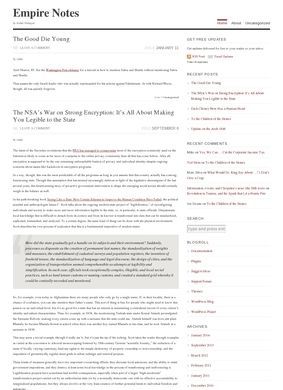
Empire Notes is a political commentary blog written by the American activist and author Rahul Mahajan, publishing critical analysis from a left-leaning, anti-imperialist angle. The writing leans into U.S. foreign policy, human rights, and the way history gets retold by the people who win wars. If you came up through the antiwar reading of the mid-2000s, the name and the tone will feel familiar, because that is roughly the period when the site was doing most of its talking.
Iraq War coverage and nuclear history
The substance is heavier than the plain layout suggests. Mahajan covers the Iraq War in detail, including first-hand framing of the Falluja battles, and he returns repeatedly to the gap between official accounts and what he argues happened on the ground. There is a strong strand of nuclear history too: the so-called Hiroshima myth, and a serious engagement with Gar Alperovitz's revisionist scholarship on why the bomb was dropped. These are not throwaway posts. They read as arguments built by someone who has done the reading and expects the reader to keep up.
From essays to interviews
Beyond the foreign-policy core, the site widens out into social justice writing and longer reflective pieces, with interviews carrying a fair share of the load. The exchange with Wael Ghonim is the one most people will recognise, and it points to the kind of figure Mahajan was able to bring into the conversation. That mix of essay, commentary, and interview gives Empire Notes more texture than a single-author opinion log usually manages. ZoomInfo's profile sums it up fairly: political, historical, and social material delivered through reflection and conversation, which matches what the search trail actually turns up.
Checking the site's current status
The catch is timing. The most active updates land in the mid-2000s, and Empire Notes would not load cleanly on a recent visit, returning a server error on one path and a certificate mismatch on the secure one. Whether anything new is being posted, or whether the archive is simply sitting where it was left, could not be confirmed. That uncertainty shapes how the place should be approached. As a live feed of current political argument, it cannot be recommended on the available evidence. As an archive of a particular voice during the Iraq War years, it is a different and more durable proposition.
Read it that way and the dated material becomes a feature instead of a flaw. Commentary written while Falluja was unfolding, or while the post-9/11 consensus was still hardening, has a contemporaneity that retrospectives cannot manufacture. Empire Notes captures what a sharp anti-imperialist critic was saying in real time, which is exactly the sort of source historians and students go digging for once the news cycle has moved on. The fixed-in-amber quality cuts both ways, and a reader needs to decide which use they have come for before judging the place.
No third-party reviews or ratings surfaced in any search. ZoomInfo lists a company profile but attaches no scores or counts to it, and a Media Bias/Fact Check entry that looks relevant on first glance actually belongs to empirenews.net, an unrelated satire outlet. There is no crowd verdict to rely on here, which is common for a single-author political blog and not in itself a mark against the writing. The author's name does the credibility work instead. Mahajan is a published writer and a known quantity in activist circles, and that traceable authorship accomplishes more for trust than an anonymous site with a polished design ever would.
Behind the lack of contact options
Reaching anyone behind Empire Notes is where the site comes up genuinely short. No phone, address, or contact route could be pulled from the pages or from search snippets, partly because those pages would not resolve when tested. A reader who wants to reach Mahajan directly will likely have better luck through his books or his other published work than through the site as it currently stands. For a blog this is not fatal, since the writing is the point and the byline is right there, but it does cap how far Empire Notes can function as a working, responsive presence.
Set against something like ZNet, which has kept a comparable left and anti-imperialist stable of writers publishing continuously for years, Empire Notes looks less like a destination and more like a personal archive worth raiding for one specific writer's perspective on one specific era. ZNet wins on breadth and on simply being alive. What Empire Notes offers that a larger collective cannot is the focused, unmediated voice of Rahul Mahajan at the height of his Iraq War commentary, and for a reader chasing that, the dust on the archive is beside the point.