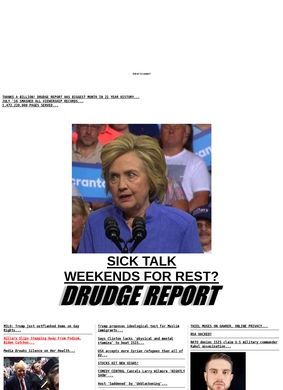
A reader who wants to know what is happening right now, without opening fifteen tabs, lands on the Drudge Report and gets exactly that: one dense page of headlines, each a link out to the outlet that reported it. There is almost nothing to learn about how the site works. A person scans the column, clicks what pulls them, and reads the story on CNN, the BBC, Reuters, or wherever the link points. The Drudge Report has run this way for three decades, and the format has barely changed, which turns out to be the whole appeal.
It is an aggregator, not a publisher. The Drudge Report hosts no articles of its own. What it does is choose, from the flood of daily news, the handful of stories it judges to matter, and stack them where a reader takes them in at a glance. That editorial act, the choosing, is the entire product.
How the front page is built
The layout is a single scrolling wall of links, sorted more by editorial weight than by any rigid template. A big story sits at the top in large type. Everything else follows beneath it in columns. There are no photographs cluttering the flow beyond the occasional lead image, no autoplay video, no infinite feed pulling a reader down forever.
The restraint is deliberate, and on a modern web it reads as almost radical. The whole page fits the way a printed front page fits, with a clear top and a clear bottom, so a reader knows when they have seen everything worth seeing.
One line on the site explains the method: it states it is "always edited by human being." In an era of algorithmic feeds, the Drudge Report leans hard on manual curation, a person deciding what leads and what gets cut. That is the entire editorial proposition, and a reader either trusts that judgement or does not. There is no middle setting, no personalization dial, no way to tune the page to your own preferences.
Top stories and political coverage
Politics is the engine. The Drudge Report gives the most prominent space to election polls, congressional developments, and policy fights, and the top slot is usually a political story judged to be the day's biggest. For readers who follow Washington closely, this is the draw: a single editor's read on which of the day's dozen political threads deserves the headline treatment.
The selection has a point of view, as any human-curated page does, and a reader is better off knowing that going in than pretending the front page is neutral. The headlines themselves are often sharpened for effect, so the wording on the link and the tone of the article it points to do not always match, which is another reason to click through before forming an opinion.
Entertainment, business, and science links
The page is broader than its political reputation suggests. Alongside the Washington coverage sit celebrity and entertainment items, awards-show news, and music-industry stories, plus business headlines and the occasional science piece. A miscellaneous strip catches weather, earthquakes, and travel. The mix means the Drudge Report works as a general news scan and not a politics-only feed, which is easy to forget given how often it gets described in purely political terms.
Someone checking it out of habit for the election coverage will still catch a major storm warning or a market swing on the same screen.
Reaching past the American press
Part of what keeps the Drudge Report useful is how far it looks past the domestic outlets a typical reader defaults to. The linking is generous with foreign publications, and the standing navigation makes them easy to reach directly. A reader who only ever opens the same two American papers gets a wider field here almost by accident.
International news by region
International coverage is organized by part of the world, with links grouped loosely around the Middle East, Asia, Europe, and Africa. A reader tracking a story in one region finds the relevant outlets clustered instead of scattered across the page. This is one of the quieter strengths of the Drudge Report: it pulls in international publications a domestic reader might never visit on their own, which widens the diet past the usual American wire services.
During a fast-moving overseas event, that regional grouping can put a reader in front of a local source hours before the same story filters into the domestic press.
Below the main column, the site keeps a standing set of navigation links that work like a newsroom's public bookmark bar. There are direct links to major news agencies, to newspaper archives, to rating trackers, and to social-media trend lists. A reader who exhausts the day's headlines can jump straight to a wire service or a paper's front page from here, which makes the Drudge Report a launchpad as much as a headline sheet.
Mobile apps exist for iPhone, iPad, and Android, and they carry the same stripped-down approach onto a phone screen. The experience changes little between devices, and given how light the page is, it loads fast on a weak connection, an underrated virtue when the news is breaking and every other site strains under traffic. A commuter checking headlines on a spotty signal gets the full front page while a heavier news app is still loading its first advertisement.
What the human editing buys you
The manual editing is a double edge, and an honest read names both sides. A human filter spares the reader the algorithmic churn that keeps people scrolling past the point of usefulness; the Drudge Report ends when the links end, and that hard stop is a feature. Against it, a single editorial hand means the page reflects one set of priorities, so a reader after a comprehensive or balanced survey should treat this as one curated view among several.
It aggregates from outside sources, which means the reliability of any given story rests with the outlet behind the link, not with the aggregator. Reading it well means clicking through and judging the source, the same discipline any link in an online business directory or news index would demand.
What the Drudge Report does supremely well is speed. It answers a narrow question, what is worth my attention this minute, faster than almost anything else online, and it wastes none of the reader's time getting there. Decades of the same spare layout have turned that into muscle memory: regulars know where the big story sits and how far to scroll before the day is covered. Few sites this old have resisted the urge to redesign themselves into something heavier, and the Drudge Report has held the line on purpose.
A reader who wants analysis, original reporting, or a single trusted editorial voice should pair the Drudge Report with a full news outlet rather than lean on it alone. Used that way, for a news-heavy reader who already juggles several outlets, it works well as a fast morning sweep of what is breaking: open it, run the column top to bottom, click through to the two or three stories that matter, and read them in full at the source.