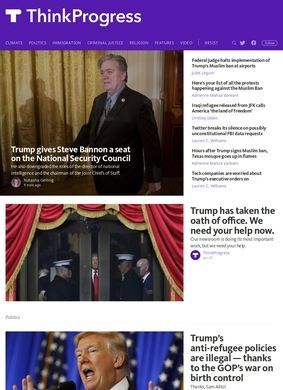
What sits at thinkprogress.org now is essentially a frozen library. Think Progress was a progressive political news and opinion outlet that launched in 2005 under the Center for American Progress Action Fund, a Washington D.C. advocacy group tied to the larger Center for American Progress think tank. It ran for roughly fourteen years before it stopped publishing in 2019. Everything you reach now is the back catalogue, and that single fact shapes how anyone should approach the site.
Coverage scope and editorial focus
The archive is not small, and the range it once covered is the main reason to bother with it. Across its active years Think Progress put out news reporting, longer analysis, and straight opinion on U.S. politics, with heavy attention to the 2020 election cycle in its final stretch. A dedicated climate and environment desk operated under the ClimateProgress banner, and that strand is probably the deepest single vein here. Immigration, healthcare, LGBTQ rights, gun control, and racial justice all got sustained coverage too, alongside occasional world news pieces that never received the same editorial investment as the domestic political beat. The intended reader was obvious from the start: progressive audiences and people working in or near Democratic policy circles.
Political bias and factual accuracy
None of that is hidden behind a guess about its slant. Think Progress wore its politics openly, and the independent bias trackers agree on the point. AllSides places it on the Left. Media Bias/Fact Check also calls it Left, and pairs that with a Mixed rating on factual reporting, flagging a handful of failed fact checks over the years. That combination is worth holding in mind. Someone reading these pieces for ammunition in an argument is on firm ground; someone reading them as neutral wire copy is using the wrong tool. The advocacy parent organization shaped the editorial voice from the inside, and Think Progress never pretended otherwise.
How to use this archive
The sensible approach is to treat Think Progress as advocacy journalism and check the load-bearing claims elsewhere. That is not a knock unique to this outlet, but the Mixed factual rating means it applies with a bit more force than it would for a publication with a cleaner record. The reporting tends to be sourced and the opinion clearly labelled, so the line between the two is usually visible. Archived political writing is most useful when the reader already knows the writer's angle going in, and at Think Progress that angle is never in doubt.
Site reputation and legitimacy
Reader reputation is a rougher story. On Sitejabber the site sits at 1.9 stars across 18 reviews, which reads as a generally dissatisfied crowd, though eighteen responses is a small pool and political sites attract drive-by anger from people who simply disagree with the politics rather than with editorial conduct. Scamadviser marks the domain as legitimate and safe, so there is no question of the archive being a sketchy clone or a parked trap. Glassdoor carries employee reviews for those curious about the workplace behind the byline. No ratings turned up on Google, Trustpilot, Yelp, or the BBB, which is unsurprising for a defunct publisher with no paying customers.
Research value by visitor type
Practically, the value of Think Progress depends entirely on what you came for. A researcher, a student, or a journalist tracing how a particular policy fight was framed from a left perspective between 2005 and 2019 will get real mileage here, especially on climate, where the ClimateProgress material is substantial. Anyone hoping for current headlines will hit a wall almost immediately, because the clock stopped years ago and nothing new arrives.
Contact methods for the archive
Getting in touch works as you would expect from an archived property. A Contact Us link sits in both the header and the footer, routing through to a form on the archive subdomain. The home page lists no phone number and no street address, and email runs through that form only. For a live operation that would raise questions; for a dormant archive maintained by a known organization, a working contact route is about all you can reasonably expect, and it is present.
Best practices for using Think Progress
The verdict is aimed at a specific kind of visitor. Policy researchers, debate-minded readers, and anyone digging into progressive coverage of the past two decades will find Think Progress a genuinely useful repository, with climate reporting as its standout. Go in expecting a stated viewpoint, not a referee. Open the ClimateProgress section or search the Think Progress archive for the policy fight you care about, then verify any decisive figure against a second source before quoting it. Think Progress is one informed witness with a clear point of view; treat it that way and the archive repays the time.