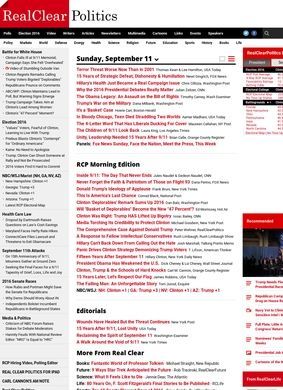
Where can a reader find the day's political commentary from a dozen different outlets and the current polling averages sitting on the same site? That is the job RealClearPolitics has done for a long time. It is a news, opinion, and polling aggregator that curates commentary from across the press each day, runs its own poll averages, and publishes original reporting under its own banner, all stacked on one homepage.
The polling operation is the part most people come for, and it is the part built with the most care.
The polls are the anchor
A dedicated Polls hub sits at the center of RealClearPolitics, and it goes well past a single headline number. There is an All Latest Polls feed, presidential job-approval tracking, direction-of-country polling, a generic congressional ballot, and election-cycle pages for the coming Senate and presidential contests. The averages are the draw: instead of one survey, a reader sees several polls blended, which smooths out the noise any lone pollster introduces. A single outlier survey can swing a headline; an average of many is harder to spin, and that is the discipline RealClearPolitics has built its reputation on.
Two features push it beyond a simple feed. An RCP Pollster Scorecard grades the firms doing the polling, which is a genuinely useful lens for a reader trying to judge whose numbers to trust. And a historical, archival polling database lets someone look backward, with interactive maps for Senate, Governor, and House races.
That archive is quietly the sturdiest thing on the site. Anyone can post today's poll; keeping a searchable record of past races, mapped state by state, is a maintenance commitment most news sites never make. It turns RealClearPolitics into a reference a researcher can return to, well beyond a feed to skim once and forget. Election-night watchers and academics alike lean on that back catalogue, and its presence is a large part of why the site outlasted so many polling blogs that came and went.
Approval tracking and a pollster scorecard
The scorecard is the detail that separates RealClearPolitics from a site that merely reprints whatever survey lands in its inbox. Grading pollsters is a value judgment the site is willing to make in public, and it hands the reader a tool for weighing the averages against the track record of the firms behind them. The approval and direction-of-country trackers work the same way, plotting movement over time so a single week's blip does not get mistaken for a trend.
For a political junkie or a working reporter, that combination of live averages, a pollster grade, and a deep archive is the real product, and it is the reason RealClearPolitics gets cited as often as it does.
An aggregator with a lot of doors
Away from the polling, RealClearPolitics fans out into a long list of content sections: Investigations, Politics, Policy, Markets, World, Defense, Energy, Health, Science, Religion, Education, History, and Books and Culture, plus a RealClearPublicAffairs vertical and even a Pennsylvania-focused subsection. That is a wide brief for a site whose name suggests it only does politics. Most of those verticals run on the same aggregation model as the front page, gathering pieces on defense or energy or religion from across the press and giving a reader one stop to scan a subject.
The depth varies section to section, and some read more like landing pages than living desks, but the spread means RealClearPolitics functions as a general current-affairs reader for anyone willing to work past the political core.
The daily engine underneath all of it is aggregation. RealClearPolitics curates opinion pieces syndicated from a broad spread of outlets, the roster of writers pulling from the Wall Street Journal, the New York Times, the Washington Post, Fox News, the Guardian, and Bloomberg, among others. Set alongside that are Video, a Podcast, Newsletters, an Opinion Research section, and the publishing, submissions, donate, subscribe, and login functions any site of this scale carries.
The columnist roster and special series
Pulling opinion from that many outlets at once is the defining move of RealClearPolitics, and it is a double-edged one. A reader gets a fast survey of what commentators across the spectrum are arguing on a given morning, without visiting six paywalled sites to assemble it. The selection itself, which pieces get promoted and which do not, is an editorial act, so the aggregation is curated, not neutral.
On top of the syndicated columns, RealClearPolitics runs its own Special Series, long-form projects with names like "America Turns 250," "Freedom of Religion," and "Energy of the Future," which is where the site's original voice comes through most clearly. These sit apart from the daily churn and read as deliberate, reported work rather than a link roundup. They also make the site's editorial interests legible: a reader who studies which themes RealClearPolitics chooses to invest original reporting in learns a fair amount about where it stands before reading a word of the reporting itself.
Where it sits on credibility
Contact is where the site comes up short. No phone number, email, or mailing address turns up on the homepage of RealClearPolitics. An About page and a Submissions link sit in the main navigation, and those are the likely routes to pitch a piece or reach the staff, but nothing direct is surfaced on the page itself.
For a publisher this is ordinary; a reader looking to actually reach someone will have to click into the About section to start. The site is plainly built for readers and contributors rather than callers, and the missing homepage contact line is a minor mark against it, not a red flag.
The outside record is unusual, because most of it is not consumer reviews at all. The conventional rating platforms barely register: SmartCustomer shows 2.4 out of five from four reviews, and Sitejabber shows 2.4 from a single review, samples far too small to be meaningful. Four ratings and one rating are not a verdict on a site this widely read; they are statistical noise, and a reader should treat them as such.
The more telling assessments come from media-bias raters, and they line up in one direction. Media Bias/Fact Check rates the site as Right-Center in bias and "Mostly Factual" in reporting, with a companion rating for Real Clear Policy landing in similar territory. Ad Fontes Media places RealClearPolitics in the "Strong Right" category with mixed reliability.
AllSides has rated the site's Fact Check Review section as Center, and Wikipedia describes RealClearPolitics plainly as an American conservative political news website and polling aggregator. A reader can take all of that as a fair map: the polling data is widely used and methodologically serious, while the editorial and aggregation lean right, and knowing that going in is most of what a visitor needs.
The polls make RealClearPolitics worth bookmarking; the tilt of the commentary is the caveat that comes attached. Setting RealClearPolitics next to FiveThirtyEight and reading the two together is the practical fix, since the polling numbers overlap even where the surrounding coverage does not.