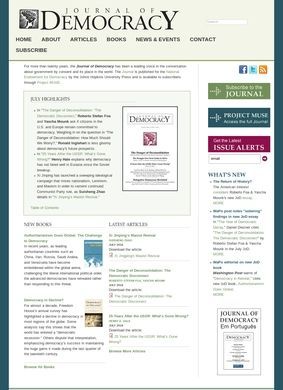
Published by Johns Hopkins University Press in association with the National Endowment for Democracy, the Journal of Democracy is a peer-reviewed academic quarterly that has been running since 1990. Its subject is the study of democratic government in practice: how elections work or fail, how authoritarian regimes hold power, what civil society and the rule of law look like across very different countries. The writing is scholarly but aimed at people who follow politics seriously, so a reader does not need a graduate degree to get something out of an issue. That balance, rigorous yet readable, is what the publication has built its name on over three decades.
Issues and geographic scope
The core of the site is the run of issues, both the current quarterly and a deep archive of past ones. Each issue of the Journal of Democracy carries full scholarly articles on comparative politics, electoral systems, and the condition of democracy in specific regions. The geographic reach is genuinely wide. Europe, Asia, Latin America, Africa, and the Middle East all get sustained attention, so the coverage does not collapse into one part of the world or one familiar set of case studies. A reader interested in, say, how an election played out in a single country can usually find an essay that treats it with care, not a quick news summary.
Book reviews and scholarship tracking
Beyond the issues themselves, the Journal of Democracy runs a Books section that reviews recent scholarship on democracy, governance, and related topics. For anyone trying to keep up with what is being written in the field, that section does useful triage, pointing toward the titles worth reading and giving a sense of where the academic conversation is heading. It rewards return visits because the literature on these subjects moves quickly and no single reader can track all of it alone.
Election Watch and audio interviews
The site keeps a strand called JoD Online, which holds web-exclusive content separate from the quarterly. Two pieces of it stand out. One is Election Watch, an ongoing record of elections happening around the world, which functions as a running reference on who is voting, when, and under what conditions. The other is a set of audio interviews with authors and scholars, where the people writing the essays talk through their arguments aloud. That audio strand is genuinely valuable, because hearing a researcher explain a thesis in plain conversation often clarifies what a dense article only implies.
Keeping current between print cycles
That web layer changes how the Journal of Democracy works as a resource. The print quarterly is, by its nature, a slower object that arrives four times a year. Election Watch and the online essays fill the gaps between issues, keeping the site current with events rather than waiting for the next print cycle. A newsletter is available for readers who want to be told when new essays go up, which stops the material from getting lost because someone forgot to check back.
Archive access through Project MUSE
For students and writers who want to go deeper, the full archive is available through Project MUSE, the scholarly database hosted by the same university press. That connection is worth knowing about, because it means the back catalog is not a few stray PDFs but a properly indexed, searchable collection. Submission guidelines are published on the site as well, so a scholar with a paper to place can see exactly what the editors are looking for before pitching anything. The Journal of Democracy is not the kind of outlet most people stumble onto casually; readers usually arrive through an academic database or a citation in someone else's footnote.
Who is this for? The honest answer is a specific audience: scholars, political scientists, policymakers, and the kind of reader who already cares about how democracies function and decay. Someone looking for breaking headlines or hot takes will find the pace too deliberate. The Journal of Democracy trades immediacy for depth, and the trade is deliberate. The essays are meant to hold up months and years after publication, which is a different goal from chasing the day's news cycle.
One practical strength is the editorial consistency across all of this. The same standard that governs the print articles carries into the online essays and the book reviews, so the quality does not drop when a reader moves from the quarterly to the web content. That uniformity is harder to maintain than it sounds, and it is part of why the publication has stayed a reference point in democracy studies for as long as it has. The Journal of Democracy reads as a single coherent project rather than a print magazine with a loosely bolted-on website.
Comparing democracies across regions
There is also something to be said for the way the material is organized around comparison. Because the Journal of Democracy sets cases from different continents side by side, a reader can see patterns that a single-country focus would miss: how a tactic used to undermine courts in one region reappears, slightly altered, somewhere else. That comparative habit is the intellectual spine of the whole enterprise, and it shows up consistently across the sections.
Weighed against something like Foreign Affairs, the difference comes into focus. Foreign Affairs ranges across the whole field of international relations, statecraft, war, trade, and grand strategy, with democracy as one theme among many. The Journal of Democracy narrows its lens to democratic governance and stays there, which means a reader who specifically wants sustained, comparative analysis of elections, authoritarianism, and civil society will get more of it here, and at a level of academic rigor that a general-interest policy magazine does not aim for. For that particular interest, this is the title to keep open.