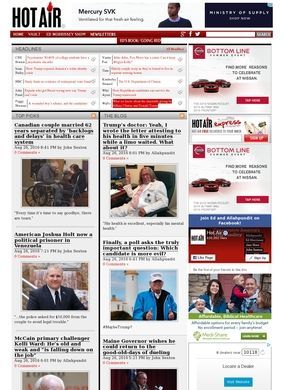
Salem Media Group runs HotAir as the flagship of a cluster that also includes Townhall, RedState, and PJ Media. That ownership shapes the product at every level: the homepage openly pulls headlines from those sister outlets alongside its own reporting, so a reader landing here gets a curated slice of the broader Salem network, with HotAir's bylined posts mixed into an aggregated stream of links pointing outward to the rest of the family. The VIP subscription tier makes the commercial logic explicit, separating the free aggregated feed from a paywalled stream of premium columns, longer analysis, and member-only video. That two-speed model runs through everything else on the site.
Ownership structure and homepage layout
HotAir was founded by Michelle Malkin, and it has kept the format she helped popularize: short, opinionated posts written fast against the day's news, each carrying a named author. There is a sizable roster of regular contributors, and the bylines are consistent, which is more than some commentary shops bother with. The writing leans hard into a stated point of view. HotAir says outright that it offers analysis "from a conservative perspective," so nobody arrives expecting neutral wire copy. The front page reads like a wire service for the American right, stacking fresh posts on elections, congressional maneuvering, and the latest fight over immigration or defense spending, while the paywall sits a click away for readers who want more from the same writers.
Writing style and editorial perspective
The beat list is wider than the "political news" label might suggest. U.S. politics is the spine: elections, legislation moving through Congress, the procedural fights that decide whether bills live or die. Around that sit culture and social-issue pieces, a steady diet of media criticism, and a foreign-affairs beat that follows Ukraine, Russia, and the Middle East. Immigration and economic policy show up often enough to count as standing beats, not occasional detours.
Coverage areas beyond politics
Most of the volume is written posts, but video segments and podcasts are threaded through, giving the regular contributors a second channel beyond text. A newsletter is on offer through account registration, so HotAir is plainly built to convert a casual visitor into a logged-in reader and, eventually, a paying VIP member. That funnel is visible without being aggressive, and the registration wall is light: you can read a great deal before anything asks you to sign in.
Multimedia content and membership funnel
One thing that stood out while clicking through is how much of the page is links out rather than original reporting. The aggregation is a feature, not a flaw, but it does shape the experience. HotAir works as much as a reading list for the conservative web as it does a destination for first-run journalism. If you want a single tab that surfaces what Townhall and RedState are running today alongside HotAir's own take, that is exactly the niche it fills.
Aggregation versus original reporting
A reader chasing deep, original investigation will hit the limits of the format fast, since the model rewards speed and volume over the slow build of a long reported piece. HotAir is a place to keep up, not a place to settle in for a 5,000-word feature. It is worth looking it up in a business directory of news sources to understand where it sits in the conservative media landscape before making it a daily stop.
Media bias ratings and reliability scores
Credibility for a site like this lives less on consumer review platforms and more in the media-rating world, and there the assessments are reasonably consistent. Media Bias/Fact Check rates HotAir as "Right" on bias with reporting graded "Mostly Factual." Ad Fontes Media places it at "Skews Right" with reliability it calls "Mixed." AllSides tracks it as a news source, and Biasly puts HotAir at "Somewhat Right" with a 24 percent bias score.
Read together, those ratings tell a coherent story. This is openly partisan content that the trackers do not flag as fabricated, but that several of them caution can run uneven on reliability depending on the piece. That is a fair characterization of fast-turnaround opinion blogging, where the quality of any given post depends heavily on which contributor wrote it and how carefully it was sourced. No general consumer ratings from Google, Trustpilot, Yelp, or the BBB turned up for HotAir, which is unremarkable for a publication.
People do not leave star reviews for a political blog the way they would for a plumber, so the media-rating bodies are the right yardstick here. The spread among them, from "Mostly Factual" to "Mixed Reliability," is the kind of split you would expect for any high-volume opinion site, and it is worth taking at face value rather than reading as either an endorsement or a condemnation.
Bylines as accountability mechanism
The transparency around the people writing is the strongest credibility point. Every post carries a byline, the contributor stable is named and visible, and the self-description of its slant is upfront. A reader is never left guessing about the editorial angle of HotAir, which is more than can be said for a lot of sites that dress opinion up as straight reporting. Named contributors also make accountability possible: a byline you can search means a track record you can check, which is the floor any commentary outlet should clear.
Contact is limited. A contact page sits in the footer and is reachable, but there is no phone number or mailing address on the homepage and no email pushed at the visitor. For a national media property that is normal, since the contact form is the expected route and most readers come for the writing, not to reach anyone directly. Someone hoping to send a correction will have to find the footer form, and that is the only door available.
VIP subscription value proposition
The VIP tier deserves an honest look on its own terms. The free stream is generous, and a casual reader can get plenty without paying, but the premium content sits behind the same paywall structure Salem uses across its sites. Whether that subscription is worth the cost depends entirely on how much value a given reader puts on the extra columns and video from contributors they already follow elsewhere. For someone who reads Townhall and RedState daily, a single VIP membership that spans the network has an obvious logic to it; for a casual visitor, the free feed is likely enough.
Taken as a whole, HotAir is a clearly labeled conservative aggregator-plus-commentary operation with named writers, a wide beat list that stretches well past domestic politics, and a paywall that mirrors its parent company's model. The bias trackers agree on the slant and split on reliability, the bylines are transparent, and the contact options are minimal but present. The aggregation feeds off the wider Salem network, the VIP upsell tracks that same network, and the free tier carries enough to fill a daily read.