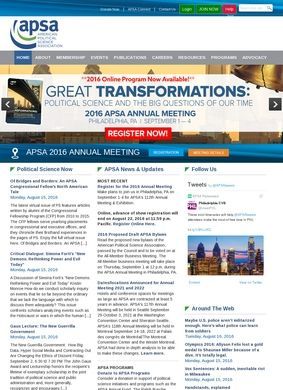
A graduate student has a manuscript on comparative electoral systems and wants it read by the people whose opinion decides careers in the field. That is the moment when American Political Science Review stops being an abstract name and becomes the specific destination. American Political Science Review is the flagship peer-reviewed journal of the American Political Science Association, and for most political scientists it sits at or near the top of where they hope to publish.
The site that hosts it, apsanet.org, is the association's own, which means the journal arrives bundled with the entire machinery of a professional discipline rather than sitting alone as a standalone publication.
What that machinery looks like is worth walking through, because the journal is one door into a much larger building.
The publishing spine of a discipline
American Political Science Review anchors a family of titles. Alongside it the association publishes Perspectives on Politics, PS: Political Science & Politics, and the Journal of Political Science Education, plus a set of organized-section journals tied to particular subfields. That spread matters. A reader who finds American Political Science Review too rarefied for a given piece, or simply the wrong fit, has somewhere else to land without leaving the same publisher.
The peer-review process is why the journal holds the standing it does among political scientists. Work that appears in American Political Science Review has cleared a review process that the field treats as a genuine filter, and citations to it function as a kind of currency in hiring and tenure files. More than one reading list I have seen treats an American Political Science Review article as the default starting point on a topic, which says something about how the journal gets used day to day rather than just how it describes itself.
Perspectives on Politics and the sibling journals
Perspectives on Politics leans toward broader synthesis and essays that speak across subfields, which makes it a useful companion to the more technical articles American Political Science Review tends to run. PS: Political Science & Politics covers the profession itself, its teaching, its methods debates, its news. The Journal of Political Science Education is narrower still, aimed at people who teach the subject. For a reader, the practical point is that a single visit surfaces several distinct kinds of writing, and knowing which title does what saves time.
None of these siblings dislodges American Political Science Review from the center. They orbit it.
Grants, fellowships, and the Congressional program
The association side of the site is where the offering widens well past reading. There are Doctoral Dissertation Research Improvement Grants and diversity fellowship travel grants, both aimed at the stage of a career where money is tight and a few thousand dollars changes what research is possible. The Congressional Fellowship Program places participants inside the workings of Congress, which is a different animal from a journal citation and arguably more formative.
Mentoring initiatives run alongside these, pairing people earlier in their careers with those further along. The grants in particular reward a close read, because the eligibility rules and deadlines decide whether a given project is even feasible, and a student who spots the right fellowship a year ahead of time is in a much stronger position than one who finds it a week before the cutoff.
What ties this to American Political Science Review is that the same body vouching for the research it publishes also funds and shapes the people who will write the next round of it. That vertical integration, from training to funding to publication, is unusual and it is the strongest argument for treating the whole site as one resource.
The eJobs platform and the meeting
eJobs is the field's job board, and for anyone on the academic market it is close to unavoidable. Postings for faculty lines, postdocs, and other roles concentrate here in a way that scattered university sites cannot match. Pairing a job platform with the publishing arm means the same visit that checks a citation in American Political Science Review can also check who is hiring, which is a genuinely practical convenience.
The Annual Meeting & Exhibition is the other large draw. The 122nd meeting is set for Boston in September 2026 under the theme "Democracy Under Threat," and gatherings like it are where papers get presented before they harden into published articles. The Boston theme is pointed, and it signals that the association is willing to put a contested political question at the center of its biggest event instead of retreating to something safely neutral. A Teaching & Learning Conference, virtual research meetings, webinars, and short courses fill out the calendar for people who cannot travel or want something more focused.
The virtual options matter more than they might seem, since they open the same programming to scholars at institutions without generous travel budgets, which is a recurring theme across what this site does.
Who gets real value here
The obvious audience is political science faculty and doctoral students, but the reach is wider than that. Community-college instructors and first-generation scholars are named as intended users, and the diversity travel grants and mentoring programs are not decoration; they point at real entry ramps for people the profession has historically served poorly. K-12 educators looking to ground civics teaching in current scholarship have a place here too, as do consultants and professionals who left academia but still want to track the research.
The site is explicit about serving people across career stages, from the first-year graduate student to the established chair, and that breadth is more than marketing; the mix of grants, teaching resources, job listings, and the journal itself genuinely maps onto different points in a working life.
The honest caveat is that depth cuts both ways. Someone outside the discipline who just wants a plain-language read on an election result will find American Political Science Review dense and slow, written for specialists and priced, in effort if not always in dollars, accordingly. This is scholarship, and it reads like it. A curious general reader is better served elsewhere and should know that going in.
Consumer review platforms, the kind that rate restaurants or repair shops, do not really apply to a scholarly journal run by its own professional association, and a search across the usual sites turns up nothing to weigh either way; standing here is set by citation counts and editorial reputation, not star ratings.
For its actual audience, though, the case for American Political Science Review is close to settled. The public-engagement programs are a real attempt to push findings outward toward audiences beyond the seminar room, and the sheer breadth of what one organization sustains, journals, grants, a job board, an annual meeting, fellowships, is hard to match. Few fields concentrate this much of their professional infrastructure in one place, and the fact that American Political Science Review sits at the middle of it, and not off in a separate publisher's catalog, is part of what gives the journal its authority.
A reader who opens it is consulting the discipline's own account of itself, which is a different thing from reading any single scholar's take.
Set against something like Political Science Now, the association's own news blog, American Political Science Review plays a completely different role. The blog is quick, current, and readable in a coffee break; the journal is where claims are tested and made to last.
A reader who wants the pulse of the field this week should bookmark the former. A reader who needs the version that will still be cited years from now, and who wants it sitting next to the grants, the job listings, and the meeting that feed it, belongs with American Political Science Review and the wider association that stands behind it. One tracks the conversation as it happens; the other is the durable record the conversation keeps coming back to.